Chapter 7

Ganesha

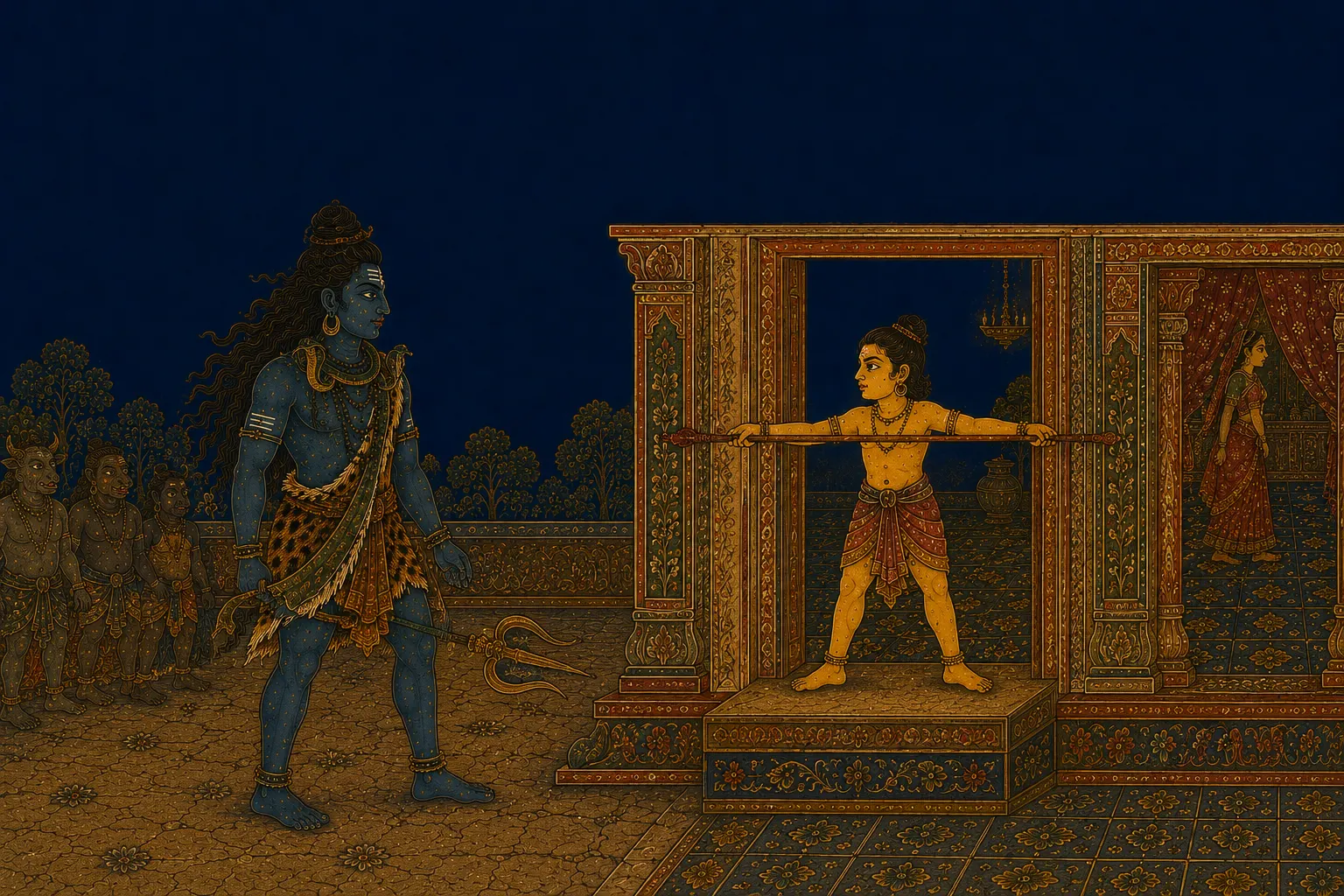
Parvati made a son from her bathing paste, and that son stopped Shiva at the door of his own house

A guard at the door

Parvati was about to bathe, and there was no one to guard the door — the ganas were Shiva's, Nandi was Shiva's, everyone around her was Shiva's.

So she gathered the paste from her own skin, shaped it into a boy, and breathed life into him.

"You are my son," she said. "Stand at this door. Until I say otherwise, let no one in — whoever it is."

The boy took up a staff and stood watch at the door.

The one stopped in his own house

Shiva returned and made to go inside.

The boy blocked his way. "Not yet. Mother is bathing."

"Mother?" Shiva stopped short. "This is my house. Stand aside."

The boy would not move. Shiva sent his ganas forward — the boy beat them all back. Vishnu came, Brahma came — still he did not yield an inch.

At last Shiva raised his trident and, in a single stroke, severed the boy's head from his body.

Parvati came out

Parvati emerged from her bath to find her son cut down at the door.

Her form began to change. "This was my son. I made him. You killed him without asking, without even knowing who he was." Her anger began to assume the force of the Goddess herself, powerful enough to threaten creation. "Bring him back to life — or I will end everything."

Shiva understood this was no empty threat.

A head from the north

Shiva said to his ganas: "Go north, and bring back the head of the first creature you find there."

The ganas went north. What they found there was an elephant.

They brought its head back, and Shiva joined it to the boy's body, restoring him to life.

The boy rose — with an elephant's face.

Lord of the ganas

Parvati's anger cooled, but she said, "This boy will look strange to everyone he meets. People will mock him."

Shiva took the boy onto his lap. "That will not happen. From this day he is lord of all my ganas — Ganapati, Ganesha. And in any undertaking, any worship, any sacrifice, his name will be invoked first of all. Anyone who begins without honouring him first will meet obstacles."

The boy who had been killed for not recognising his own father had become the deity invoked before every new beginning.

Two brothers, one circuit

Years later a question arose: who is the elder of Ganesha and Kartikeya, and who is to be worshipped first.

Shiva and Parvati said: "Whoever circles the whole world and returns first."

Kartikeya flew off on his peacock — the seas, the mountains, every pilgrimage place.

Ganesha looked at his mouse, then at his parents. He rose and made one circuit around Shiva and Parvati and sat down. "For me the world is right here."

When Kartikeya returned worn out, Ganesha's circuit had long since been complete.

Note: The Ganesha-birth story is in the Shiva Purana (Rudra Samhita, Kumara Khanda), where he is Parvati's creation alone. In the Brahmavaivarta Purana he is a son of Shiva and Parvati and his head burns from Shani's glance. The circuit story and the moon-curse story come mainly from Ganesha-centred texts (the Ganesha Purana, the Ganesha khandas of the Skanda Purana) and folk tradition. There are several separate stories of the broken tusk (Ekadanta) — the Parashurama one, and the one about writing the Mahabharata — which are not part of this chapter.

Source: from several texts, Ganesha

Now — how much stayed with you?

Whose son?

How did Parvati make Ganesha?

  • From the union of Shiva and Parvati, in the usual way
  • From the fire of a sacrifice
  • From the water of the Ganga
  • By making a shape from the paste of her own body's bathing scrub, then breathing life into it
Read the whole story — A son made without a father

The Shiva Purana (Kumara Khanda) says this especially: Ganesha at first belongs only to Parvati. Shiva was not at home at the time and did not even know about the boy.

This is the root of the whole clash: the boy does not know Shiva because he was made without Shiva, and Shiva does not know the boy because he was not even there.

Later, when the elephant's head is joined, Ganesha becomes the son of both — Parvati's making, Shiva's given life.

Who said it?

"Stand at this door. Until I say so, let no one come in — whoever it is." — Who said this, and to whom?

  • Shiva, to Nandi
  • Parvati, to the boy she had made
  • Shiva, to Ganesha
  • Parvati, to the ganas
Read the whole story — A command carried out to the letter

The boy did exactly what he was told — "whoever it is" meant to him really anyone, Shiva included.

The story does not hold the boy wrong. He was obedient, only he had not been told whose house this was.

This is the sad centre of the chapter: a command fully obeyed, and its price the boy's head.

What happened?

Whose head did Shiva's ganas bring from the north?

  • An elephant's
  • Airavata's, Indra's elephant
  • An asura named Gajasura's
  • A bull's
Read the whole story — The first creature, no particular one

In the Shiva Purana the ganas are sent north and find an elephant there. The precise formula "the first creature found sleeping with its head to the north" is more fixed in popular retelling; the core point is — the ganas went, an elephant was found.

In some later traditions this head belongs to an asura named Gajasura, whom Shiva had killed — but that is not part of the main story.

The choice of the north is also held meaningful in tradition — the direction linked to Kailasa and to knowledge.

Why is that?

Why did Shiva not take Parvati's anger as an empty threat?

  • Because Parvati had begun to weep
  • Because Brahma and Vishnu warned Shiva
  • Because Parvati's form had begun to change
  • Because Parvati spoke of leaving Kailasa
Read the whole story — When Parvati was no longer only Parvati

In many tellings, at this moment Parvati begins to take the form of Kali/Mahakali — the same power that was Bhadrakali in the Shakti Pitha story.

For Shiva this was the moment of recognising that this was not merely his wife's anger — this is the very goddess without whom he himself is incomplete (this opens in the Ardhanarishvara chapter ahead).

This is why Shiva did not argue, did not delay — he sent the ganas north at once.

Fact

Which boon did Shiva give Ganesha that shows in every worship today?

  • That he would be the strongest gana
  • That his face would become as before
  • That he would never be defeated
  • That at the start of every work, every worship, every sacrifice, his name would be taken first of all
Read the whole story — The first beginning, every time

This boon makes Ganesha the deity invoked before every occasion — a wedding, a house-warming, the first line of a book.

The irony of the story completes itself: the boy killed for not recognising his own father is now the first name invoked at every beginning.

From this boon Ganesha is both "Vighnaharta" and "Vighnakarta" — for the one who remembers him first, the obstacle is removed; for the one who leaves him out, an obstacle comes in the way.

Riddle

A quarrel arose between my two sons over who is first. I said — whoever circles the whole world and returns first. One flew off, the other circled around me and sat down — and he won. Who is the winner?

  • Ganesha
  • Kartikeya
  • Nandi
  • Virabhadra
Read the whole story — A world that fit into the parents

This circuit story is found less in the mainstream of the Shiva Purana and more in Ganesha-centred texts and folk tradition — but it is so common that it has become part of Ganesha's identity.

Ganesha's victory is of wit, not of speed — exactly as, in the sea, Hanuman's victory came from wit.

In some forms, as the reward of this victory Ganesha gets the "first-worshipped" boon — that is, two separate stories arrive at the same result.

Who am I?

I was made from Mother's bathing scrub, then life was breathed into me. I carried out a command to the letter and its price became my head. Then I got a new head, and with it, the honour of being invoked before every beginning. Who am I?

  • Kartikeya
  • Ganesha
  • Andhaka
  • Nandi
Read the whole story — One command, one head, one name

Ganesha's whole story rests on three things: a command carried out to the letter, a head that became its price, and a boon that turns that price around.

It's another instance of a pattern in Shiva's own anger being mended afterward — like Virabhadra, like (half of) Kamadeva.

The difference is that here Shiva does not do the mending alone — it is Parvati's anger that forces him. This chapter is as much about Parvati's power as it is about Ganesha.

Put it in order

Which is the correct order of events?

  • Shiva cutting the boy's head → Parvati making the boy → the boy barring the door → the elephant's head
  • Joining the elephant's head → the boy barring the door → Shiva's trident → Parvati's anger
  • Parvati making the boy from paste and setting him at the door → Shiva returning and the boy stopping him → the ganas, Vishnu and Brahma being beaten → Shiva cutting off the head with the trident → Parvati's anger and change of form → the ganas bringing an elephant's head from the north → the head being joined and the name Ganapati → the first-worshipped boon
  • Parvati's anger → making the boy → Shiva returning → the boon
Read the whole story — Making, clash, repair

The shape of this chapter recurs again and again across these stories: something is made, Shiva's anger breaks it, and then it is mended — remade better than it was before.

The story pivots on Parvati's change of form — that is where it turns from clash to repair.

The last scene — taking Ganesha in his lap and giving the boon — puts Shiva's anger and his mercy in one and the same moment.

The texts disagree

How do the different texts tell Ganesha's birth?

  • In the Shiva Purana, Ganesha is Parvati's creation alone; in the Brahmavaivarta Purana he is a son of Shiva and Parvati whose head burns from Shani's glance; in some forms the head is an elephant's, in some an asura's named Gajasura
  • All the texts agree that Ganesha is the ordinary son of Shiva and Parvati
  • Ganesha is mentioned only in folk tales, not in any Purana
  • In every text Ganesha's head burns from Shani's glance
Read the whole story — One god, several birth-stories

There are two large forms: the Shiva Purana's (Parvati's creation alone, the head cut by the trident) and the Brahmavaivarta's (a son of Shiva and Parvati, the head burned by Shani's glance).

The result of both is the same — an elephant's head, the name Ganapati, the office of first-worshipped.

Shiv-Mahima takes the Shiva Purana form as its base, since these are Shiva's stories — but records that the Ganesha-centred texts tell it differently.

Later tradition

The tradition of not looking at the moon on Ganesha Chaturthi is linked to which story?

  • To the moon on Shiva's brow
  • To the Soma sacrifice
  • To Kartikeya's peacock
  • To a story in which the moon mocked Ganesha's elephant face and broken tusk, and Ganesha cursed that whoever looks at the moon on this day will bear a false stain
Read the whole story — One laugh, one curse

This story is mainly in the Ganesha-khandas of the Ganesha Purana and the Skanda Purana: Ganesha was returning from a feast, slipped, and the moon laughed at his state.

It is because of Ganesha's curse that in tradition Krishna bore the false charge of stealing the Syamantaka jewel — because he had looked at the moon on the night of Ganesha Chaturthi. This link is from the Syamantaka story in the Bhagavata.

This retelling doesn't prescribe how the festival should be observed — it records which story the tradition rests on, and where that story is found.