
Chapter 1
The Pillar of Light
Two gods set out to find the two ends of one pillar, and a flower was made to lie
Two claimants
After the dissolution, when nothing existed but water, two gods stood facing each other on that water — Brahma and Vishnu.
"Creation begins with me," Brahma said. "I am the maker. There is none greater than me."
"The lotus you sit on," Vishnu said, "has its stalk in my navel. You came out of me. I am the greater one."
The argument escalated. Brahma's four mouths began speaking at once; Vishnu's discus began to spin. Their mounts — the swan and Garuda — spread their wings and faced off. A clash seemed only moments away.
A pillar of fire
Then something tore open between them.
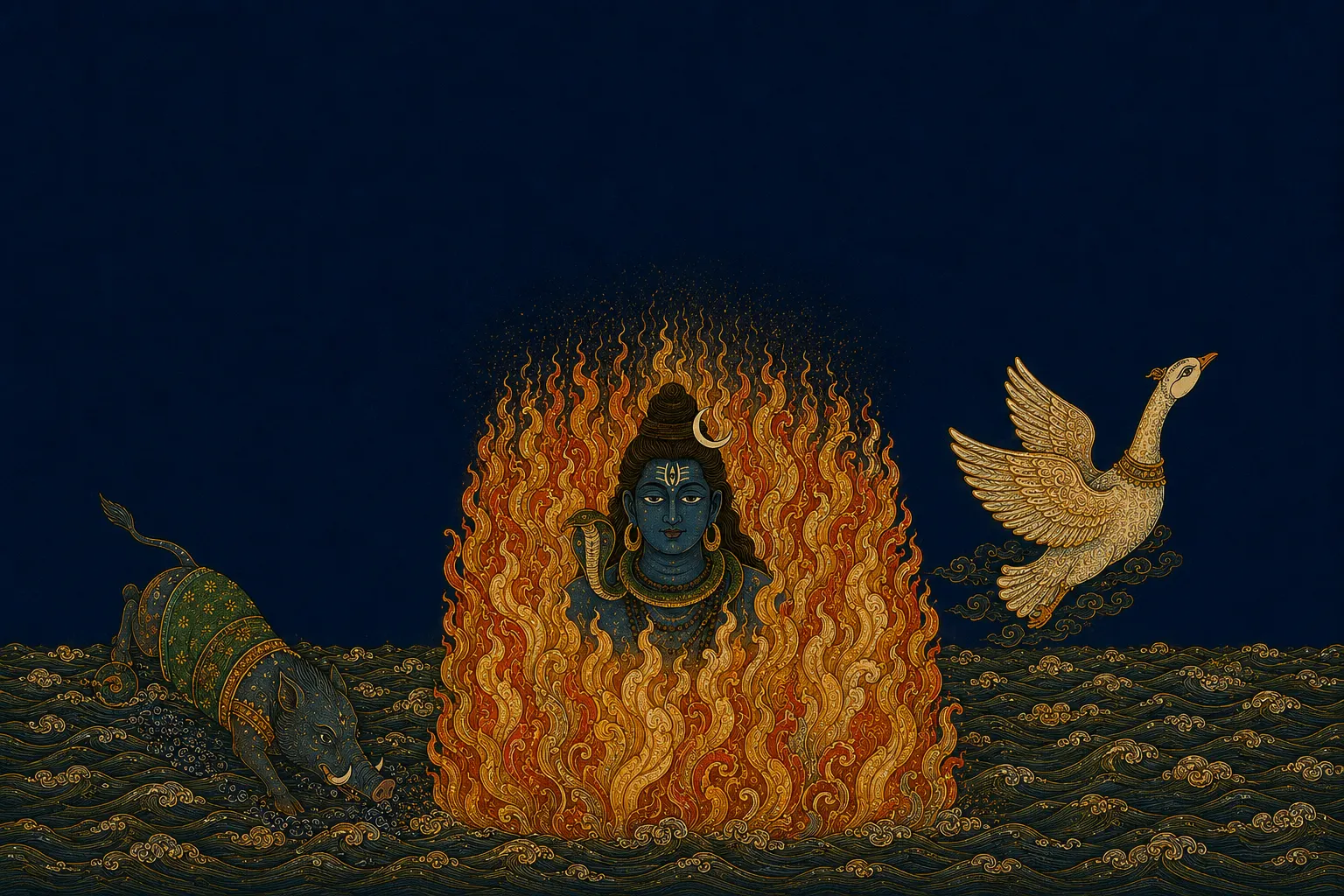
A pillar of fire and light burst from the water and shot off in both directions — no top visible above, no base visible below. No beginning, no end. Its heat forced both gods back.
Then a voice spoke from within it, belonging to no visible form:
"Whichever of you finds one end of this pillar is the greater. Go up or go down — but come back with an end."
Brahma looked up. Vishnu looked down.
The boar below, the swan above
Vishnu took the form of a boar — the animal whose tusks can tear through earth — and began digging downward toward the pillar's root. Layer after layer of water gave way to darkness, then deeper darkness still. For a thousand years he dug. No matter how far he went, the pillar stayed just as wide, just as blinding. Its base never came.
Brahma took the form of a swan and flew upward. The clouds fell away below him, then the stars, and still there was only more pillar above. For a thousand years he flew. No matter how high he climbed, no summit ever appeared.
Both were exhausted. Both now understood: this pillar could not be measured.
The ketaki made to lie
Then Brahma noticed something drifting down toward him — a flower. A ketaki blossom, white and fragrant, sinking slowly through the air.
"Where have you come from?" Brahma asked.
"From very high up," the flower said. "I fell from Shiva's head, at the very top of this pillar. I've been falling for ages now."
Brahma paused. He himself had never reached the top — yet here was a flower that had.
"Come down with me," he said. "And say that I plucked you from the summit. That's all I ask."
The flower hesitated, then agreed.
Meanwhile Vishnu had returned from below. He folded his hands before the pillar and admitted it plainly: "I never reached the root. It has no end. I have lost."
Shiva from the pillar
Brahma descended and announced: "I reached the top. Here is my proof — this ketaki flower, which I plucked from there myself. It will bear witness too."
The flower agreed.
And then the pillar split open down the middle.
Out of it stepped Shiva — whole, calm, eyes open. "A lie," he said. "You never reached the top, Brahma. And you made a flower lie for you."
He turned to Brahma. "You are the maker, and yet you lied for the sake of your own rank. So on this earth you will not be worshipped. No temples will be built in your name."
Then to the ketaki: "And you bore false witness. From this day you will never again be offered in my worship."
Then to Vishnu, gently: "You accepted defeat and told the truth. So your worship will equal mine, in separate temples, under separate names."
The pillar became a Shiva-linga — without beginning, without end. And this form of Shiva, emerging from within it, came afterward to be called "Lingodbhava."
What tradition tied to this night
In the Shiva temples of South India, this same scene is often carved into the western wall of the sanctum — the pillar at the centre, Vishnu digging below as a boar, Brahma flying above as a swan, and Shiva stepping out from between them.
Shaiva tradition ties the night of Mahashivaratri to this very event — the night Shiva first appeared in the form of the linga.
But this story is openly a Shaiva claim. Vaishnava texts either leave it out, or tell the Varaha avatar simply as the story of raising the earth, with no contest attached. Both versions are recorded here, with neither called the "real" one — exactly as the Buddha chapter of Vishnu-Puran does.
Note: The Lingodbhava story is found in the Shiva Purana (Vidyeshvara Samhita), the Linga Purana, the Skanda Purana and the Kurma Purana. It is openly a Shaiva claim — both Vishnu and Brahma acknowledge their limit before Shiva. Vaishnava texts tell the Varaha avatar without this contest, simply as the story of raising the earth from the water. Tying Mahashivaratri to Lingodbhava is especially a South Indian Shaiva tradition; northern traditions also tie the same night to the marriage of Shiva or the drinking of the poison. The full Neelkanth story is on this site in Vishnu-Puran, chapter 2 (Kurma).
Source: from several texts, The Pillar of Light