
Chapter 8
Kartikeya
The son Kamadeva burned for — neither fire could hold him, nor the Ganga; six Krittikas raised him
A radiance no one could hold
Everything that had happened so far — Kamadeva's burning, Parvati's penance, Shiva's marriage — had been leading to the birth of one child.
But Shiva's radiance was so fierce that the gods took fright: "The earth will never bear this conception."
Agni was sent to receive that radiance. He took it — and began to scorch. He passed it on to the Ganga. She too could not hold it, and set it down in a reed-forest of Himalaya — in the Sharavana.
Six mothers
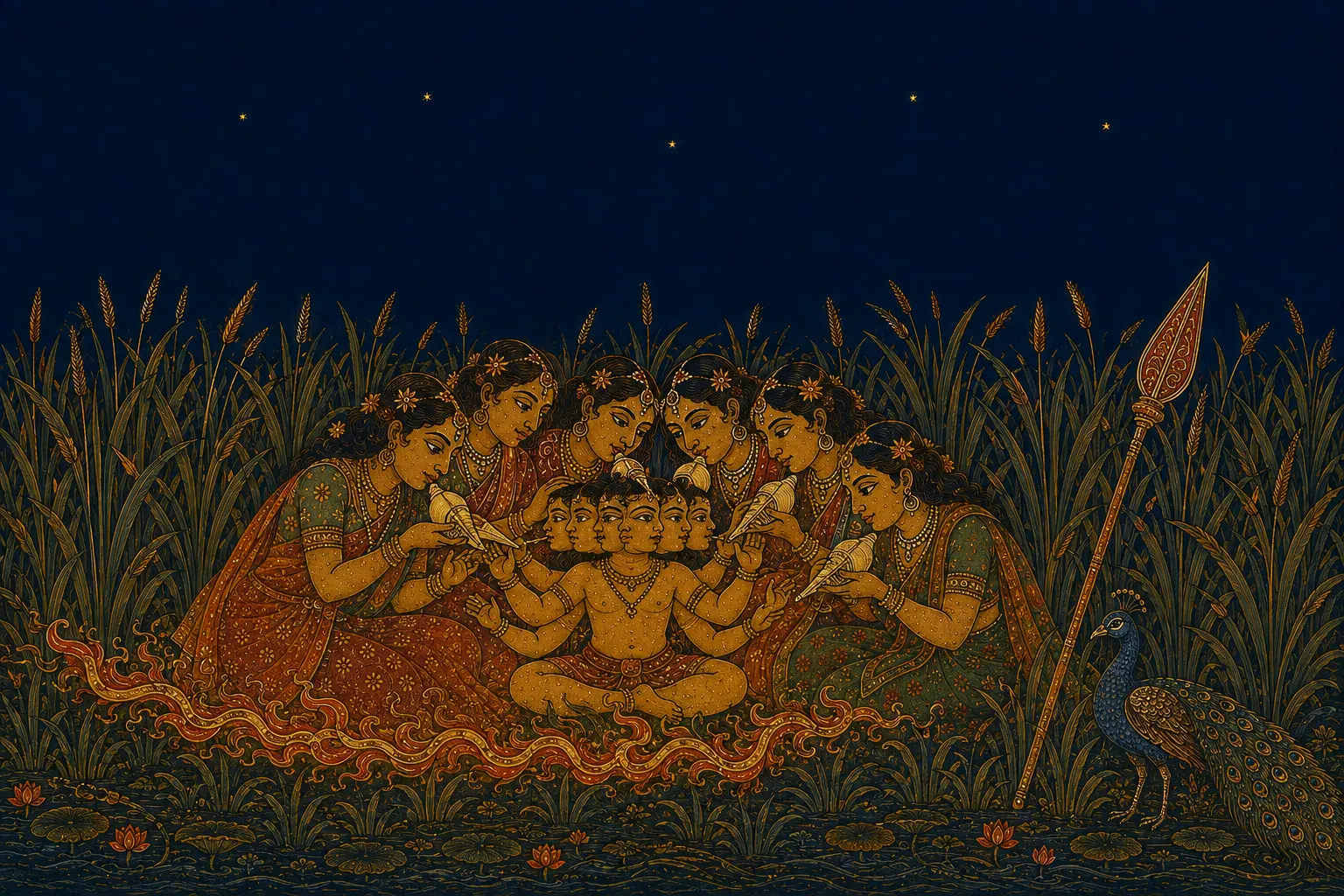
In that forest a child appeared.
The six Krittikas of the sky — what we today call the Pleiades — came to nurse him. He grew six mouths so he could drink the milk of all six at once.
From this came one of his names — Kartikeya, raised by the Krittikas. And Shanmukha — the six-faced one.
One body, six heads
Word reached Parvati that her son was in a forest with the six Krittikas, six-faced.
She ran to him and embraced her child — her own son, found at last.
The boy gathered many names: Skanda, Kumara, Guha (the one who hid in a cave), Subrahmanya. Belonging to Shiva and Parvati both, to the Krittikas, to Agni and the Ganga — this one boy had so many parents that every tradition addresses him in its own way.
Some traditions tell this differently — six separate infants, whom Parvati embraced into a single body while six heads remained. This retelling takes the six-mouths-for-nursing version as its base, since that's the one the questions ahead — the Krittika name, Shanmukha — connect to directly.
General of the gods
The gods came to Kartikeya. "Only a son of Shiva can kill Tarakasura. You are that son. Lead our army."
Kartikeya was still a boy when he was made general of the Devasena. Indra gave him his own daughter Devasena in marriage — her name meaning, quite literally, the army of the gods.
The end of Tarakasura
Kartikeya, mounted on his peacock, a spear named Shakti in hand, fell upon Tarakasura's army.
The war dragged on. In the end Kartikeya hurled that spear at Tarakasura, and the very boon the asura had won — that only a son of Shiva could kill him — became the condition of his death.
The son for whom Kamadeva had burned, for whom Parvati had spent years in penance, for whom Agni and the Ganga had both been scorched — his first act was this: killing an asura no one else in creation could touch.
Another name in the south
In Tamil tradition, Kartikeya is Murugan, one of the region's most important and beloved deities, with an extensive mythology of his own.
There he fights an asura named Surapadma and splits him in two — one becomes a peacock which is his mount, the other a rooster which sits on his banner. There he has two wives — Devasena and Valli, a girl of a hill tribe. In Tamil Nadu he has six principal abodes, called the "Arupadai Veedu."
This is the Tamil Shaiva tradition's own stream — of texts like the Kanda Puranam and the Tirumurugatruppadai — and it has a relation to the Skanda story of the Sanskrit Puranas, but it is not a copy of it.
Note: Kartikeya's story is in the Shiva Purana (Rudra Samhita, Kumara Khanda), the Mahabharata (Vana Parva and Shalya Parva), the Ramayana (Bala Kanda, where Vishvamitra tells it) and the Skanda Purana. The chain of Shiva's radiance going from Agni to the Ganga and then to the Sharavana is in both the Ramayana and the Shiva Purana. In the Tamil tradition (the Kanda Puranam, the Tirumurugatruppadai) he is Murugan, with two wives — Devasena and Valli — and the killing of Surapadma and the six Arupadai Veedu abodes are of this stream. This Tamil Shaiva tradition is the sibling of the Sanskrit Skanda story, not a copy.
Source: from several texts, Kartikeya