Chapter 14

Kirata

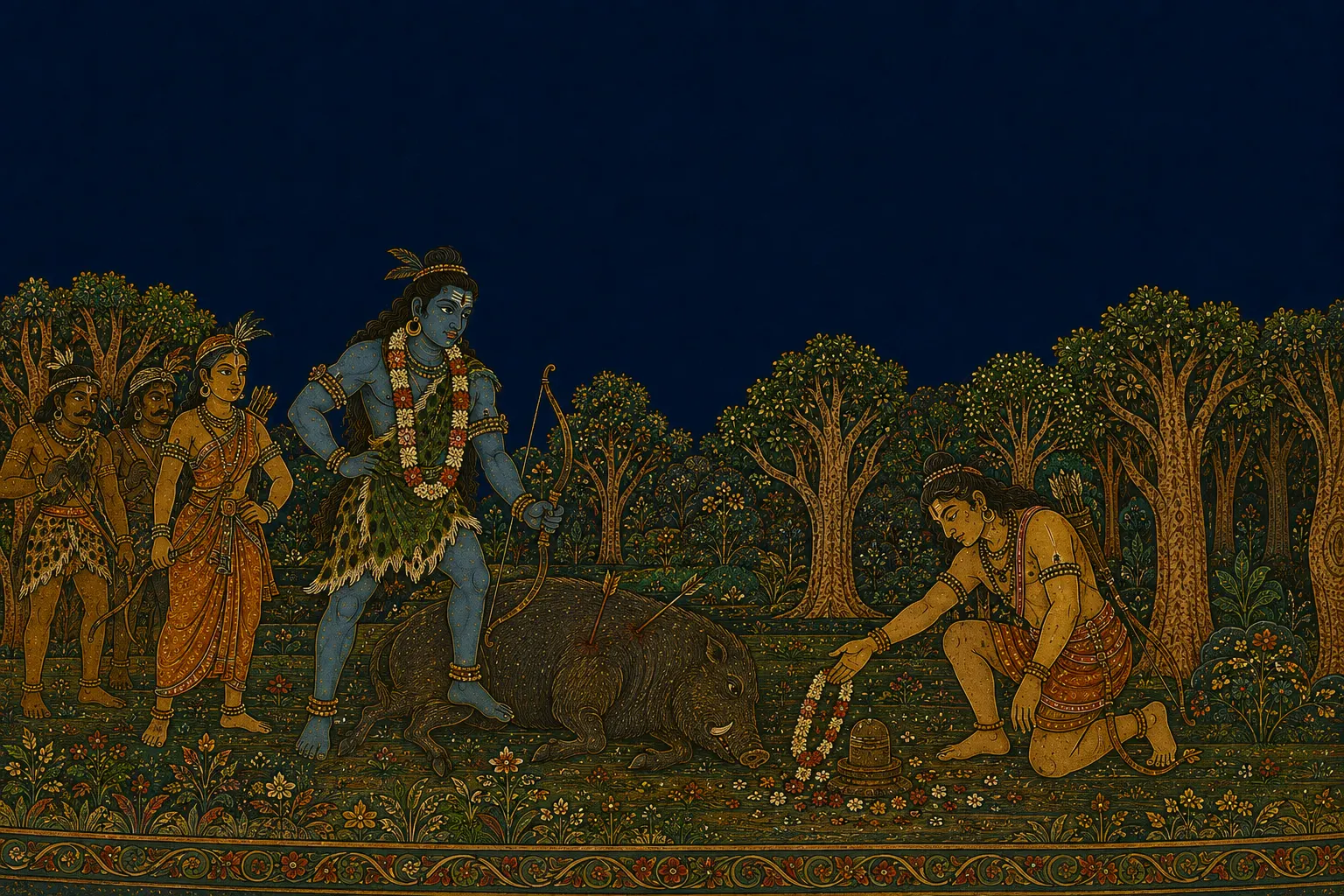
Arjuna shot an arrow at a boar, and in the same instant a wild hunter did too — then the two came to blows over whose kill it was

A penance on the mountain

In the days of the exile, Arjuna went alone to Himalaya — to gain divine weapons.

Vyasa and Yudhishthira had said: for the war that is to come, an ordinary bow is not enough. Shiva's Pashupatastra is needed, and only Shiva gives it.

Arjuna began a harsh penance — first on fruit, then on air, standing on one foot, arms raised. The sages of the mountain grew alarmed and went to Shiva: "This penance is so fierce that the mountains are shaking."

One boar, two arrows

At that time an asura named Muka took the form of a huge boar and came to kill Arjuna.

Arjuna raised the Gandiva and shot an arrow.

In that same instant another arrow came — a wild hunter's, who had come out from among the trees, with a hunter woman and some other hunters. This was Shiva in the guise of a Kirata, Parvati as a Kirati, and the ganas as hunters.

The boar took two arrows, fell, and returned to its true asura form.

Whose kill

"This is my kill," said Arjuna. "I shot first."

"No," said the Kirata. "In this forest we hunt. This is ours. And you shot at my kill without asking."

The matter grew. Arjuna began to rain arrows on the Kirata — one after another, the whole quiver. Not a scratch came on the Kirata.

Arjuna swung the Gandiva like a club — it broke. He used the sword — it struck the Kirata's head and shattered. Eventually Arjuna was left with no weapon at all — and the Kirata lifted him and pressed him so that his breath stopped.

An earthen linga

Arjuna was almost unconscious. On the verge of defeat, he turned to Shiva in worship, as he always did.

He made a small earthen Shiva-linga and offered a garland of flowers on it.

The garland did not stay on the linga — it fell around the Kirata's neck.

Arjuna looked up. The hunter standing before him had that same offered flower around his neck.

The Pashupatastra

Arjuna fell at the Kirata's feet. "I raised a hand against you. I did not know."

The Kirata's guise fell away. Shiva stood there, Parvati with him.

"Had you known, what test would it be," Shiva said. "You fought even as you were losing, and even as you fought you came to my refuge. This is what I wanted to see."

He gave Arjuna the Pashupatastra — with a warning: "Do not loose this on any lesser enemy, on any human. It can burn the whole of creation. Use it only when every other option has failed."

Then Indra, Yama, Varuna and Kubera came too, each with his own weapon.

The god who had given Ravana a sword on hearing one song made Arjuna earn every weapon in a fight — because what stood before him was different.

Note: The Kirata-Arjuna story is from the Vana Parva of the Mahabharata (the Kairata Parva, chapters roughly 38–41). Bharavi's "Kiratarjuniya" (around the sixth century) is a Sanskrit epic poem written on that one episode — a poem, not a scripture. "Kirata" is among Shiva's hidden-guise forms, like the beggar of the Daruka forest and the brahmachari of Parvati's test. The Pashupatastra warning — not to loose it on a human or a lesser enemy — is plain in the Mahabharata, and Arjuna keeps it at Kurukshetra. In Kerala "Kiratam" is a famous play of Kathakali and Kutiyattam.

Source: from several texts, Kirata

Now — how much stayed with you?

Whose son?

Why had Arjuna gone to do penance on Himalaya?

  • To live alone, apart from his brothers
  • To gain divine weapons
  • To get Shiva to shorten the Pandavas' term of exile
  • To ask for revenge for Draupadi's humiliation
Read the whole story — A penance, for one weapon

In the Vana Parva of the Mahabharata, Vyasa and Yudhishthira explain to Arjuna that ordinary weapons will not do against Bhishma, Drona and Karna at Kurukshetra.

So Arjuna's penance is one with a clear aim — not, like Parvati's, "to gain Shiva," but "to take a weapon from Shiva."

That gives this chapter its own angle on Shiva's nature: here he does give, but only after testing — unlike with Ravana and Bhasmasura, a mere ask or a song is not enough.

What happened?

How did the fight between Arjuna and the Kirata go on?

  • Arjuna shot the very first arrow and the Kirata fell
  • The Kirata rained arrows on Arjuna and Arjuna escaped
  • The two talked and settled the quarrel
  • Arjuna emptied the whole quiver, then used the bow like a club, then the sword, then his bare hands
Read the whole story — Every weapon, then nothing

The Mahabharata shows this fight in stages: first arrows from a distance, then the bow-club up close, then the sword, then wrestling.

At every stage Arjuna's best weapon breaks or fails — even the Gandiva, the bow given by the gods.

This is deliberate: the story strips every support from Arjuna, so that in the end only refuge is left to him — and that is what works.

Who said it?

"Had you known, what test would it be. You fought even as you were losing, and even as you fought you came to my refuge." — Who said this, and to whom?

  • Arjuna, to Shiva
  • Parvati, to Arjuna
  • Shiva, to Arjuna
  • Indra, to Arjuna
Read the whole story — The purpose of the test

Shiva's words say two things at once: that this was a test, and that Arjuna passed it for two reasons — his not giving up, and his coming to Shiva's refuge.

Valour alone was not enough, devotion alone was not enough. Shiva wanted to see both.

This is a direct difference from the Ravana chapter: from Ravana Shiva only heard a hymn and gave a sword. From Arjuna he took a whole fight.

Who am I?

I was in the guise of a wild hunter, with a hunter woman and some other hunters. I shot an arrow at a boar and then came to blows with the archer who was in truth my devotee. Who am I?

  • Indra
  • Nandi
  • Virabhadra
  • Shiva
Read the whole story — Shiva the hunter

"Kirata" is the form of Shiva in which he comes like a hill-dwelling forest hunter — Bharavi's whole Sanskrit epic poem "Kiratarjuniya" is on this one episode (it is a poem, not a scripture).

Parvati coming along as a Kirati matters: in every great test of Shiva's the goddess is present — the Saptarishis in Parvati's own penance, her anger in the Ganesha story, this guise here.

Of all Shiva's "hidden guises" across these stories, this is the most warlike — the brahmachari (Parvati's test), the beggar (the Daruka forest), and now the hunter (Arjuna's test).

Fact

How did Arjuna come to know that the hunter before him was in truth Shiva?

  • He made an earthen Shiva-linga and offered a garland of flowers on it, and that garland fell around the Kirata's neck instead of the linga
  • The Kirata told his own name
  • Parvati gave Arjuna a sign
  • Arjuna recognised the Kirata's trident
Read the whole story — A garland that reached the right neck

This is the most beautiful turn of the story: Arjuna, having lost, almost unconscious, does what is habit — the worship of Shiva. And the worship itself gives the answer.

The garland going from the Shiva-linga to the Kirata's neck says that the two are one — the one Arjuna was worshipping and the one he was fighting.

This is the moment the test ends: Arjuna's valour Shiva had already seen; now he has seen Arjuna's devotion too.

Why is that?

What warning did Shiva give Arjuna in giving him the Pashupatastra, and why?

  • To loose it only at night
  • Not to loose it on any lesser enemy or any human, because it can burn the whole of creation
  • Not to show it to anyone
  • To ask Parvati before loosing it
Read the whole story — A weapon whose condition was its power

The Pashupatastra is held in the Mahabharata to be the most destructive weapon — so much that its very use is a responsibility.

Shiva's warning is for this reason: this weapon is not for winning but for a last defence. Arjuna never looses it at Kurukshetra — that is the warning being kept.

It's another turn on the same theme: Shiva gives, but when someone like Arjuna stands before him, he ties a limit to the gift — something he never did with Ravana or Bhasmasura.

Put it in order

Which is the correct order of events?

  • Arjuna making the Shiva-linga → two arrows on the boar → the fight with the Kirata → the Pashupatastra
  • The Kirata's guise falling away → the boar coming → Arjuna's penance → the Pashupatastra
  • The boar coming → Arjuna's penance → the fight with the Kirata → the Shiva-linga → the Pashupatastra
  • Arjuna's penance on Himalaya → the asura Muka coming in boar form → Arjuna and the Kirata shooting at the same time → the quarrel over the kill and the fight → every weapon of Arjuna's failing → the earthen Shiva-linga and the garland falling around the Kirata's neck → Shiva appearing and giving the Pashupatastra → the other gods giving their weapons
Read the whole story — Penance, fight, refuge, weapon

This chapter strips everything from Arjuna in stages — first ease (the penance), then weapons (the fight), then strength (the wrestling) — until only devotion is left.

The pivot is the garland scene — that is where the fight turns into recognition.

The last scene — several gods giving their weapons — shows that passing Shiva's test was a kind of key: after it the other doors opened of themselves.

Who said it?

"In this forest we hunt. This is ours. And you shot at my kill without asking." — Who said this?

  • Arjuna, to the Kirata
  • The Kirata (Shiva), to Arjuna
  • The asura Muka, to Arjuna
  • Parvati, to Arjuna
Read the whole story — A quarrel that was a pretext for the test

The quarrel over the kill is a pretext — Shiva needed a reason to fight Arjuna, and "my kill" became that reason.

Worth noticing: the Kirata's argument is fair in its place — it was his forest, and Arjuna shot without asking. The story does not hold anyone wholly wrong.

From this small quarrel begins the fight that becomes Arjuna's greatest ordeal.

The texts disagree

Where does the Kirata-Arjuna story come from, and what is Bharavi's "Kiratarjuniya" to it?

  • This story is only in Bharavi's poem, not in the Mahabharata
  • This story is the Shiva Purana's and the Mahabharata borrowed it
  • This story is in the Vedas
  • The original story is from the Vana Parva of the Mahabharata; Bharavi's "Kiratarjuniya" is a Sanskrit epic poem written on that one episode
Read the whole story — One story, two forms

In the Vana Parva of the Mahabharata this story is direct and fight-centred — Arjuna's penance, the boar, the fight, the Pashupatastra.

Bharavi (around the sixth century) made it into an ornate epic poem under the name "Kiratarjuniya" — counted among the six "great poems" of Sanskrit, for its command of language.

Shiv-Mahima takes the Mahabharata form as its base and says that the most famous literary form is a later poet's — exactly as with Kalidasa in Parvati's penance.

Later tradition

What place does this story have in the Kathakali and Kutiyattam tradition of Kerala?

  • It has no place
  • It is only in a Ramlila-like tradition of North India
  • "Kiratam" is a favourite play of both Kathakali and Kutiyattam, where the wrestling of Arjuna and the Kirata is shown at length on stage
  • It is only in temple sculptures, in no theatre tradition
Read the whole story — A fight that is danced on stage

The wrestling of the Kirata and Arjuna is among the most dramatic scenes of Kathakali — two performers, with no weapons, show a whole fight by pose and rhythm alone.

In Kutiyattam (the ancient Sanskrit theatre of Kerala) this episode is older still, and there every stage of Arjuna's penance and defeat unfolds over hours.

This retelling doesn't dictate how the theatre should stage it — it simply records that the story has been played, not merely read, for centuries in South India.