Chapter 11

Markandeya

A boy was destined to live only sixteen years — and in the sixteenth year he held the Shiva-linga tight

A choice, before the parents

The sage Mrikandu and his wife Marudmati had no child. The two did a long penance for Shiva.

Shiva appeared and set a strange choice before them:

"One of two things can be yours. A dull-witted son, who will live a long life. Or a radiant, virtuous, devoted son — who will die at exactly sixteen years. Choose."

Mrikandu and Marudmati chose the second.

A boy who did not know

A son was born — Markandeya. Sharp of mind, gentle in nature, and a devotee of Shiva from childhood.

His parents never told him that he was destined to die at sixteen. But as that year drew near, a silence began to settle over the house. The mother wept, the father looked away into the distance.

At last Markandeya asked, and they told him.

Markandeya did not weep. "Then I will spend whatever time remains with the one who gave me life." He went to the Shiva-linga.

Yama's noose

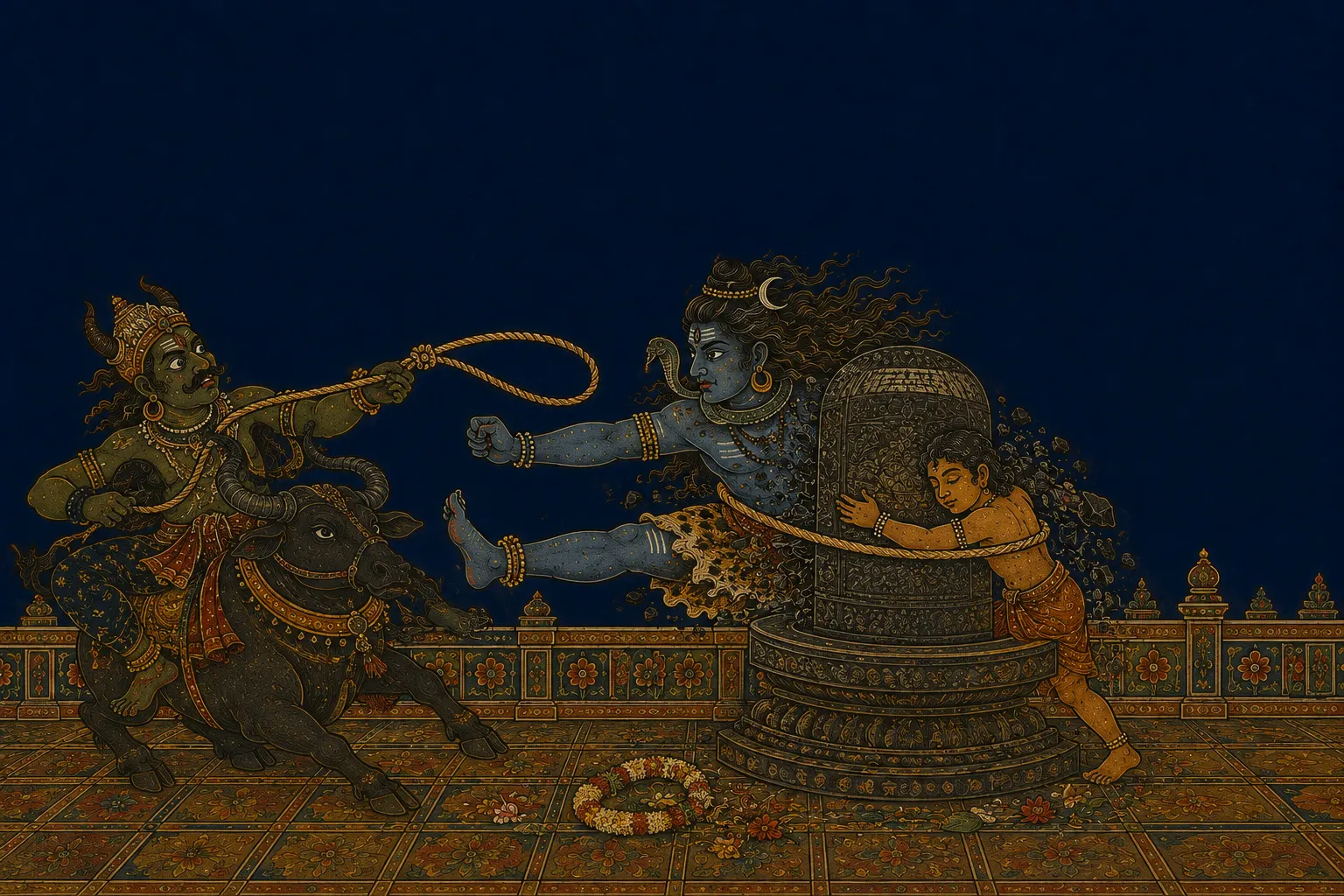
The sixteenth year was complete. Yama's messengers came to take Markandeya — but he was wrapped around the Shiva-linga, eyes closed, and the messengers could not go near.

Then Yama came himself, mounted on a buffalo, a noose in his hand.

"Your time is up," Yama said, and cast his noose.

The noose fell around Markandeya's neck — and with it wound around the Shiva-linga the boy was clinging to.

Shiva from the linga

The linga burst open.

Out of it came Shiva — in anger, the form tradition calls "Kalantaka," the one who ends time.

"You cast a noose on my devotee," Shiva said, "and on me." He struck Yama a blow with his foot — some texts say he struck him with the trident — and Yama fell there lifeless.

Death itself died. And with it dying stopped in the world — no one was aging, no one was leaving, the cycle of life and death ground to a halt.

The gods' plea

The gods came to Shiva. "The world's burden cannot be carried without Yama. What is born must also go — or the earth will fill up. Bring Yama back."

Shiva brought Yama to life, on one condition: "This is all right. But he will never touch Markandeya. He will stay sixteen forever."

Markandeya became a chiranjivi — one of the eight who live on in every age. Further on he would also see the deluge, and on the water of that deluge an infant lying on a banyan leaf.

Note: Markandeya's Yama-killing story is in the Shiva Purana, the Linga Purana and the Skanda Purana. "Kalantaka" or "Kalari" is the form of Shiva who comes out of the Shiva-linga and presses Yama down — the main image at the Tirukkadavur temple in Tamil Nadu is this. In the Vana Parva of the Mahabharata, Markandeya is a chiranjivi sage who tells Yudhishthira the vision of the deluge and the infant on the banyan leaf. The "Markandeya Purana" is named for him but is mainly the text of the Devi Mahatmya (the Durga Saptashati) — the Yama-killing story is not its centre. The Mahamrityunjaya Mantra is Vedic; linking it to Markandeya is tradition.

Source: from several texts, Markandeya

Now — how much stayed with you?

Whose son?

Whose son was Markandeya, and what choice did Shiva give his parents?

  • Of the sage Mrikandu and Marudmati
  • Of King Dasharatha
  • Of the sage Vyasa
  • Of the sages Atri and Anasuya
Read the whole story — A choice that was the parents'

Everything in the story turns on this one decision: knowingly, Mrikandu and Marudmati chose the sixteen-year son.

This was not a sacrifice, it was a wager — that a devoted son of sixteen years might do something greater than his years. And that is what happened.

Shiva gave the choice, but did not change the outcome — Markandeya's life was really written for just sixteen years, until Yama's noose reached Shiva himself.

Who said it?

"Then I will spend whatever time remains with the one who gave me life." — Who said this, and when?

  • Mrikandu, to Shiva, during the penance
  • Yama, to his messengers
  • Markandeya, when he learned that his life was for sixteen years
  • Shiva, to Markandeya
Read the whole story — A choice in place of fear

Markandeya's response is the heart of this story — he learns the date of his death, and instead of weeping or fleeing he goes and sits near Shiva.

It's the devotee's mirror of Shiva's own nature: Shiva gives freely, without weighing the petitioner, and Markandeya doesn't calculate either — he simply stays near him.

It is because of this trust that Shiva has to come out of the linga further on. The devotee did not loosen his grip, so the god had to come.

What happened?

When Yama cast his noose, on what all did it fall?

  • On Markandeya, and with him on the Shiva-linga he was clinging to
  • Only on Markandeya, and Shiva saw it later
  • Only on the Shiva-linga
  • On Yama himself, by mistake
Read the whole story — One noose, two targets

This is the turn of the story: had Yama's noose fallen only on Markandeya, things might have been different — but it wound around the Shiva-linga too.

For Shiva this was a double insult: a hand on his devotee, and on himself. Which is why the anger was so sharp.

Yama had done nothing wrong — he was doing his work, and Markandeya had stuck himself to the linga so tightly that the two became one.

Fact

What does tradition call this form of Shiva who came out of the linga and defeated Yama?

  • Nataraja
  • Tripurantaka
  • Kalantaka (or Kalari)
  • Dakshinamurti
Read the whole story — The ender of time

"Kalantaka" is the form of Shiva in which he is shown with one foot out of the Shiva-linga, pressing Yama down — this is the main image at the Tirukkadavur temple in Tamil Nadu.

There is a play on words in the name: "kala" means both time and death. Shiva is above both — which is why he is also called "Mahakala."

It's the boldest claim in the whole cycle of stories: Shiva stands outside the established order, even the order of death itself — and for a devotee, he can bring that order to a halt.

Why is that?

Why did Shiva bring Yama back to life?

  • Because Yama apologised
  • Because the gods explained that the cycle of the world will not run without Yama
  • Because Parvati insisted
  • Because Brahma threatened to make Yama again
Read the whole story — An order that cannot be stopped

This is the necessary balance of the story: Shiva can stop death for a devotee, but he cannot remove death forever — or the earth will fill up.

This is why the solution is an exception, not the end of the rule: Yama returns, but Markandeya is put outside his reach.

This is the same manner as the Daksha-sacrifice — Shiva breaks the established order, then restores it at the gods' plea, but with one condition of his own.

Who am I?

I was destined to live only sixteen years. In the sixteenth year I saw the god of death before me, but I did not loosen my grip. Today I am among the few who live on in every age — and always sixteen. Who am I?

  • Markandeya
  • Dhruva
  • Nachiketa
  • Prahlada
Read the whole story — Always sixteen

The traditional list of the chiranjivis has seven or eight names — Ashvatthama, Bali, Vyasa, Hanuman, Vibhishana, Kripacharya, Parashurama, and Markandeya.

Markandeya is the only one of them whose immortality came from a death deferred — the rest got it from a boon or a curse.

Being "always sixteen" is the most beautiful part of the story: at the very age he was to die, he stopped.

Later tradition

What relation does tradition give between the "Mahamrityunjaya Mantra" and Markandeya?

  • No relation; this mantra comes straight from the Vedas and is linked to no story
  • This mantra was given to Markandeya by Yama
  • Tradition says Markandeya worshipped the Shiva-linga in his sixteenth year reciting this very mantra, which is why it is held to be the "conqueror of death" mantra
  • This mantra is the first verse of the Markandeya Purana
Read the whole story — A mantra that got linked to a story

The Mahamrityunjaya Mantra ("Tryambakam yajamahe…") is in the Rigveda and the Yajurveda — it is older than the story.

But tradition tied it to Markandeya's story: this is the recitation by which a boy of sixteen deferred death.

This is why this mantra is today recited in illness, in danger and in the wish for a long life — the story gave it a use.

Riddle

I am the god of death. I did my work — I went to take a boy whose time was up. In that very work I was killed myself, and then brought back on one condition. What was that condition?

  • That from now on I would not touch any sage's son
  • That instead of a buffalo I would ride some other mount
  • That before every death I would ask Shiva
  • That I would never touch Markandeya
Read the whole story — One exception, everything else as before

Yama's return condition is very limited: the whole order of death will run on, only one name outside it.

This is typical of how these stories work — Shiva does not break the rule, he opens a single hole in it, shaped exactly to one devotee.

Yama is not a villain in this story. He was doing his duty, and the story leaves him not by punishing him but by making an exception.

What happened?

After becoming a chiranjivi, what did Markandeya go on to see, which comes in several texts?

  • The deluge
  • The end of the Kali age and the coming of Kalki
  • The war of the devas and asuras
  • The coronation of Rama
Read the whole story — An infant, on the water of the deluge

In the Vana Parva of the Mahabharata, Markandeya himself tells this vision to Yudhishthira — he wanders alone in the deluge and finds an infant lying on a banyan leaf, who draws him inside himself and shows him the whole universe.

That infant is Vishnu/Narayana — that is, the devotee saved by Shiva's grace goes on to receive the greatest vision of Vishnu. The tradition treats this not as a contradiction but as one continuous cycle.

This is why Markandeya's story is both Shaiva and Vaishnava — beginning with Shiva, going on to Vishnu.

The texts disagree

Which texts is Markandeya's Yama story in, and what place does it have in the "Markandeya Purana"?

  • This story is mainly in the Markandeya Purana, which is named for him
  • This story is only in the Mahabharata
  • This story is in the Shiva Purana, the Linga Purana and the Skanda Purana; in the Vana Parva of the Mahabharata Markandeya is a chiranjivi sage; the "Markandeya Purana" is named for him but is mainly the text of the Devi Mahatmya, and the Yama-killing story is not its centre
  • This story is in the Vedas
Read the whole story — The name in one place, the story in another

This is an interesting tangle: the most famous Markandeya story (the Yama-killing) is not in the Purana named for him.

The "Markandeya Purana" is in fact known because it contains the "Devi Mahatmya" (the Durga Saptashati) — the story of Mahishasura-mardini.

The Yama-killing story is of the Shaiva Puranas, and the chiranjivi Markandeya is of the Mahabharata. Shiv-Mahima joins them into one story, but says where the parts are from.