
Chapter 12
Nataraja
The proud sages of a forest sent a tiger, a snake and a dwarf against Shiva — and Shiva put all three on and began to dance
The sages of the Daruka forest
In the Daruka forest lived a group of sages who believed only in ritual — mantra, sacrifice, procedure. They thought that beyond the right act there was no need of any god.
Shiva went to them in the guise of a naked beggar — smeared with ash, begging for alms. The sages' wives found themselves drawn to the mysterious beggar, and the sages took offence.
"This is no ordinary beggar," they said. "Teach him a lesson."
Tiger, snake, dwarf
The sages, by the power of their ritual, lit a fire-pit and drew weapons out of it.
First a tiger came out and sprang at Shiva. Shiva tore it with his nails and stripped off its skin and wound it round his waist.
Then a huge snake came out. Shiva lifted it and put it round his neck — another ornament.
Then a dwarf demon came out — Apasmara, whose name means forgetting, ignorance. It lunged at Shiva's feet.
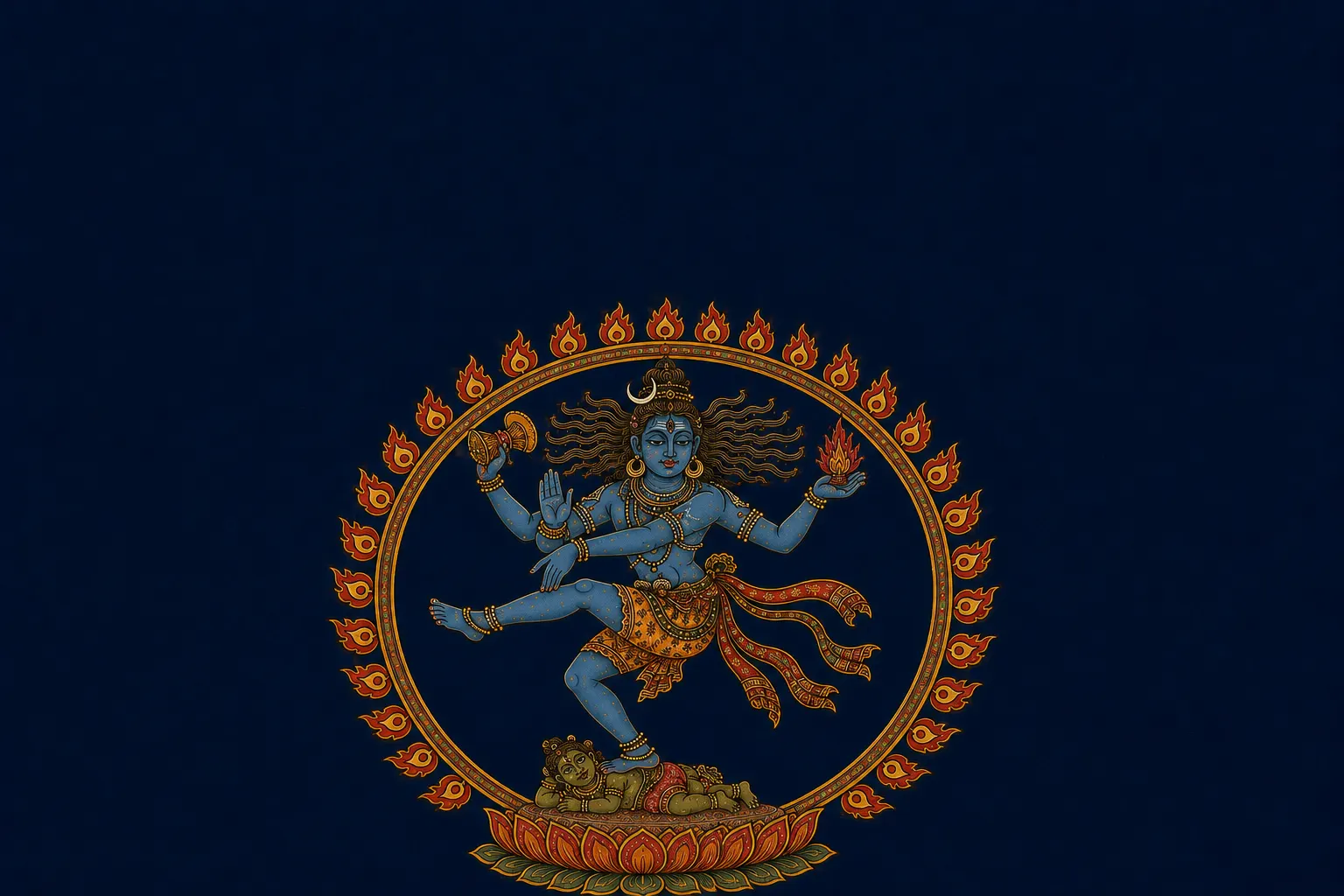
Shiva set one foot on its back — and standing on it, began to dance.
Five acts, one dance
That dance was no performance. Tradition says that in it the five acts of the whole of creation were running at once:
The drum — from which the first pulse of creation comes. The raised hand (the abhaya mudra) — which says, do not fear, this will hold. The fire in the other hand, symbolising dissolution. The foot on Apasmara — which presses down ignorance. And the raised foot — which points toward release, refuge.
Creation, preservation, destruction, veiling, grace — all five in one body, in one rhythm.
All around was a ring of fire — the universe turning inside this dance.
The sages' heads bowed
The sages of the Daruka forest stood watching.
Everything they had conjured to destroy Shiva — the tiger, the snake, the dwarf — had become part of his iconography instead. Their weapons were now his identity.
They understood: the right act is one thing, but behind it is something else they were denying. The sages bowed.
The dance contest with Kali
Another story is from near Tillai (Chidambaram).
There a fierce form of Kali ruled over that land. Shiva set a dance contest with her — whoever lost would leave the land.
The two danced on, matched. Then Shiva did a pose — the urdhva-tandava, in which one leg is raised straight up, higher even than the head.
Kali did not repeat that pose — some forms say out of modesty, some say she was the goddess of that land and it was her own place which she left out of respect. Shiva won the contest, and Tillai became the land of the "Ananda Tandava."
What stayed at Chidambaram
At the temple of Chidambaram there is no ordinary image of Shiva — the main form there is Nataraja's, and in one part of the sanctum there is nothing at all, only empty space (the "Chidambaram secret") — that is, that which is not seen.
Patanjali (in snake-form) and Vyaghrapada (the sage with a tiger's feet) are held to be the witnesses of this dance. And that bronze image of Nataraja that the whole world recognises today — the ring of fire, the raised foot, Apasmara — came to its settled form in the Chola period (the tenth to twelfth centuries).
Note: The story of the sages of the Daruka forest (or Taragam forest) is in the Shiva Purana, the Linga Purana and the Kurma Purana; the root of the tiger's skin, the snake and Apasmara is here. The dance contest with Kali at Tillai/Chidambaram and the Ananda Tandava story are of the Tamil sthala-puranas (the Chidambara Mahatmya, the Koyil Puranam) and Tirumular's Tirumantiram. The "five acts" interpretation is of the Agama texts and the Tamil Shaiva tradition; its global spread came from Ananda Coomaraswamy's 1918 essay. Nataraja's settled bronze form is of the Chola period (roughly the 10th–12th centuries). The deluge-time tandava and the grief-dance of the Shakti Pithas (chapter 4) are separate from this Ananda Tandava.
Source: from several texts, Nataraja