
Chapter 6
Parvati's Penance
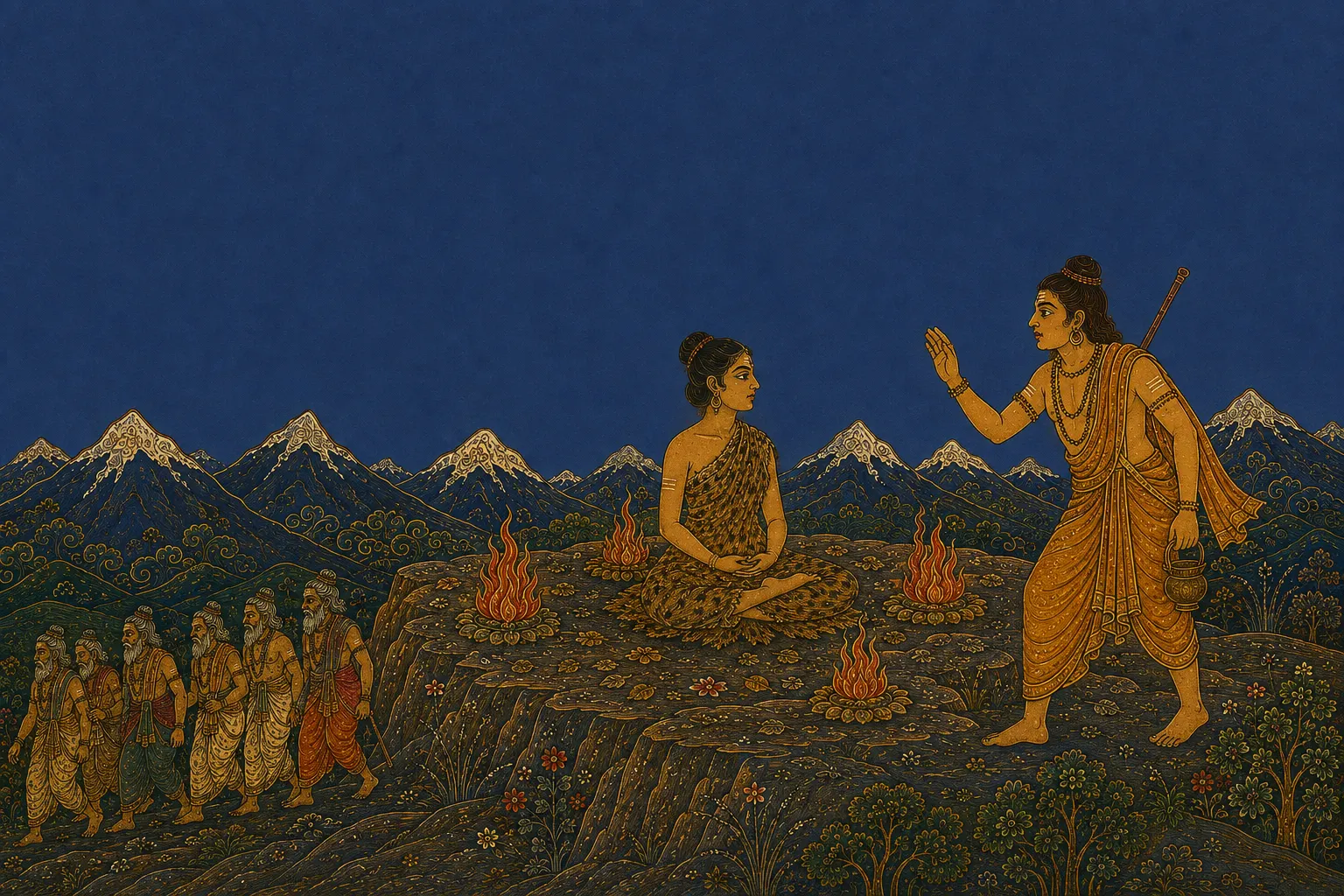
Kamadeva failed, so the daughter of the mountain took off her ornaments and went to that peak to do penance herself
She took off her ornaments
After Kamadeva burned, the gods had given up. Parvati had not.
"Shiva cannot be woken by desire," she said. "Then I will meet him on his own ground. I will win him through penance."
She took off her ornaments, traded silk for bark, left the palace, and climbed to a peak of that same mountain — the one that afterward came to be called "Gauri-shikhar."
In every season
In summer she lit fires around herself and sat at the centre — the sun blazing above, embers on every side. Through the rains she sat in the open, with no roof over her. In winter she stood neck-deep in water, amid the snow.
First she gave up grain, then fruit, then leaves. In the end, not even fallen dry leaves. From this came one of her names — Aparna, the one who ate not even a leaf.
Her mother Mena watched from a distance and wept: "u ma" — "oh, don't." Tradition holds that Parvati's other name, Uma, came from those very words.
Seven sages, a test
Shiva sent the Saptarishis to test her.
The sages came and began to run Shiva down: "He smears himself in ash, wears snakes, has neither house nor lineage. He lives among ghosts in cremation grounds. You're a princess — let us arrange your match with Vishnu instead. Vaikuntha, Lakshmi's company, a palace of gold."
Parvati's expression hardened. "What you describe isn't a lack in Shiva — it's his own choosing. I've made my choice too. If not in this birth, then the next — but it will be Shiva."
The sages returned smiling. Parvati had passed the first part of the test.
The brahmachari who spoke against himself
Then a young brahmachari appeared — lean, radiant, alone.
He too began running Shiva down, more sharply than the sages had: "All this penance, for a beggar? He wears a garland of skulls at his neck. Ghosts will walk in his wedding procession. Your mother will faint at the sight of him."
Parvati turned away and rose to leave. "Even one who merely listens to Shiva being reviled shares the fault. And to speak with the one doing the reviling is itself a sin."
Then the brahmachari's form dissolved. Shiva stood before her.
"The penance is complete," he said. "You have proved your devotion three times over — before the sages, before me, and before my own insults. Now I will send word to your father."
The procession that made the mother faint
The marriage was fixed. The Saptarishis carried a formal proposal to Himavan.
Then the wedding procession arrived. At its head walked Shiva — matted hair loose, ash covering his body, a snake at his neck — and behind him came his ganas: some headless, some three-legged, ghosts and spirits, drums and skulls.
Mena climbed to the roof to watch the procession arrive, and fainted at the sight, collapsing where she stood.
Then Shiva changed his form — richly ornamented, the moon resting on his brow, a bridegroom unlike anyone had ever seen. Mena came to, and the marriage went ahead. Brahma officiated as priest, Vishnu took the ceremonial role of the bride's brother, and the couple circled the fire seven times.
The daughter of the mountain had won through penance what Kamadeva's arrows never could.
Note: The story of Parvati's penance and marriage is in the Shiva Purana (Rudra Samhita, Parvati Khanda), the Skanda Purana and the Kalika Purana; its fullest literary form is Kalidasa's "Kumarasambhava" (the argument by Shiva as a brahmachari is in the fifth canto). The explanations of the names "Aparna" and "Uma" are traditional. In the Bala Kanda of the Ramayana this story is brief. The tradition of linking Hartalika Teej to this penance is in North India and Nepal.
Source: from several texts, Parvati's Penance