
Chapter 13
Ravana and Kailasa
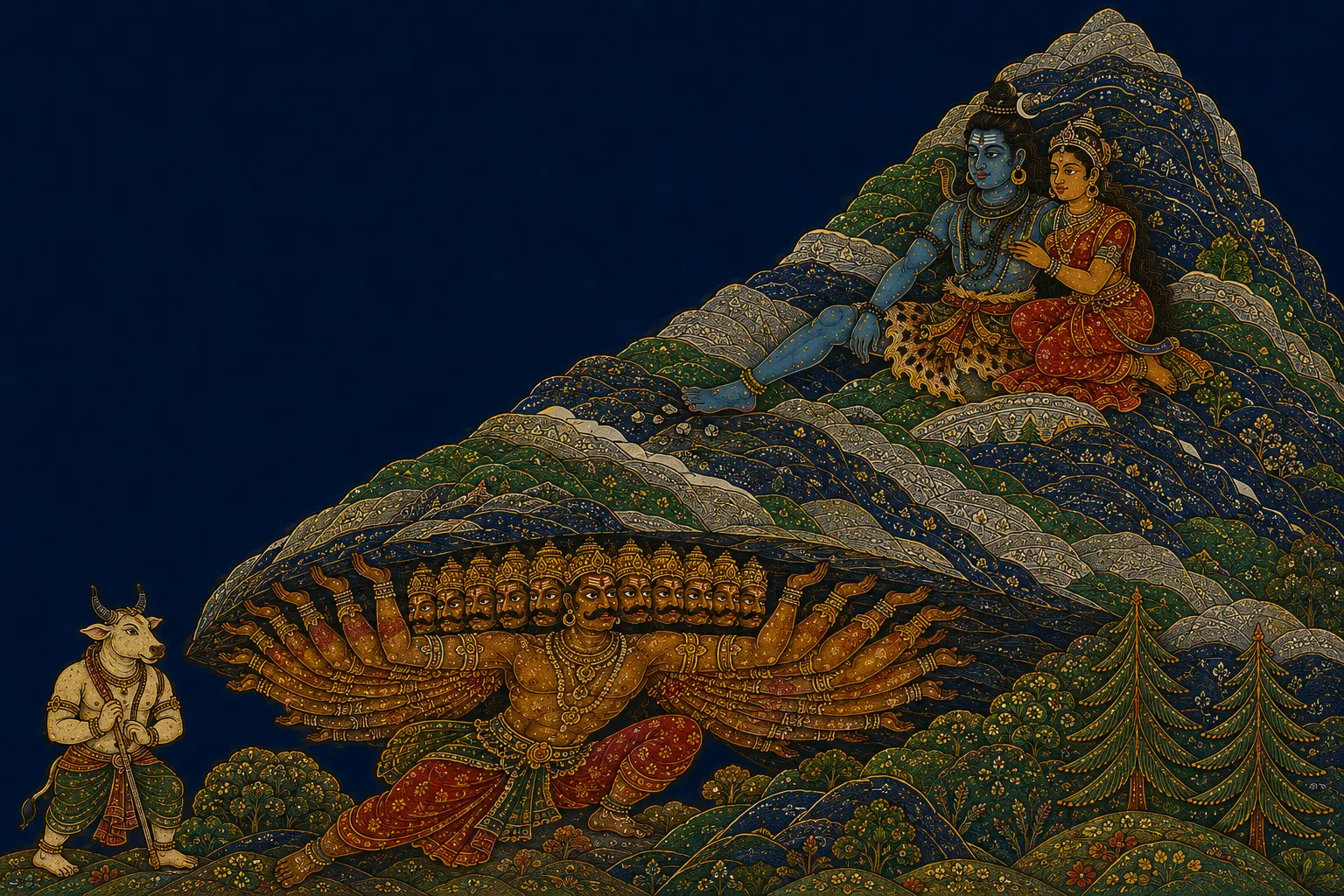
Ravana tried to lift the mountain Shiva was seated on — and Shiva, without rising, pressed it down with the toe of one foot
The vimana that stopped
Ravana was returning from his conquests, in his Pushpaka vimana. Above a mountain the vimana suddenly stopped — it would not go on.
Below stood Nandi. "No road onward from here. This is Kailasa. Above are Shiva and Parvati. No one passes."
Ravana looked at Nandi's face — monkey-like — and burst out laughing.
Nandi said: "You laughed at this monkey-like face. Monkeys will destroy your line."
Ravana paid no heed. But the curse was set down all the same. That curse would be fulfilled much later, in the Ramayana.
Twenty arms, one mountain
Ravana got down from the vimana. "The mountain that blocks my road, I will remove it."
He put his twenty arms under the mountain and strained.
Kailasa began to shake. Above, Parvati took fright and clung to Shiva. The ganas rolled about. Slabs of snow broke off and fell.
One toe
Shiva did not rise.
From where he was sitting, he pressed one toe of his foot onto the ground.
The mountain settled back — and under it Ravana's twenty arms were trapped. He could pull them neither forward nor back.
Ravana screamed. So loud that the three worlds shook. Tradition says his name — Ravana, "the one who makes [others] weep" — came from this scream, given by Brahma or Shiva.
A thousand years, one hymn
Ravana stayed pinned — some texts say a thousand years.
At last someone advised him: Shiva can be won over not by force but by a hymn.
Ravana began to sing. Tradition says he drew a sinew from one of his arms and made a veena of it, and sang a hymn to Shiva — the hymn that tradition calls the "Shiva Tandava Stotra," and links to Ravana's name.
Shiva was moved by Ravana's devotion — the same Ashutosh, the same Bholenath. He lifted the mountain, released Ravana.
A boon to the enemy
And then Shiva gave the man who had just tried to uproot his home — a sword. Chandrahasa. And a boon.
It's the same truth about Shiva, once again: he gave freely, without weighing who stood before him. Ravana had shaken his mountain and frightened his wife — and then sang a song, and Shiva gave him a weapon.
Chandrahasa became one more symbol of Ravana's power and standing. But the story of the Rama avatar has its main cause in the boon Ravana won from Brahma — in which he asked no protection against humans.
Note: The story of Ravana lifting Kailasa is in the Uttara Kanda of the Valmiki Ramayana (sarga 16) and the Shiva Purana; many modern scholars hold the Uttara Kanda to be a later expansion of the original Ramayana. Nandi's curse about the destruction of Ravana's line and the full reckoning of the Chandrahasa sword are in the Ramayana, not here. The "Shiva Tandava Stotra" is linked to Ravana in tradition, but many scholars hold it to be a much later work. The largest sculpture of this scene is at the Kailasa temple of Ellora (cave 16). Ravana's Atmalinga episode at Gokarna (Ganesha's trick) is a separate story, not part of this chapter.
Source: from several texts, Ravana and Kailasa