
Chapter 4
The Shakti Pithas
Shiva lifted Sati's body onto his shoulder and refused to set it down — so Vishnu began, quietly, to cut it away
The body he did not set down
The sacrifice was complete. Daksha had risen. But one thing still lay at Kanakhal — Sati's burned body.
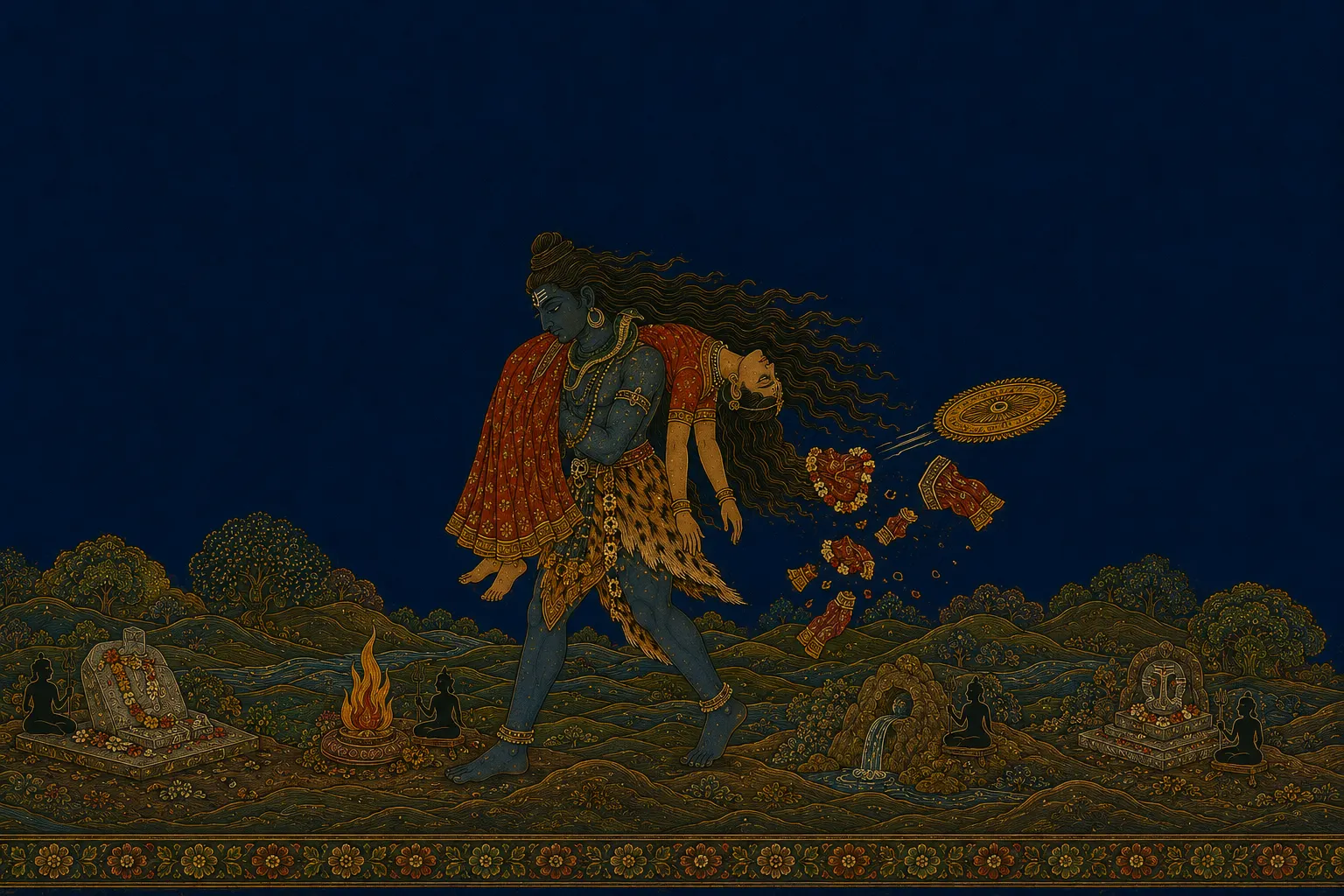
Shiva lifted it onto his shoulder and began to walk.
He did not stop. From one mountain to the next, across a river, through a forest — the body on his shoulder, his steps leading nowhere in particular. The gods followed at a distance, but none of them had the courage to step forward and say, "Set her down now."
The earth began to shake
As Shiva wandered, his grief slowly turned into a terrible dance — heavy, without rhythm, the kind that shook the ground at every step.
Boulders broke loose from the mountains. The seas rose over their shores. Sages lost their concentration mid-penance. The gods realised that if this dance did not stop, everything Daksha's sacrifice had spared would now burn anyway — the whole of creation with it.
"Shiva won't stop while the body is with him," Vishnu said. "So the body has to go — but in a way he never notices."
The discus, quietly
In the most widespread later tradition, Vishnu cuts the body into pieces with the Sudarshana discus. The Devi Bhagavata's own account differs — there, Vishnu separates the limbs with arrows.
Vishnu loosed the Sudarshana discus.
It trailed behind Shiva, and with every step he took, it sheared away another piece of Sati's body. The pieces fell as they were cut loose — some onto a mountain, some onto a riverbank, some into dense forest.
Shiva kept walking. The weight on his shoulder lessened with each piece, but he never looked back.
Eventually, nothing remained on his shoulder at all.
Wherever the pieces fell
Each place where a piece of Sati's body fell became sacred.
A pitha rose there — a seat of the goddess. Kamakhya, where the yoni fell. Kalighat, where the toes fell. Jwalamukhi, where the tongue fell — and there, fire has risen from the ground ever since, with no fuel to feed it. Hinglaj, far to the west, where the crown of her head fell.
At every pitha the goddess is never alone — each site is guarded by a Bhairava, a form of Shiva himself. Wherever a piece of Sati is, Shiva is there too, under a different name.
Shiva sat down
Once the body was gone, the dance stopped on its own.
Shiva climbed to a peak of Himalaya, closed his eyes, and sat down — no speaking, no moving, letting no one near him. Sati's rebirth in the mountain's household still lay ahead, and until then Shiva meant to stay exactly where he was, sealed in that stillness.
The chapter ends here, but this stillness is the seed of two chapters still to come: the burning of Kamadeva, and Parvati's penance.
What tradition could never quite count
The count of the pithas is different in every list.
The most common number is 51 — as many as the 51 letters of the Sanskrit alphabet. Some lists give 52, some 108, and some older traditions hold only 4 principal pithas. The full list of 51 comes from the Tantra texts and is relatively late.
The pithas today are spread across India, Nepal, Bangladesh, Pakistan and Sri Lanka — that is, this story of Sati's body is in a way also a goddess-map of the subcontinent.
Note: The Shakti Pitha story is in the Shiva Purana, the Devi Bhagavata Purana, the Kalika Purana (especially for Kamakhya) and the Mahabhagavata Purana; the full list of 51 pithas comes mainly from the Tantra texts (the Tantrachudamani and so on) and is late. The number changes with tradition — 4, 51, 52, 108. The tradition of a Bhairava (a form of Shiva) with the goddess at every pitha is in both the Shakta and the Shaiva streams. The pithas are today held to be spread across India, Nepal, Bangladesh, Pakistan and Sri Lanka.
Source: from several texts, The Shakti Pithas