
Chapter 5
The Third Eye
The gods sent the god of desire to wake want in Shiva's mind — and Shiva opened an eye and turned him to ash
An asura, a condition
Tarakasura had a boon: he could die only at the hands of a son of Shiva.
It was a cunning boon. Since Sati's death, Shiva had sat in unbroken absorption on Himalaya — no marriage, no household, no son. As long as he stayed that way, no one could touch Taraka. The asura trampled the three worlds, and the gods could do nothing about it.
There seemed to be only one solution: draw Shiva out of that absorption and toward marriage.
The daughter of the mountain, who was in service
Sati was now Parvati — the daughter of Himalaya. Himavan had set her to attend on Shiva as he sat in that same unbroken absorption. Every day Parvati came, offered flowers, tidied the surroundings, and left again. Shiva never opened his eyes.
The gods reasoned: Parvati was right there — they only needed to awaken desire in Shiva's mind. And there was only one god who could do that.
Kamadeva on Kailasa
Indra summoned Kamadeva, who came to Kailasa with his wife Rati and his friend Vasanta, the season of spring itself.
Vasanta arrived out of season — amid the snow, blossoms burst open on the trees, the cuckoo began to call, the air turned warm. Spring had suddenly settled around Shiva's meditation.
Kamadeva hid behind a tree and waited for Parvati to approach.
An arrow, and an eye
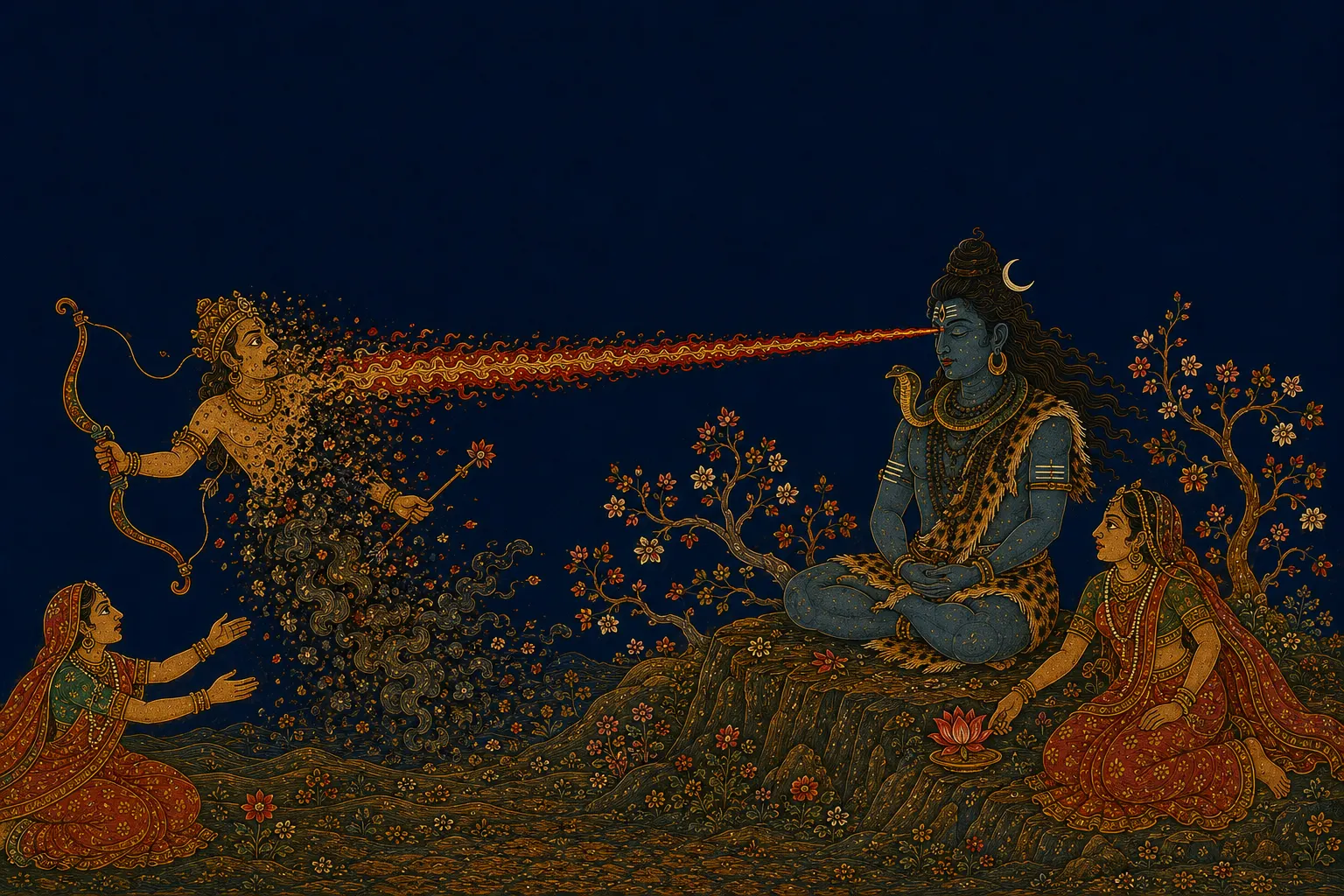
Parvati arrived and bent down to lay a lotus at Shiva's feet.
In that instant, Kamadeva drew his arrow of enchantment and loosed it.
A tremor passed through Shiva — for a moment his gaze lifted toward Parvati. Then he caught himself. He immediately sensed that the desire wasn't his own; someone had deliberately planted it there.
His brow furrowed. The third eye at its centre, always closed, opened — and a tongue of fire shot out of it.
Kamadeva burned to ash on the spot, instantly. Behind the tree, only a handful of ash remained.
Rati
Rati collapsed over the ash, shrieking.
"He did not do this of his own will," she said. "Indra sent him — to wake something in you. And you killed him for it."
Shiva said nothing. He rose and walked away, without a single glance toward Parvati.
The spring ended. The snow returned. And on Himalaya, Rati remained beside the ashes of her husband, inconsolable.
What Shiva said later
Rati went to Shiva again and again, the gods alongside her.
At last Shiva relented, though only this far: Kamadeva had not died, but he would go without a body from now on. He would remain "Ananga" — the limbless one — present everywhere, visible nowhere. Some texts add that he would take a body again in the Dvapara age, as Pradyumna, Krishna's son, and that Rati would find him once more.
One thing was now clear to the gods: Shiva could not be woken by desire. What remained was Parvati's path — not desire, but penance.
Note: The Kamadeva-burning story is in the Shiva Purana (Rudra Samhita, Parvati Khanda), the Matsya Purana, the Skanda Purana and the Saura Purana. Its most famous form is Kalidasa's epic poem "Kumarasambhava," which is a poem, not a scripture — Rati's lament and the description of Vasanta come mainly from there. The addition of Kamadeva's rebirth as Pradyumna is from a separate story in the Bhagavata and the Harivamsha, not in every Shiva-story. In South India the Kamadahanam is linked to the time of Holi.
Source: from several texts, The Third Eye