
Chapter 9
Tripurantaka
Three flying cities that only one arrow could destroy — and only when the three came into a single line
Three sons, one boon
Tarakasura had three sons — Tarakaksha, Vidyunmali and Kamalaksha.
They did years of harsh penance and asked Brahma for a boon: "Give us three cities — one of gold, one of silver, one of iron. Let them fly in the sky. And let anyone be able to kill them only when the three come exactly into a single line — and then too only with one arrow."
The three cities came into a line only once in a thousand years, for a single moment. The rest of the time they were unconquerable.
Brahma granted the boon.
Cities that at first kept to dharma
At first the asuras of Tripura were not evil.
They were devotees of Shiva, they made sacrifices, they gave in charity. So Shiva could not raise a hand against them — how could he kill his own devotees.
The gods were troubled. Then Vishnu made a Maya-purusha — shaven head, a different garb, a new teaching — who went to Tripura and began to turn the asuras from their dharma. (This is the same method as in the Buddha chapter of Vishnu-Puran on this site — there too it is said whose view this is.)
Slowly the asuras gave up sacrifices, gave up charity, and sank into pride. Only then could Shiva act against them.
The chariot the gods built
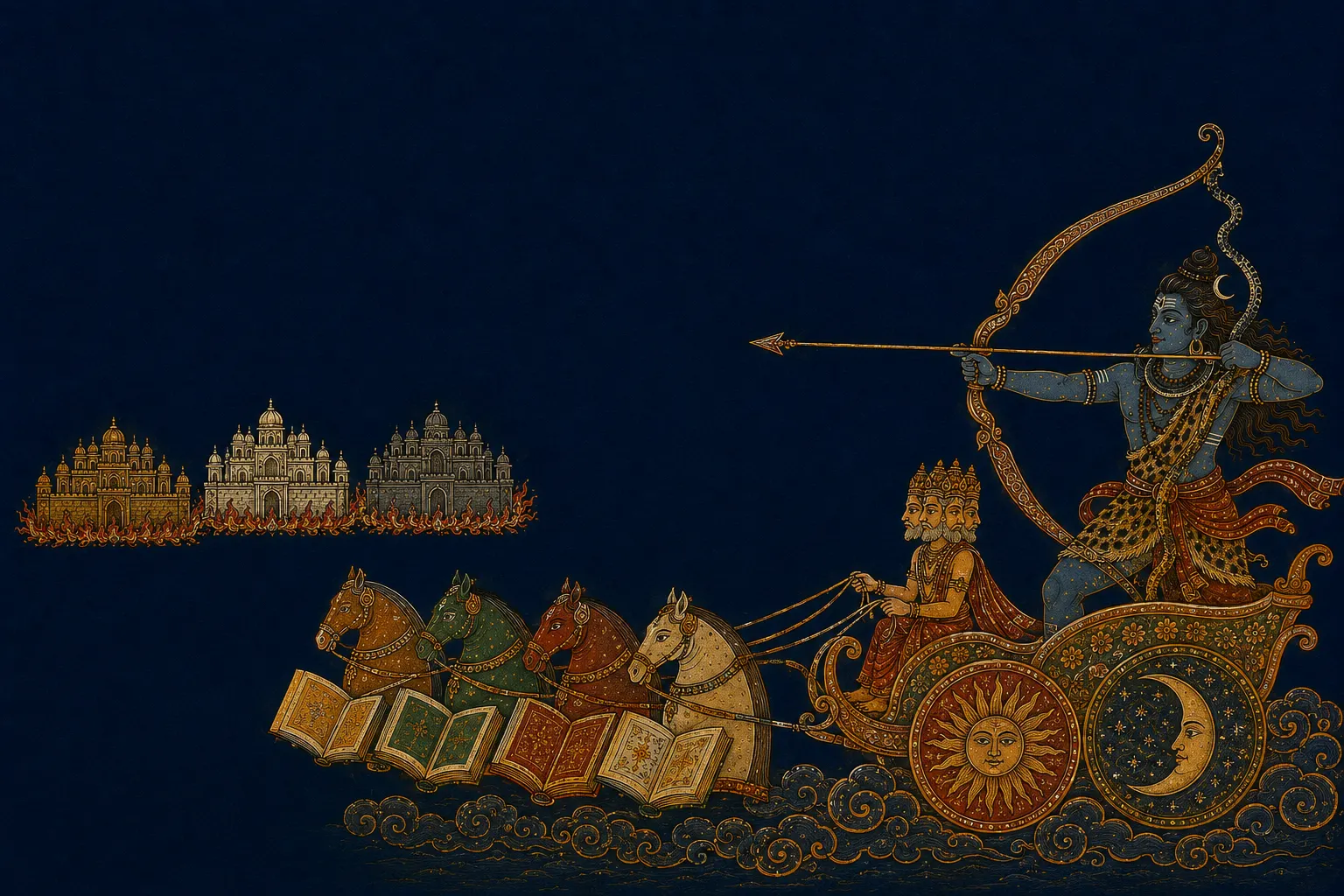
The gods put together a chariot for Shiva, in which every part was a god or an element.
The earth became the chariot. The sun and the moon the two wheels. Mount Meru the bow. The serpent Vasuki the bowstring. Vishnu himself became the arrow, Agni its tip. The four Vedas were the horses, and Brahma the charioteer.
The gods took great pride in the magnificent weapon they had assembled for Shiva.
One arrow, one smile
Shiva mounted the chariot and waited for the moment when the three cities would come into a line.
That moment came — once in a thousand years. Shiva raised the bow, set the arrow.
And then, some texts say, before loosing the arrow he only looked once toward the three cities with a smile — and that smile alone burned all three. The arrow was just a formality.
In an instant, all three cities were reduced to ash. Shiva earned the name — Tripurantaka, Tripurari.
The gods' pride, which broke
When it was all over, the gods began to praise Shiva — but in their minds was the thought that they had made the chariot, so they had a share in the victory.
Shiva understood. He said nothing — he only looked toward that chariot, and the gods saw that there had been no need of the chariot at all. The smile was enough.
The gods' heads bowed. What the gods had considered essential, Shiva had never needed at all.
Note: The story of Tripura's burning is in the Mahabharata (Karna Parva, chapter 24, where it is told to Karna), the Shiva Purana (Rudra Samhita, Yuddha Khanda), the Linga Purana, the Matsya Purana and the Skanda Purana. The Mahabharata form is the fullest — there every part of the chariot is a god or an element and Shiva looses one arrow. The "the smile/laugh alone was enough" emphasis is of the later Shaiva forms. Turning the asuras from dharma by a Maya-purusha made by Vishnu is the same kind of episode as the Buddha chapter of Vishnu-Puran — whose view it is is said there too.
Source: from several texts, Tripurantaka