
Chapter 3
Virabhadra
Shiva tore a lock from his matted hair, and what rose from it pulled a whole sacrifice out by the roots
A lock, on the ground
On Kailasa, Shiva heard the news and for a long time did nothing.
Then he rose. For a moment his face showed nothing at all. Then grief gave way to fury. He tore a lock from his matted hair and struck it against the mountain rock.
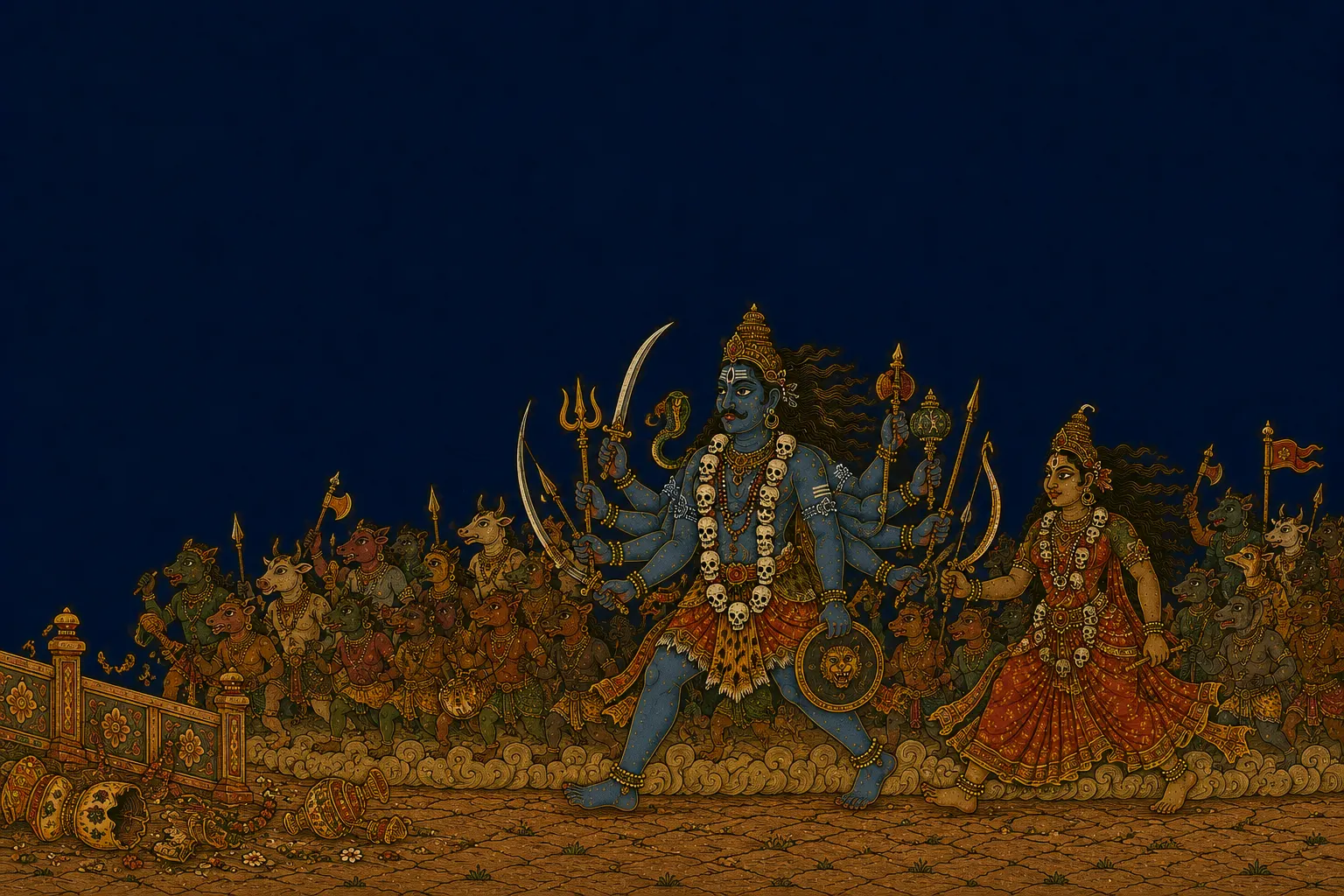
The lock split in two. From one half rose a huge figure — a thousand arms, a garland of skulls at the neck, weapons in every hand. This was Virabhadra. From the other half rose another figure — Bhadrakali.
Virabhadra bowed his head. "Command me."
The command
"Go to Kanakhal," Shiva said. "Stop Daksha's sacrifice, and punish those who took part in this insult. As for Daksha — let him meet whatever end awaits him."
Behind Virabhadra, Shiva's ganas poured out — thousands of them, every shape, every voice. Bhadrakali went with them.
The army swept down from Kailasa toward Kanakhal. Storms rose along the way, the sky darkened, and the sages at the sacrifice ground saw the dust cloud approaching long before it arrived.
At the sacrifice ground
The ganas tore into the sacrifice pavilion.
Fire-pits were overturned. The brahmins reciting the mantras fled. The gods, who until moments before had sat on high seats, scattered to hide wherever they could.
Virabhadra tore out the eyes of Bhaga, who had signalled his approval of Daksha's insults with a glance. He knocked out the teeth of Pushan, caught chewing the sacrificial offering. He tore the beard from Bhrigu, Daksha's chief officiant.
The sacrifice itself took the form of a deer and bolted for the sky. Virabhadra gave chase.
Daksha's head
Daksha stood by the fire-pit, trapped in the wreckage of his own sacrifice.
Virabhadra reached him. The Shiva Purana says he cut Daksha's head from his body and threw it into the sacrificial fire — the same fire into which Daksha had made offerings to every god but one.
The sacrifice ground to a halt. The pavilion lay in ruins. The surviving gods and sages fled to Brahma, who led them on to Kailasa.
Pleading on Kailasa
The gods stood before Shiva, hands folded.
"We were wrong," they said. "We went to Daksha's sacrifice, where your name was never even spoken. The sacrifice stands unfinished, and the cycle of the world has stopped with it. Let it be completed."
Shiva said nothing for a while. Then: "It will be completed. But this time, with my share in it."
He went to Kanakhal himself.
The goat's head
Shiva restored the wounded gods. Bhaga's sight returned. Pushan, unable to chew, was granted ground grain instead. Bhrigu grew a new beard.
Daksha's own head had burned in the fire and could not be recovered. So Shiva fixed onto his body the head of the goat that had been brought for the sacrifice.
Daksha rose with a goat's face — and for the first time in his life, praised Shiva. The sacrifice was completed at last, and this time the first offering went to Shiva's name.
The sacrifice that had begun by excluding him could now be completed only by honouring him.
Note: The Virabhadra and sacrifice-wrecking story is in the Shiva Purana (Rudra Samhita), the Bhagavata Purana (fourth skandha), the Vayu Purana and the Linga Purana; in the Mahabharata it comes in brief form (Shanti Parva and Shalya Parva). The details of Bhaga's eyes, Pushan's teeth and Bhrigu's beard are from the Bhagavata and the Shiva Purana. Daksha being fixed with a goat's (aja) head is strong in the Shaiva tradition. Virabhadra is later worshipped as an independent god, especially in the Virashaiva tradition of Karnataka.
Source: from several texts, Virabhadra