Chapter 6

One Anklet

The goldsmith pinned the blame for the queen's stolen anklet on Kovalan — the king ordered his death without any inquiry

The goldsmith

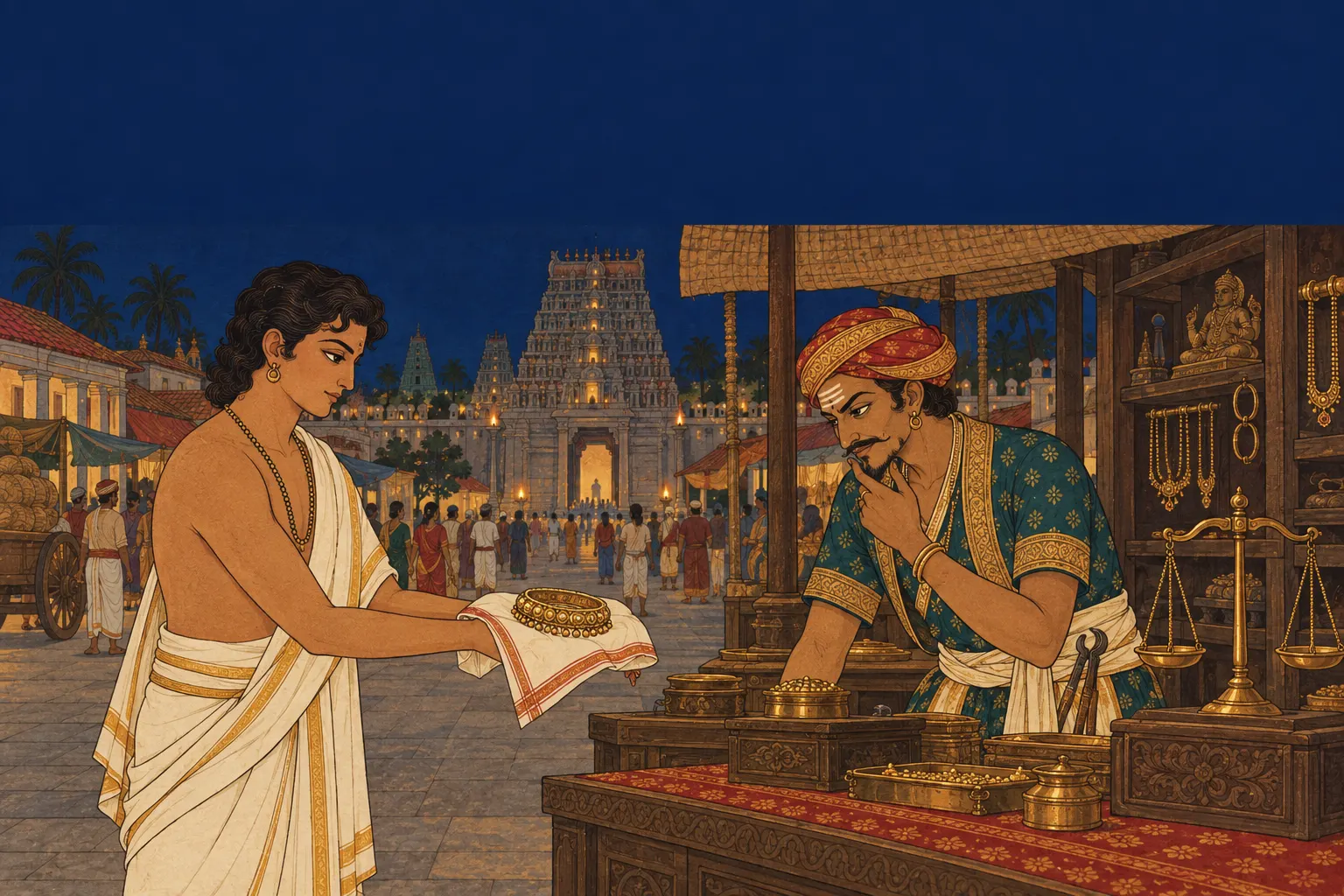
In the market Kovalan met the royal goldsmith. The goldsmith examined the fine workmanship of the anklet — the rubies and diamonds set inside — and saw that it resembled the anklet of Queen Kopperundevi, which he himself had in fact stolen. He said to Kovalan — "Only the great queen could ask for this anklet. I will go and inform the king; wait meanwhile near my little hut."

The goldsmith went straight to the king and falsely accused a stranger, hiding near his hut, of having stolen the palace anklet. At that time the queen, upset over the palace dancing girls, had left the king with the excuse of a headache, and the king was on his way to her chamber to appease her. Just then the goldsmith arrived, and King Nedunjeliyan, without any inquiry, ordered the city watchmen — "If you find my consort's lost anklet with a clever thief, kill him, and bring the anklet here."

The killing

The watchmen at first felt that "this man's appearance does not show him deserving of death." But the goldsmith won them over with a long speech on the eight aids of thieves. Then an unlettered man who was present there, in drink and haste, swung his gleaming sword at Kovalan. Kovalan fell, blood flowing — and through this injustice, the story says, the Pandya kingdom's ever-straight sceptre became bent.

The goldsmith's name is given nowhere in the story — he is called only "the royal goldsmith" or "the deceitful goldsmith." It was a royal killing carried out without trial or inquiry: the order came from the king, and Kovalan was struck down on the spot while the order was being enforced.

Source: Tamil epic — the Silappadikaram (traditionally by Ilango Adigal), One Anklet

Now — how much stayed with you?

Fact

What did the goldsmith recognise on seeing Kovalan's anklet?

  • That it was a fake anklet
  • That it was made by another goldsmith
  • That it resembled the stolen anklet of Queen Kopperundevi
  • That it was an old, broken anklet
Read the whole story — A dangerous recognition

The goldsmith saw Kovalan's anklet as resembling the queen's stolen anklet.

In fact the goldsmith himself had stolen it — and he decided to put the blame on Kovalan.

Who said it?

"If you find my consort's lost anklet with a clever thief, kill him." — who said this?

  • King Nedunjeliyan to the city watchmen
  • The goldsmith to the watchmen
  • Queen Kopperundevi herself
  • A minister to the king
Read the whole story — An order without inquiry

King Nedunjeliyan gave this order without any inquiry.

At that time the king was going to appease the sulking queen, and on the goldsmith's accusation he gave the order at once.

Why is that?

In what circumstances did the king give the order without inquiry?

  • Because he had an old enmity with Kovalan
  • Because the goldsmith was the king's relative
  • Because thefts had grown in the city
  • The king was then going to appease the sulking queen; the goldsmith made the accusation just then, and the king ordered at once without inquiry
Read the whole story — The circumstances of the order

The queen, upset over the palace dancing girls, had left the king.

The king was going to appease her when the goldsmith arrived, and he gave the order without inquiry. What was in the king's mind the text does not say.

Fact

Who swung the sword at Kovalan?

  • King Nedunjeliyan himself
  • An unlettered man present there, in a state of drunkenness
  • The goldsmith himself
  • The king's chief minister
Read the whole story — A disorderly killing

It was a royal killing without trial and without inquiry; the order was the king's.

An unlettered man present there, in a state of drunkenness, swung the sword.

The text gives him no rank; translations describe him in different ways.

Fact

What was the guards' first reaction when they saw Kovalan?

  • They felt that his appearance did not show him deserving of death
  • They demanded that he be killed at once
  • They recognised him at once
  • They suspected the goldsmith
Read the whole story — A first hesitation

At first sight the guards felt that Kovalan's appearance did not show him deserving of death.

The goldsmith won them over with a speech on the eight aids of thieves.

What happened?

What is said to have happened to the sceptre in the story?

  • It broke
  • It grew stronger
  • It is not mentioned
  • Through this injustice it became bent
Read the whole story — A symbolic bending

The story says that through this injustice the Pandya kingdom's ever-straight sceptre became bent.

That bend is straightened only by the king's death.

Fact

What name is the goldsmith given in the story?

  • Subhadra
  • No name is given
  • Ratnakar
  • Vajra
Read the whole story — A nameless villain

No name is given to the goldsmith in the story.

He is called only "the royal goldsmith" or "the deceitful goldsmith."

Why is that?

Why did the goldsmith give the excuse of informing the king and leave Kovalan waiting?

  • To fix the anklet's true price
  • Because no trade could be done without the king's leave
  • To hide his own crime, by naming Kovalan the guilty one before his own theft came out
  • Because he only wanted to cheat Kovalan, not have him killed
Read the whole story — Hiding his own crime

Before his own theft could come out, the goldsmith decided to name Kovalan as guilty.

He went straight to the king and made a false accusation.

Fact

How is the man who swung the sword at Kovalan described in the story?

  • The king's general
  • The goldsmith's assistant
  • The city's chief guard
  • An unlettered person, who was in a state of drink
Read the whole story — The order the king's, the hand drunk

In Dikshitar's words — "an unlettered person, in a fit of drunkenness."

Whether he was a soldier, guard or executioner the text does not settle; translations differ.

Fact

In the capital of which kingdom did this injustice happen?

  • Madurai, capital of the Pandya kingdom
  • Puhar, capital of the Chola kingdom
  • Vanji, capital of the Chera kingdom
  • No capital, but a small village
Read the whole story — An event at Madurai

This injustice happened at Madurai, capital of the Pandya kingdom.

From here the poem's second book, the Madurai book, moves toward its climax.