
Chapter 9
The Stone from the Himalaya
Hill-maidens first worshipped Kannagi as a goddess — then King Senguttuvan marched north to bring a stone from the Himalaya to carve her image
The hill-maidens' worship
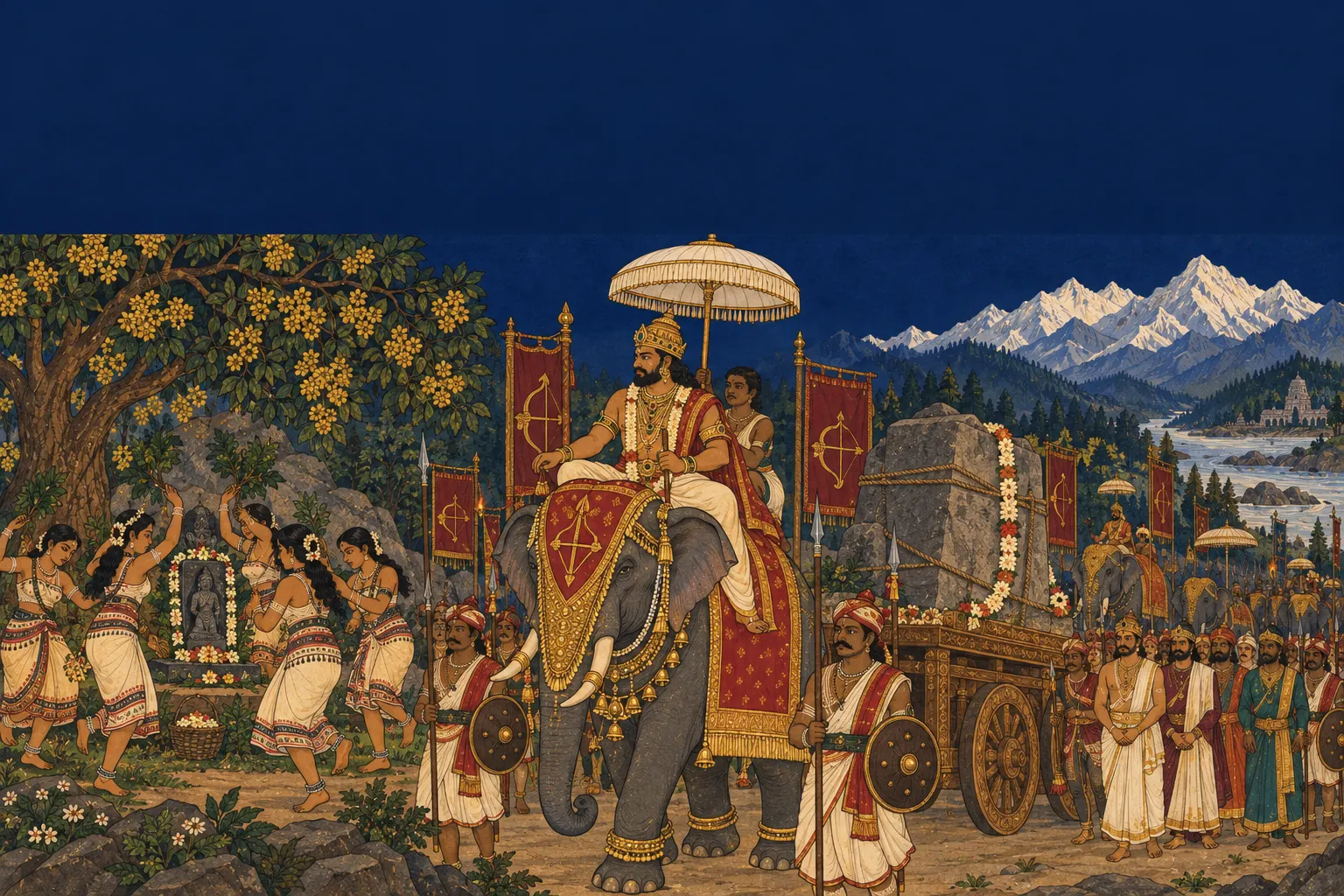
On the hill where Kannagi had come, hill-maidens, devotees of Murugan, saw her in her sorrow, missing a breast, and heard her story. Witnesses to her ascent to heaven, they said — "For us there is no greater goddess. O people of the small hamlets, accept this goddess!" So the worship of Kannagi began first among ordinary hill folk, not in a royal court.
The news reached Senguttuvan, king of the Cheras — first from the hill tribes, then through the testimony of the Tamil poet Sattanar (traditionally identified as the author of the Manimekalai), who had himself seen all this at Madurai. Sattanar told the whole story to the king and his queen Ilango-Venmal. The queen said — "This goddess should be given due honour." The king resolved that the goddess's image would be carved not from ordinary stone but from a stone brought from the Himalaya. The contemptuous remarks of the northern kings, which had reached him through saints of the Himalaya, seemed to him a challenge — and bringing the stone became tied to a show of Tamil royal power.
The march north
Senguttuvan marched north with his vast army, defeating many northern and central Indian kings along the way, and at last on the banks of the Ganga took the "Arya kings" Kanaka and Vijaya captive. When the captive kings were shown to the Chola and Pandya kings, they remarked sarcastically that taking captive kings who had fled the battlefield and put on the guise of ascetics was not in keeping with kshatriya honour — and this angered Senguttuvan.
The Brahmin Madalan calmed the king, reminding him of the impermanence of life and the philosophy of rebirth, and advised him to perform a sacrifice in place of war. The king accepted the advice, released the captive Arya kings with honour, proclaimed a general amnesty and remission of taxes, and, having Kannagi's image — now worshipped as Pattini — carved from the stone brought from the Himalaya, had it consecrated at Vanji with full ceremony according to the rules of the Agama texts.
Gajabahu's presence
At this very consecration — according to the poem — the Arya kings Kanaka and Vijaya, the ruler of Kongu, the king of Malwa, and Kayavahu (Gajabahu), king of sea-girt Lanka, were all present, and they prayed to the goddess to grace their own kingdoms as well. It is this scene on which the whole historical dispute over the "Gajabahu synchronism" rests — because Gajabahu's time is known from history to some degree, scholars try from this scene to estimate the time of Senguttuvan and the poem.
Source: Tamil epic — the Silappadikaram (traditionally by Ilango Adigal), The Stone from the Himalaya