
Chapter 3
Madhavi
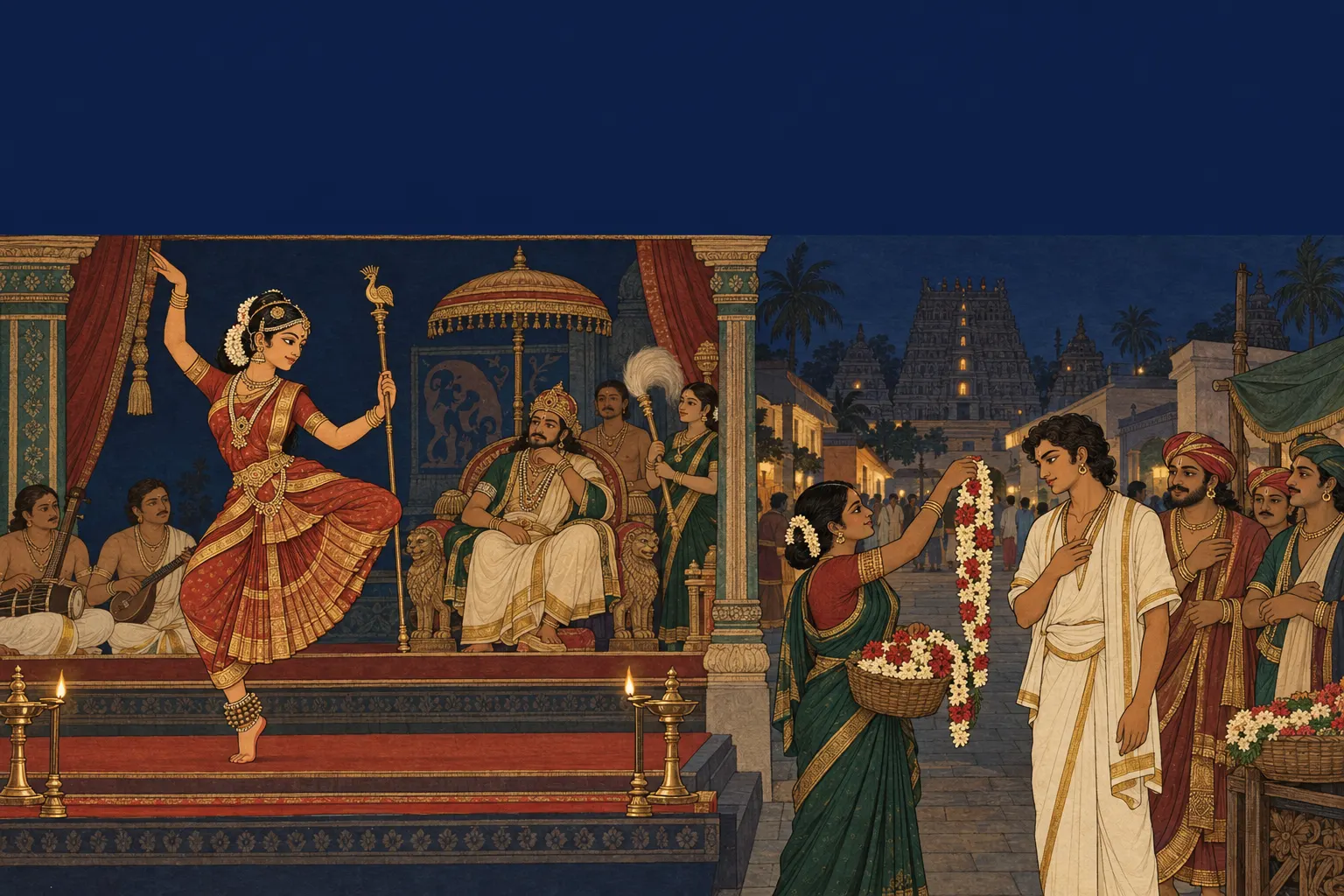
A dancer of Urvashi's line, rewarded by the king for her first performance — and whose garland Kovalan bought for 1,008 kalanjus
A line joined to a curse
Madhavi was a dancer of hereditary line. According to the story, her lineage is joined to a curse — the sage Agastya cursed Indra's son Jayanta and the apsara Urvashi for their improper conduct. Jayanta had to be born as a bamboo in the Vindhya hills, and Urvashi on earth as a dancing girl; Urvashi won release from that curse by showing her art on the stage. Madhavi was born in that line of Urvashi. From the age of five she was trained in dance and music, for seven years, and at twelve she gave her first performance before the king.
Her dance was so flawless and so true to the rules of the art that the king, pleased, gave her a garland of green leaves and 1,008 kalanjus of gold — the customary reward given to a dancer, holding the ceremonial rod (talaikkol), who was performing on the stage for the first time. After this Madhavi handed a garland to one of her maidservants and had her stand in the city street where wealthy citizens passed, and had it proclaimed that this garland was worth 1,008 kalanjus of excellent gold, and that whoever bought it would, in Dikshitar's rendering, become the "husband" of this creeper-like girl — effectively her chosen companion or patron, not a marriage like Kannagi's Vedic wedding. (Dikshitar notes that the garland itself was not worth so much; it stood as a symbol of Madhavi, whose worth was reckoned at 1,008 kalanjus.)
Kovalan's choice
Kovalan bought the garland and entered Madhavi's chamber. He was so bound by her charm that he forgot both his home and his wife. After this he began to spend most of his time and wealth with Madhavi, leaving Kannagi alone at home. Kannagi made no complaint and no protest — she waited, with her dignity and patience.
Kovalan's parents too sensed the sorrow behind Kannagi's silence, yet they kept her with affection and respect. In those years with Madhavi, Kovalan and Madhavi also had a daughter — Manimekalai — whose own story is told separately later in Tamil literature.
Source: Tamil epic — the Silappadikaram (traditionally by Ilango Adigal), Madhavi