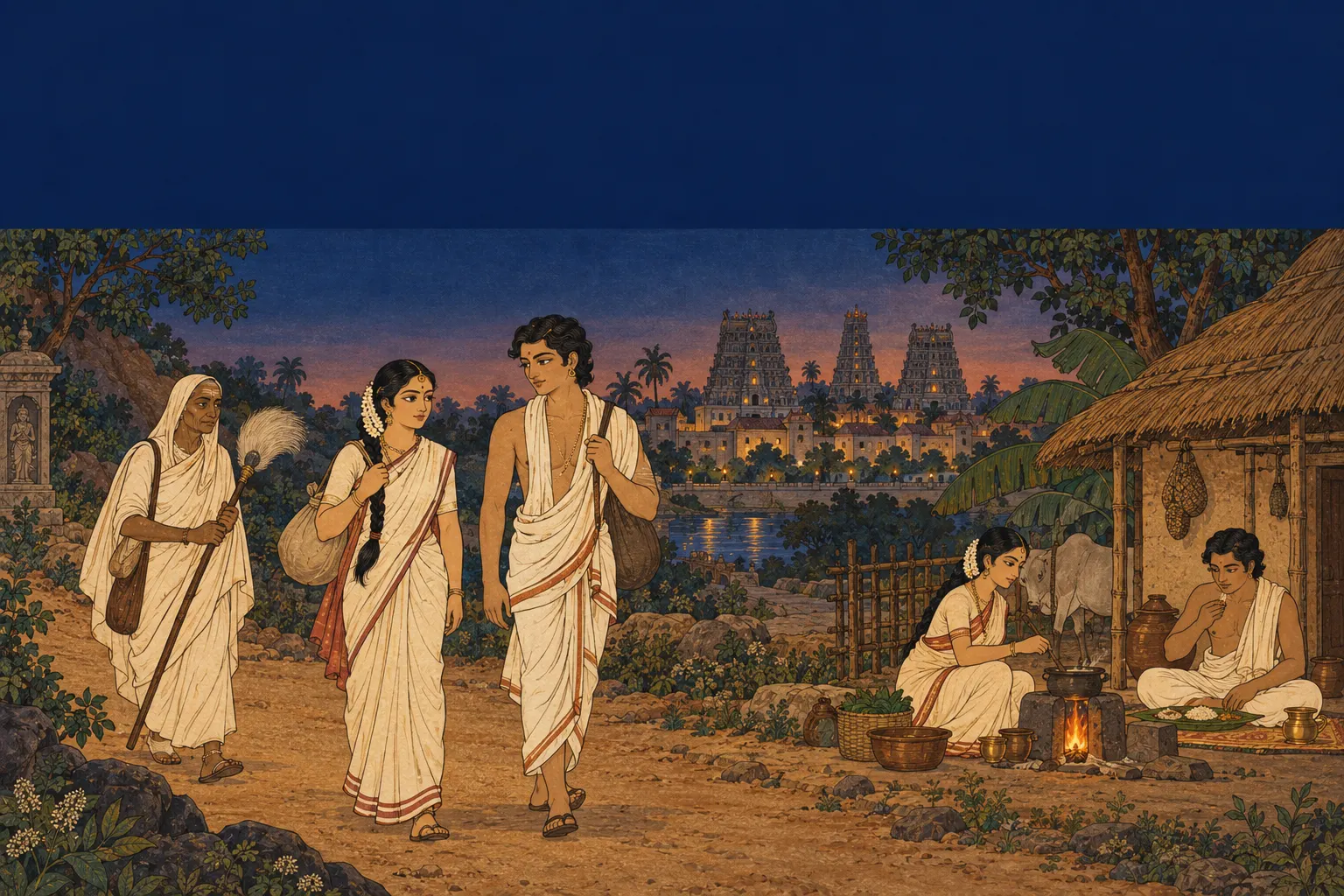
Chapter 5

The Road to Madurai

Returning to Kannagi, ruined, Kovalan asked her forgiveness — Kannagi took him back without reproach, and the two set out for Madurai

The return

Parted from Madhavi, Kovalan returned to Kannagi — his wealth gone, full of regret. He said — "I was not dutiful to my parents; I insulted you, who are younger in years but greater than I in wisdom. I thought I was doing no wrong."

Kannagi answered — "Though I could not give to those who keep dharma, could not honour Brahmins, could not receive guests as our family deserved — still, though you strayed from the path, I kept to the path of dharma, and so I chose to go with you." She made no reproach and set no condition.

Madalan's testimony, Madari's shelter

On the road they met the Jain ascetic Kavunthi Adigal, who walked with them to Madurai. On the edge of the city they met a Brahmin, Madalan, who described in detail Kovalan's earlier good deeds — saving a Brahmin from a maddened elephant, clearing a woman's burden of debt, offering his own life in place of a man falsely accused. Hearing this, one sees that there was generosity and courage in Kovalan too, even if he had strayed into his infatuation with Madhavi.

Kavunthi Adigal found Kannagi shelter in the home of the cowherd woman Madari, whose daughter Aiyai became Kannagi's friend. In Madari's house Kannagi cooked a meal with her own hands and served Kovalan — a plain, intimate scene, compared in the poem to Krishna and Nappinnai. After the meal Kovalan said — "I will take one of your anklets to the market, sell it, and return. Keep your courage until then."

Source: Tamil epic — the Silappadikaram (traditionally by Ilango Adigal), The Road to Madurai

Now — how much stayed with you?

Fact

In what state did Kovalan return to Kannagi?

  • Honoured by the king
  • With Madhavi beside him
  • With all his wealth gone, full of regret
  • With a plan for new trade
Read the whole story — Home, ruined

After parting from Madhavi, Kovalan returned to Kannagi.

His wealth was gone and he was full of regret.

Who said it?

"Though you strayed from the path, I kept to the path of dharma, and so I chose to go with you." — who said this?

  • Kannagi to Kovalan
  • Kavunthi Adigal to Kovalan
  • Madhavi to Kovalan
  • Madari to Kannagi
Read the whole story — Forgiveness without reproach

Kannagi took Kovalan back without any reproach.

She said that she herself had kept to the path of dharma, and so chose to go with him.

Why is that?

Why did Kavunthi Adigal find Kannagi shelter with Madari on the way?

  • Because Madari was Kannagi's relative
  • Because there was no other way inside Madurai
  • Because the king had ordered it
  • Because Madari was a faultless and merciful woman, and a cowherd's life was held harmless
Read the whole story — A trusted shelter

Kavunthi Adigal found Madari faultless and merciful.

Regarding a cowherd's life as harmless, she placed Kannagi in her care.

Fact

What did Madalan tell about Kovalan?

  • His future prophecy
  • His earlier good deeds
  • The mistakes he had made with Madhavi
  • The reasons for his business failure
Read the whole story — Good deeds of the past

Madalan described many good deeds from Kovalan's earlier life.

Such as saving a Brahmin from a maddened elephant and clearing a woman's burden of debt.

Fact

What was the name of Madari's daughter, who became Kannagi's friend?

  • Aiyai
  • Manimekalai
  • Devandikai
  • Nili
Read the whole story — A new friend

Madari's daughter Aiyai became Kannagi's friend.

In Madari's house it is this Aiyai who later brings Kannagi the news of Kovalan's death.

What happened?

What did Kannagi do in Madari's house?

  • Nothing, only rested
  • She danced
  • She cooked for Madari
  • She cooked a meal with her own hands and served Kovalan
Read the whole story — A plain scene

Kannagi cooked a meal with her own hands and served Kovalan.

The poem compares this scene to Krishna and Nappinnai.

Fact

What did Kovalan say after the meal?

  • That he would go back to Puhar
  • That he would take one of Kannagi's anklets to the market, sell it and return
  • That he would go to see the king
  • That he would do penance
Read the whole story — One anklet, one plan

Kovalan said he would take one of Kannagi's anklets to the market.

This plan, to raise money by selling it, becomes the turning point of the story.

Interpretation

How can we read the telling of Kovalan's old good deeds through Madalan's mouth?

  • As a way to make the reader hate Kovalan
  • As a way to raise Madalan's importance
  • As episodes that make Kovalan's character more complex
  • As essential evidence for the later justice
Read the whole story — A complex character

Madalan describes Kovalan's earlier good deeds — that is in the text.

They can be read as episodes that make Kovalan's character more complex; that is our interpretation, not the poem's declaration.

Fact

Who was Kavunthi Adigal?

  • A princess
  • Kovalan's sister
  • Madari's mother
  • A Jain ascetic, who walked with Kovalan and Kannagi to Madurai
Read the whole story — A companion on the road

Kavunthi Adigal was a Jain ascetic.

She walked with Kovalan and Kannagi to Madurai and found them fitting shelter there.

Fact

What did Kovalan admit while asking Kannagi's forgiveness?

  • That he had wronged both his parents and Kannagi
  • That he had never loved Madhavi
  • That he would never trade again
  • That it had all been Kannagi's fault
Read the whole story — An open admission

Kovalan admitted that he had not been dutiful to his parents.

He also said that he had insulted Kannagi, though at the time it had not seemed wrong to him.