
Chapter 10
Pattini
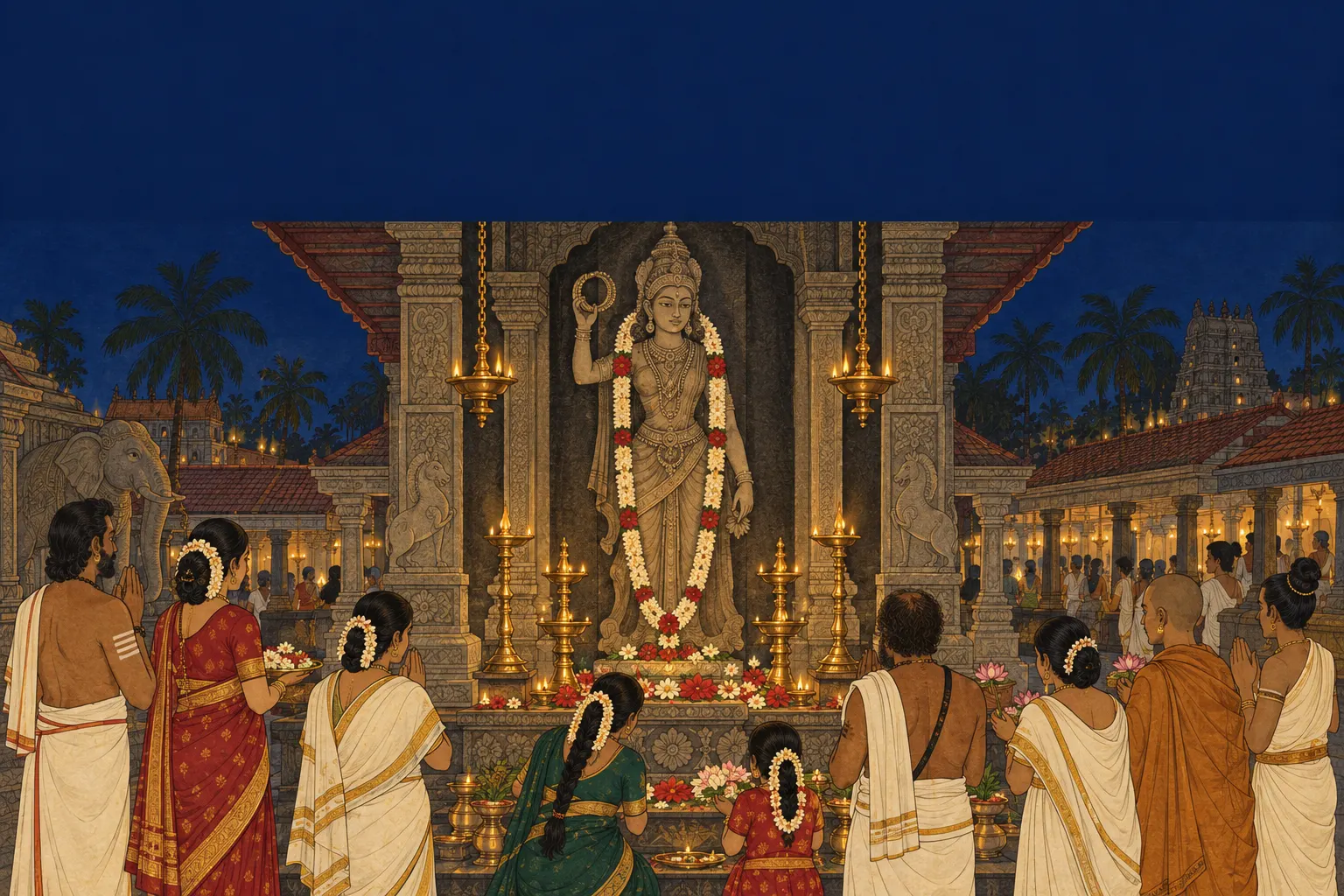
Even today Pattini is worshipped in Kerala and Sri Lanka — a goddess from a Tamil poem, still binding people together centuries later
Pattini in Kerala and Sri Lanka
In later centuries the worship of Kannagi/Pattini spread beyond Tamil Nadu. In Kerala a local tradition about the Kodungallur Bhagavati temple, in the old Chera capital region, is said to be linked to Kannagi. In Sri Lanka both Sinhala Buddhists and Tamils have worshipped Pattini — in the Eastern Province there are more than sixty "Kannaki Amman kovils" (temples). Sri Lankan tradition also says that Gajabahu himself brought back an anklet of Pattini to Lanka and built a temple there — but some scholars hold the opposite, that this worship began in the 13th century and the Gajabahu story was added later to give it legitimacy. The Manimekalai, the story of Kovalan and Madhavi's daughter Manimekalai, is counted as this poem's sequel. This retelling sets out both views openly and takes neither side.
Modern memory
In the twentieth century Kannagi's story also became tied to Tamil identity politics — the 1942 film *Kannagi*, the 1964 film *Poompuhar* with a screenplay by M. Karunanidhi, Jeyamohan's novel *Kotravai* (2005), and Amritlal Nagar's Hindi novel *Suhag Ke Nupur* (1960). The statue of Kannagi on Chennai's Marina Beach was removed in 2001. The government gave reasons of a damaged pedestal and safety or traffic; the opposition challenged that explanation and alleged political and astrological motives as well. On 3 June 2006 the statue was reinstalled at the same Marina site.
A careful tribute
The Silappadikaram is often compared, as a foundational classic of Tamil literature, to epic traditions such as the Greek *Iliad* and *Odyssey*. But this story is worth remembering in all its complexity — a woman who burns a whole city over her husband's death; an authorial tradition whose religious identity remains disputed; a history that still does not know its own date. That complexity makes it not merely a heroic tale, but one that still gives rise to both argument and reverence today.
Source: Tamil epic — the Silappadikaram (traditionally by Ilango Adigal), Pattini