
Chapter 1
Why This Story Is Told
The story of an anklet — in which a king dies, a city burns, and a woman becomes a goddess
Three truths
In the prologue of the Silappadikaram, the poem announces three truths that the whole story then sets out to prove. First, that when a king strays from the path of dharma, dharma itself becomes the god of death to him. Second, that even the great will honour a chaste and faithful woman. Third, that fate always bears its fruit, and no one can escape it.
The story ties all three together — a king whose verdict was given without any inquiry; a woman who rises before an entire city as a goddess; and a debt from a past life that returns as the death of an innocent man.
The author, by tradition
Tradition says the poem was composed by Ilango Adigal — the younger brother of the Chera king Senguttuvan, who heard an astrologer predict that he would be the one to become king, and turned ascetic so that the prophecy could never come true. But scholars disagree about this too — this part of the prologue may have been added later than the rest of the poem, and no contemporary Sangam literature mentions Ilango Adigal at all. His religion is also unclear — he is usually called a Jain, yet in the poem he takes part in a Vedic sacrifice. This retelling does not hide these disputes; it states them openly.
The date is not settled either — the proposed dates differ widely. One basis for the earlier date is the Gajabahu synchronism — the mention, near the poem's end, of the Sri Lankan king Gajabahu, whose time is known from history to some degree; many modern scholars, however, place the poem around the 5th-6th century. This dispute is taken up in later chapters.
Three crowns, one anklet
The poem is divided into three books, and each is named for the capital of one of the three great Tamil kingdoms of the time — Puhar (capital of the Cholas), Madurai (capital of the Pandyas), and Vanji (capital of the Cheras). In Dikshitar's translation the poem runs to thirty cantos in all — ten in the Puhar book, thirteen in the Madurai book, seven in the Vanji book.
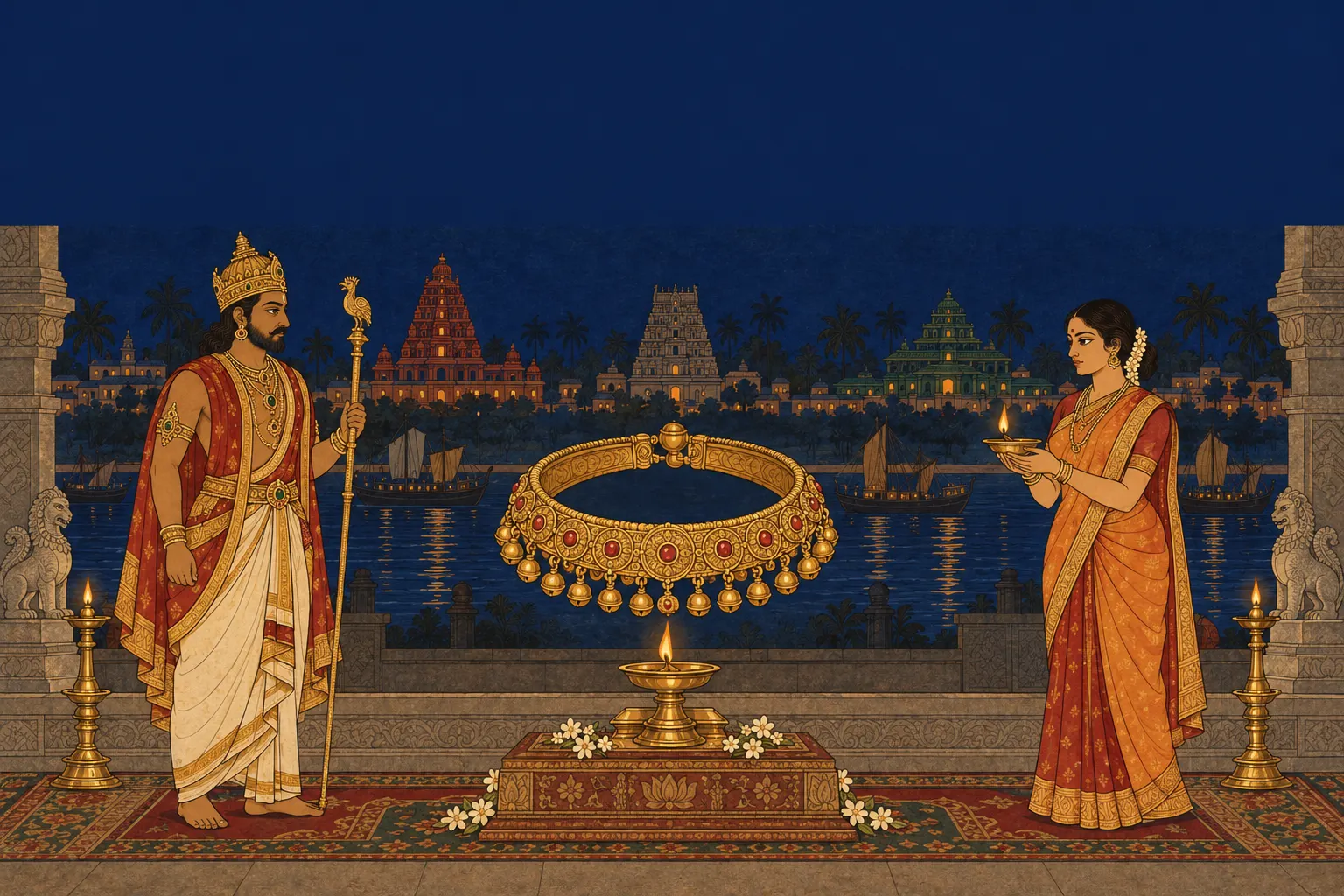
And at the centre of this entire story lies one very small object — a woman's anklet. That anklet gives a broken marriage the capital for a fresh start, becomes the reason for a trading journey, is the root of a false accusation, causes a king's death, and at the end is broken open as proof of innocence. That is why the poem is called Silappadikaram — "the story of the anklet."
Source: Tamil epic — the Silappadikaram (traditionally by Ilango Adigal), Why This Story Is Told