
Chapter 9
The Unfinished Spell, the Three Hands
A gambler Brahman's son who did not succeed in his spell, and a king at whose offering at Gaya three hands rose from the river — the vetala asked, why, and who gets the pinda?
The Unfinished Spell, the Three Hands is chapter 9 of Vikram and Baital. Source: Baital Pachisi, tales 17 and 18. It is told in 2 scenes — The seventeenth tale: Gunakar and the unfinished spell; The eighteenth tale: Dhanvati's daughter and the thief — followed by 10 quiz questions.
The seventeenth tale: Gunakar and the unfinished spell
Vikram took the vetala down from the tree again, set him on his shoulder and walked on. 'Now hear the seventeenth tale, King,' said the vetala.
King Mahasen ruled in Ujjain. In the same city lived a Brahman named Devsharma, whose son was called Gunakar. Gunakar turned out to be a terrible gambler; he lost all the Brahman's wealth at dice. Then the whole household turned him out. With nowhere else to go he left the city, and some days later he reached another one. There he saw an ascetic sitting before a fire, performing penance by inhaling smoke. He bowed to the ascetic and sat down beside him. 'Will you eat something?' the ascetic asked. 'Maharaj, if you give it to me, I will certainly eat.' The ascetic returned with food heaped in a skull. Gunakar looked at it and said, 'I will not eat food from this skull.'
When he would not eat, the ascetic recited a spell, and an apsara appeared before him with folded hands. 'Maharaj, whatever you command, I will do.' The ascetic said, 'Give this Brahman whatever food he wants.' The apsara conjured a beautiful palace, furnished it with every comfort, took Gunakar there and, seating him on a stool, set before him dish after dish of delicacies. He ate to his heart's content. Then she set the betel box before him, rubbed saffron and sandal into rose-water and applied it to his body, dressed him in perfumed clothes and hung a garland round his neck, and the night passed in the same pleasures.
At dawn the apsara returned to her own place, and Gunakar went to the ascetic and said, 'Master, she is gone. What shall I do now?' The ascetic said, 'She came by the power of a spell, and she stays with the one who holds the knowledge.' 'Master, teach me that knowledge too. I will practise it.' The ascetic gave him the spell and said, 'For forty days, sit in water at midnight and chant it with a steady mind.' Gunakar went every day to chant. All sorts of terrifying things appeared, but none of them frightened him. When the forty days were done he came to the ascetic and said, 'Master, I have chanted for as many days as you told me.' The ascetic said, 'Now chant for as many days again, sitting in fire.' 'Master, let me first visit my family. Then I will come back and chant.'
With that he went home. His relatives, seeing him, embraced him and began to weep. His father said, 'Gunakar, my son, where have you been all these days? Why did you forget your home? It is said that a man who abandons a faithful wife and lives apart, who ignores a woman who loves him, is the lowest of the low. No duty equals the duties of a householder, and no one gives as much happiness as the woman of one's own house. Those who dishonour their parents are sinners and will never find release.'
Gunakar said, 'This body is made of flesh and blood, which is food for worms. Neglect it for a single day and it begins to stink. Those who love it are fools; those who set their hearts elsewhere are wise. It is born and dies, again and again. What trust can one place in it? However much you wash it, it is like an earthen pot full of filth, never clean on the inside, or like charcoal, which does not turn white however you scrub it. Whose father, whose mother, whose wife, whose brother? The way of the world is that many come and many go. I will not take on these householder's duties. I will practise meditation.' So saying, he took leave of his family, went back to the ascetic and chanted the spell sitting in fire. The apsara did not come. He went to the ascetic, who asked, 'Did the knowledge come to you?' 'Master, no,' he said. 'It did not.'
When he had finished the tale, the vetala asked, 'King, tell me, why did the knowledge not come to him?' The king said, 'The mind of the one who practised was in two places, so it did not succeed. It is said that a spell is won by a single mind, and one whose mind is divided will not win it.' The vetala asked, 'How can a man who sits in fire to practise be called double-minded?' The king said, 'When he went to see his family, the ascetic thought in irritation, "Why did I teach this art to a man who wavers so?" That is why it failed. And it is said that however hard a man may strive, fate goes with him.' At this the vetala hung himself on the tree again, and the king took him down, tied him up, put him on his shoulder and walked on.
The eighteenth tale: Dhanvati's daughter and the thief
As they walked, the vetala said, 'Now the eighteenth tale, King.'
In the city of Kubalpur ruled King Sudakshi. A merchant named Dhanakshi lived there, and his daughter was Dhanvati. He married her in her childhood to a merchant named Gauridatt. In time Dhanvati had a daughter, whom she named Mohini. When the girl was a few years old her father died, and Gauridatt's relatives seized all his property. Helpless, Dhanvati left the house in the dark of night with her daughter and set out for her parents' home.
After a short way she lost the road and found herself in a cremation ground, where a thief was impaled on a stake. Without meaning to, she touched his foot with her hand. The thief cried out, 'Who just hurt me?' 'I did not hurt you on purpose,' said Dhanvati. 'Forgive my fault.' The thief said, 'No one gives anyone pain or pleasure; each man receives what the Creator has decreed. Those who say "I did this" and "I did that" are fools. Man is tied to the rope of fate, and it drags him wherever it pleases.'
'Brother, who are you?' asked Dhanvati. 'I am a thief,' he said. 'Today is my third day on the stake and my life will not leave me.' 'Why not?' she asked. The thief said, 'I am unmarried. Give me your daughter in marriage and I will give you ten million gold coins.' It is said that greed is the root of all evil. In the end greed overcame Dhanvati, and she agreed to give her daughter. 'I would like you to have a son,' she said, 'but how can that be?' The thief said, 'When she is grown, send a handsome Brahman to her with five hundred gold coins, and she will have a son by him.'
Hearing this, Dhanvati had four rounds made round the stake and married her daughter to him. The thief said, 'East of here there is a large masonry well with a banyan tree beside it. The gold coins are buried under it. Go and take them.' With that he died. Dhanvati went there, dug up some of the buried coins and came to her parents' house. She told them everything, then took them with her to her husband's city. There she built a large house and lived in it, and the girl grew up.
When she was a young woman, she stood one day on the roof with a friend, watching the road, when a young Brahman passed by. At the sight of him she was bewitched. 'Friend, bring this man to my mother,' she said. The friend brought the Brahman to the mother, who said, 'Brahman, my daughter is young. If you will stay with her so that she may have a son, I will give you a hundred gold coins.' 'Very well,' he said. He was given a meal, and some time later the girl conceived. When her time was complete, she bore a son.
On the sixth night the girl's mother dreamed that an ascetic with matted hair stood before her, a moon shining on his forehead, ashes on his body, a sacred thread across his shoulder, a necklace of white snakes and a string of skulls round his neck, a skull in one hand and a trident in the other. In his terrifying form he said, 'Tomorrow at midnight put a bag of a thousand gold coins in a basket, lay this boy in it and leave the basket at the palace gate.' Her eyes opened. In the morning she told her own mother everything. The next day her mother did exactly as directed, laid the boy in a basket and left it at the king's gate.
In the palace the king too had a dream: a figure with ten arms and five heads, each head with three eyes and a moon on its brow, a trident in its hand. It said, 'King, a basket lies at your door. Bring in the boy who is inside it. He will rule your kingdom.' The king woke. He told the queen everything, then got up and went to the door. When he opened the basket he found a boy and a bag of a thousand gold coins. The king lifted the child himself, told the guards to bring in the bag, and laid the boy in the queen's lap.
At dawn the king summoned astrologers and pandits and asked, 'What marks of kingship do you see in this child?' One of them, who could read the marks of the body, said, 'Maharaj, three marks are clear in the boy: a broad chest, a high forehead and a large face. All thirty-two marks that are counted in a man are in him. Do not worry, he will rule.' The king was pleased. He took a string of pearls from his own neck and gave it to the Brahman, gave great gifts to all the Brahmans and had the boy named. The astrologer, choosing an auspicious hour, named the child Hardatt. He grew day by day. By the age of nine he had studied the six shastras and fourteen sciences and become a great scholar. In the meantime, by the will of fate, the king and queen died, and Hardatt took the throne and ruled justly.
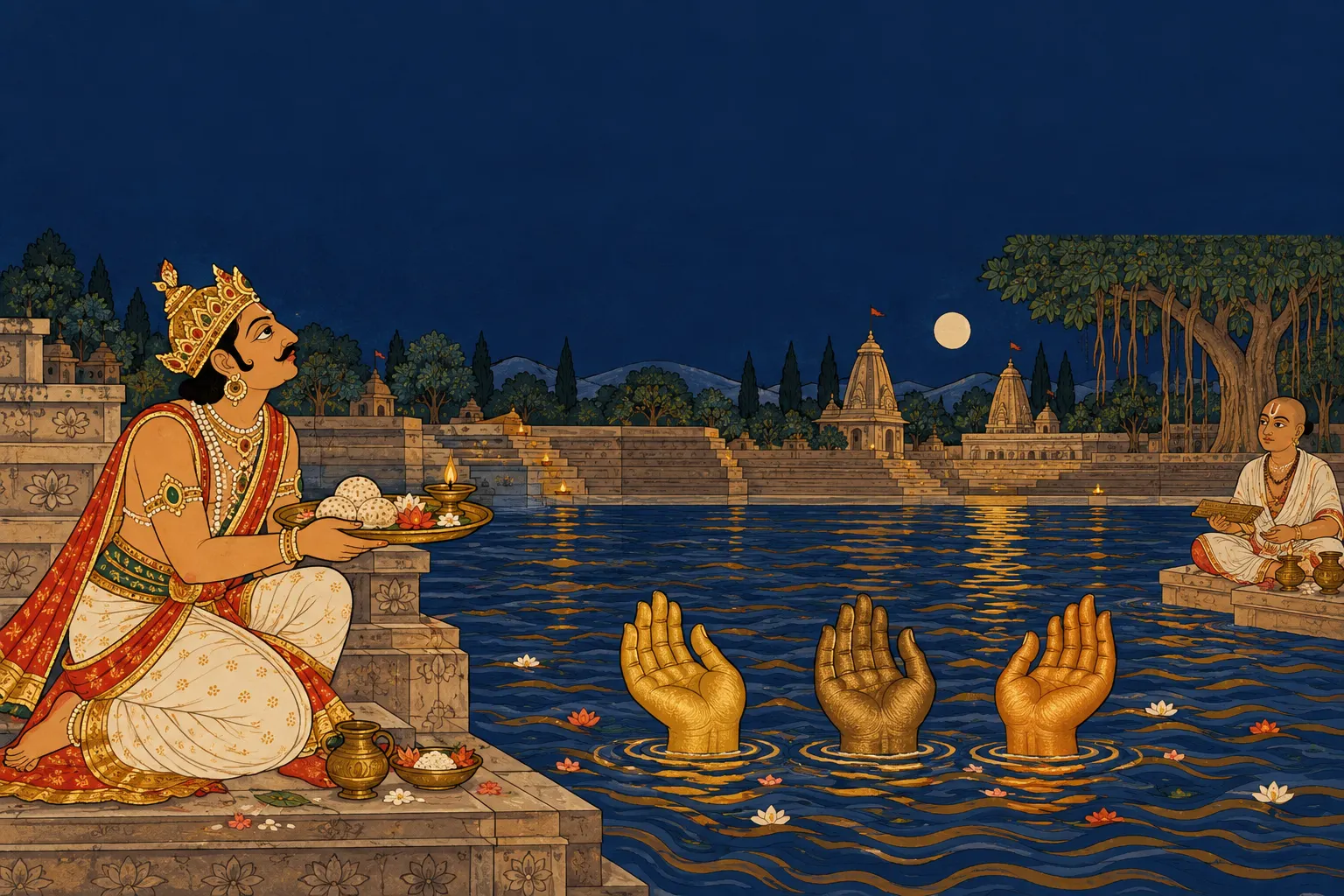
Some years later the king thought one day, 'What have I done for my parents, in whose house I was born? Those who perform shraddha and pinda without faith and in pride gain nothing, and their ancestors depart with their wishes unfulfilled.' So he resolved to perform the shraddha for his ancestors. King Hardatt came to Gaya, called out the names of his ancestors and began to offer pinda on the bank of the Falgu river, when three hands rose out of the water. He was troubled at the sight, wondering to which hand he should give the offering and to which he should not.
When he had finished the tale, the vetala asked, 'King, tell me, to which of the three was it right to give the pinda?' The king said, 'To the thief.' 'Why?' said the vetala. The king said, 'The Brahman's seed was bought, and the king took a thousand gold coins and raised the boy. Neither of those two has any claim on the pinda.' At this the vetala hung himself on the tree again, and the king took him down, tied him up, put him on his shoulder and walked on.
Note: This chapter is written from tales 17 and 18 of the popular Hindi tradition of the Baital Pachisi (Lallu Lal's text, in John Platts' 1871 English translation). In tale 18 the text describes child marriage and getting a son for money, which is hard by today's standards; here it is told only for the sequence of the tale, without detail. In tale 17 the text's description of the night spent with the apsara is long; it is left out here. Names are as in the text: Mahasen, Devsharma, Gunakar, Dhanvati, Mohini, Hardatt, Sudakshi.
Source: Baital Pachisi — Lallu Lal's Hindi Baital Pachisi (1805), in the text rendered by Duncan Forbes, The Unfinished Spell, the Three Hands