
Chapter 1
The Fruit of Immortality
A fruit passed from king to queen, from queen to the city guard, from the guard back to the king — and because of it one king became a hermit and another walked toward the cremation ground
The Fruit of Immortality is chapter 1 of Vikram and Baital. Source: Baital Pachisi, the frame story (Dharanagar, Bhartrihari's fruit, Shantshil, the shirish tree). It is told in 5 scenes — The fruit that came back; The empty throne; Shantshil's fruit; A night in the cremation ground; On his shoulder — followed by 10 quiz questions.
The fruit that came back
Dharanagar was ruled by King Gandharvasen, who had four queens and six sons, each more learned and more powerful than the last. When Gandharvasen died, his eldest son Shankh succeeded him. Before long, however, his younger brother Vikram killed him, seized the throne and proved an able ruler. His glory spread until he was lord of all India, and he began an era of his own.
(The text tells of Vikram's rise to the throne in just these few words. Everything that follows concerns this same Vikram.)
In time Vikram grew curious about the distant lands whose names he kept hearing. He left the kingdom in the care of his younger brother Bhartrihari, put on a hermit's robe and set out to wander from country to country and forest to forest.
In the same city lived a Brahman devoted to austerities. One day a god gave him a fruit that would make whoever ate it immortal. The Brahman went home and told his wife, 'Whoever eats this will never die. The god told me so himself.' His wife began to weep. 'That is no blessing, it is a calamity! How long are we to go on begging for our bread if we cannot even die? Better to die and be free of the world's sorrows.' The Brahman said, 'I brought the fruit home, but your words have left me bewildered. Tell me what to do and I will do it.' She said, 'Give the fruit to the king and take a reward from him. Then we can enjoy comfort in this world and, by giving, earn merit for the next.'
The Brahman went to King Bhartrihari, blessed him and explained what the fruit could do. 'Maharaj, please accept it, and reward me as you think fit. Nothing would please me more than to see you live long.' The king gave him a hundred thousand rupees and sent him away. Then he went into the palace and gave the fruit to the queen he loved best. 'Eat this,' he said. 'You will never die, and you will stay young for ever.' She took it, and the king went out to hold court.
The queen had a lover, the city's chief guard, and she gave the fruit to him. The guard in turn had a friend, a courtesan, and he gave it to her, telling her what it could do. She thought, 'This fruit is fit for a king,' and carried it to Bhartrihari as a gift. The king rewarded her richly and sent her away.
Holding the fruit in his hand, the king fell into deep thought, and his heart turned away from the world. 'The wealth of this world is fleeting and worth nothing,' he said. 'In the end it leads only to hell. Better to do good and remember God, so that the next life may be better.' He went to the queen and asked, 'What did you do with that fruit?' 'I ate it,' she said. The king took out the very same fruit and showed it to her. She went pale and could not say a word. He came out, had the fruit washed and ate it himself. Then he renounced his kingdom, put on a hermit's robe and walked into the forest, taking no companion and speaking to no one.
The empty throne
Vikram's throne stood empty. When the news reached Indra, he sent a demon to guard Dharanagar, and the demon kept watch over the city day and night. Slowly the word spread from land to land that King Bhartrihari had abandoned his kingdom. Vikram heard it too, and hurried home.
It was the middle of the night when he reached the city, and the demon barred his way. 'Who are you? Where are you going? Stop, and give me your name.' 'I am King Vikram,' said the king, 'and I am going into my own city. Who are you to stop me?' The demon said, 'The gods sent me to guard this city. If you really are Vikram, fight me first, and then go in.'
Vikram tightened his belt and challenged the demon. The demon drew himself up to his full height and the wrestling began. In the end the king threw him down and knelt on his chest. 'King, you have beaten me,' said the demon. 'I give you your life.' Vikram burst out laughing. 'Have you lost your senses? You are the one at my mercy. How can you claim to spare my life?' The demon said, 'King, I am the one who can save you from death. Listen to one story of mine first, and then go and rule the whole earth without fear.' The king let him up and listened closely.
The demon said, 'You were born together with two others, under the same star, in the same conjunction, in the very same moment: you in a king's house, one in an oilman's house, and one, who became an ascetic, in a potter's house. You rule here. The oilman's son became king of the underworld. But the potter's son has perfected his austerities, killed the oilman, hung him upside down from a shirish tree in the cremation ground and turned him into a vetala. Now he wants to kill you. If you escape him, you will rule in peace. That is all I have to tell you. Do not let down your guard.' With that the demon left, and the king went into his palace.
The next morning the king held a public audience. Servants of every rank came and presented gifts, drums sounded through the city, and every house rang with song and dance. After that the king ruled with justice.
Shantshil's fruit
One day, they say, an ascetic named Shantshil came to the king's court carrying a fruit. He offered it to the king, spread a cloth, sat for a while and went away. The king wondered whether this might be the man the demon had spoken of, and his suspicion kept him from eating the fruit. He called the treasurer and told him to store it safely. The ascetic came every day in the same way and left one fruit each time.
One day the king went with a few servants to look over the stables. The ascetic arrived there too and gave him the fruit as usual. The king was tossing it in the air when it slipped from his hand and fell, and a monkey snatched it up and tore it open. Out of it came a ruby so brilliant that the king and his servants stared in astonishment. 'Why did you give me this ruby?' the king asked the ascetic.
The ascetic said, 'Maharaj, the scriptures say that no one should visit a king, a teacher, an astrologer, a physician or his daughter's house empty-handed, for a gift in such places brings a reward. What is one ruby? Every fruit I have given you has a jewel inside.' The king at once ordered the treasurer to bring out every fruit he had stored. They were broken open one by one, and every fruit held a ruby. Delighted, the king called in a jeweller to appraise them. 'We take nothing with us when we die,' he said. 'A man's integrity is the one wealth that remains. Tell me honestly what each jewel is worth.'
The jeweller said, 'Maharaj, you are right. A man who keeps his integrity has lost nothing that truly matters; it goes with him into both worlds. Look at them: every stone is flawless in colour, quality and cut. Even if I named ten million rupees for each, it would be too little. In truth each jewel is worth a kingdom.' The king was pleased and sent the jeweller away with a robe of honour. Then he took the ascetic by the hand, seated him on the throne and said, 'My whole kingdom is not worth one of these jewels. Tell me, why would an ascetic give me so many?'
The ascetic said, 'Maharaj, some matters are not spoken of before others: spells and charms, medicines, religious rites, household affairs, the eating of foul meat, and slander one has heard. I will tell you in private. It is said that a secret heard by three ears is no secret; one heard by two ears no one will hear; and one known to a single ear, not even Brahma can learn, let alone a man.' The king drew him aside and said, 'Holy one, you have given me all these jewels and have not accepted even a mouthful from me. You have shamed me. Tell me what you want.'
The ascetic said, 'Maharaj, I am about to perform a rite in a great cremation ground on the bank of the Godavari, and it will give me supernatural powers. Spend one whole night with me there; with you beside me my practice will succeed.' The king said, 'Very well, I will come. Name the day.' The ascetic said, 'On the evening of a Tuesday in the dark half of the month of Bhadon, come to me alone and armed.' 'You may go,' said the king. 'I will certainly come, and I will come alone.'
A night in the cremation ground
Having secured the king's promise, the ascetic went to a temple, made his preparations, gathered everything he needed and settled in the cremation ground. The king, meanwhile, was left with his thoughts. Then the appointed hour came. He buckled on his sword, tightened his belt, went alone through the night to the ascetic and bowed to him. The ascetic told him to sit. All around, the king saw ghosts, spirits and witches dancing in every frightful shape, and in the middle of them the ascetic sat chanting. Vikram felt no fear. 'What are your commands for me?' he asked.
The ascetic said, 'King, now that you are here, do this. Two kos south of this place is another cremation ground, and in it stands a shirish tree. A corpse hangs from it. Bring it here at once, to where I shall be at my practice.' He sent the king off and settled himself on his seat to chant.
The night was dark enough to be frightening, and the rain came down as though it meant to pour itself out that very night. The ghosts and spirits made such a din that even great heroes would have flinched. But the king kept walking. Snakes came again and again and coiled around his feet, and he recited a spell and shook them off. At last, by some means, he got through the difficult road and reached that cremation ground. There ghosts were seizing men and killing them, witches were chewing on children's livers, tigers roared and elephants trumpeted. He looked at the tree and saw every branch and leaf of it, from root to crown, in flames, while from every side a cry went up: 'Kill him! Seize him! See that he does not escape!'
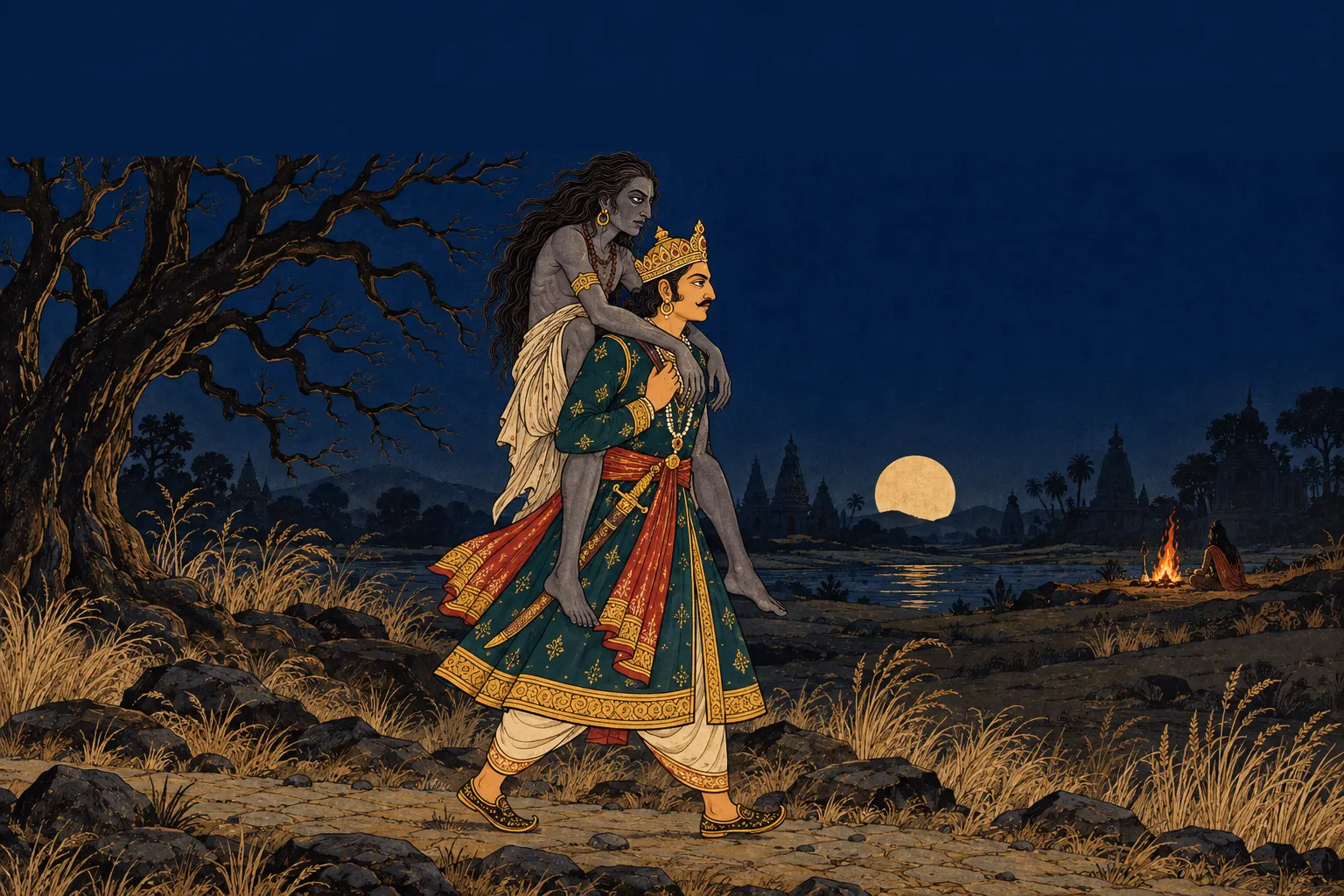
None of it frightened him. 'This must be the very ascetic the demon told me about,' he said to himself. He went closer and saw a corpse hanging upside down, bound with a rope. Glad that his labour was nearly over, he took up sword and shield, climbed the tree boldly and struck so that the rope was cut and the corpse fell. The moment it hit the ground it began to wail loudly. Hearing it, the king was pleased: 'Why, it is alive.' He climbed down and asked who it was. At that the corpse burst out laughing, and the king stared. Then the corpse leapt up the tree and hung there upside down again. The king climbed up at once, tucked it under his arm and carried it down. 'Wretch, tell me who you are.' The corpse gave no answer. The king thought, 'Perhaps this is the oilman the ascetic put in the cremation ground.' He wrapped it in his cloak and set off toward the ascetic. Whoever shows such courage will surely succeed in what he undertakes.
On his shoulder
Then the vetala riding on his shoulder spoke. 'Who are you, and where are you taking me?' 'I am King Vikram,' said the king, 'and I am taking you to an ascetic.' The vetala said, 'I will come on one condition. If you speak a single word on the road, I will go straight back.' The king agreed and walked on.
After a while the vetala said, 'King, the days of the learned, the sensible and the wise pass in the pleasure of song and scripture, while fools spend theirs in indulgence and sleep. So let us pass this long road in hearing something worthwhile. I will tell you a story, King. Listen carefully.'
Note: This chapter is written directly from the popular Hindi tradition of the Baital Pachisi (Lallu Lal's text, in John Platts' 1871 English translation). In this form the king is called Vikram (Bir Vikramajit), the city is Dharanagar and the ascetic is Shantshil; in Somadeva's Kathasaritsagara the king is Trivikramasena, the city is Pratishthana and the ascetic is Kshantishila. Two things in the text are deliberately kept short or left out of this chapter: the account of how Vikram took the throne (including the killing of his brother) is only one sentence, and the earlier-birth tale the demon tells (about the courtesan and the ascetic hung upside down) is left out entirely. The text mentions the queen's love affair; it is stated here as a fact, without elaboration. Names are as in the text: Gandharvasen, Shankh, Vikram, Bhartrihari, Shantshil, Dharanagar.
Source: Baital Pachisi — Lallu Lal's Hindi Baital Pachisi (1805), in the text rendered by Duncan Forbes, The Fruit of Immortality