
Chapter 4
The Swapped Heads, the King's Servant
Breaking a vow made before the Goddess cost three lives, and when she revived them in a hurry the heads were swapped — and a king repaid his servant for a hungry night in an unusual way
The Swapped Heads, the King's Servant is chapter 4 of Vikram and Baital. Source: Baital Pachisi, tales 6 and 8. It is told in 2 scenes — The sixth tale: a vow before the Goddess; The eighth tale: the king and his servant — followed by 10 quiz questions.
The sixth tale: a vow before the Goddess
Vikram took the vetala down from the tree and walked on, and the vetala said, 'Now hear the sixth tale, King.'
There was a city named Dharmpur, whose king was Dharmshil and whose minister was Andhak. One day the minister said, 'Maharaj, build a temple to the Goddess, set up her image and worship her every day. The scriptures promise great merit for it.' The king built the temple, installed an image of the Goddess and began to worship her according to the Vedic rites. He would not drink even water without having worshipped first.
After some time the minister said, 'Maharaj, you must have heard it said that a house without a son is empty, a fool's mind is empty, and for a poor man everything is empty.' The king went to the Goddess's temple and said with folded hands, 'O Goddess, Brahma, Vishnu, Rudra and Indra wait all day for your command. You killed demons like Mahishasur, Chand-Mund and Raktabij and eased the earth's burden. Wherever your devotees have fallen into danger, you have come to their aid. In that hope I have come to your threshold. Grant the wish of my heart as well.' A voice came from the temple: 'King, I am pleased with you. Ask any boon you wish.' 'Mother,' said the king, 'if you are pleased, give me a son.' The Goddess said, 'You will have a strong and renowned son.' The king went on worshipping with sandalwood, rice, flowers, incense, lamps and offerings, and some days later a son was born to him. He went to the temple with his family, to the sound of music and drums, and worshipped the Goddess.
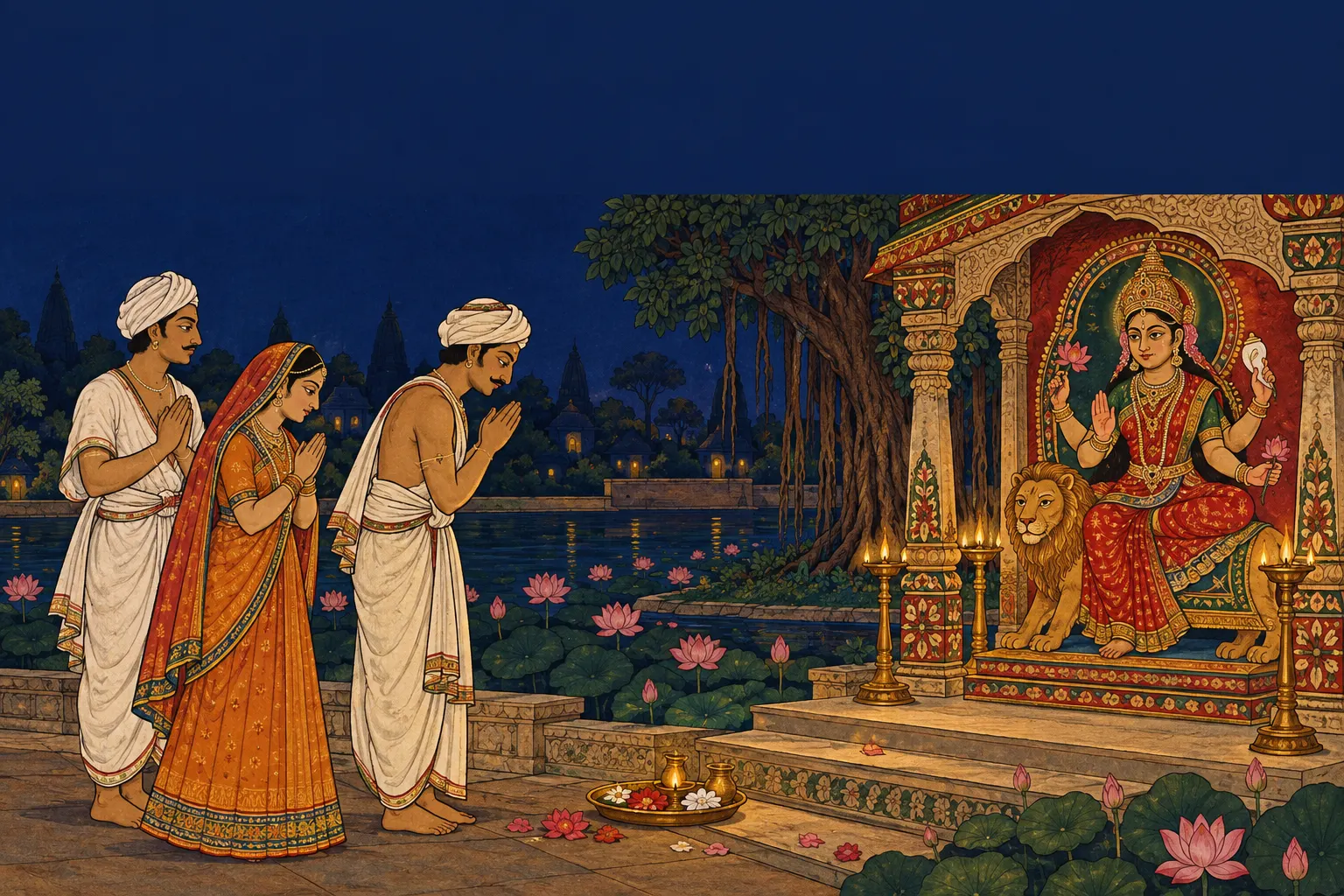
In those same days a washerman was travelling with a friend from another town toward this one when he saw the Goddess's temple. He decided to stop and bow to her. At that moment he saw a very beautiful washerman's daughter coming toward him, and at the sight of her he was bewitched. He went in to worship, bowed with folded hands and said in his heart, 'O Goddess, if by your grace I am married to this beauty, I will offer you my head.' Having made this vow, he went back to his own town with his friend.
Back home, he grew so restless in longing that he forgot sleep, hunger and thirst and thought of nothing but her all day. Seeing his state, his friend told his father everything. The father was alarmed; if his son did not marry that girl, he feared, the boy would die of grief. So he took his son's friend with him, went to the girl's town and said to her father, 'I have come to ask you for something. If you give me your word, I will tell you.' 'Whatever I have, I will certainly give,' said the girl's father. 'Then give your daughter in marriage to my son.' He agreed. A pandit was called, the day, the auspicious moment and the hour were fixed, and he said, 'Bring your son, and I will give my daughter's hand in marriage.' The washerman's father went home, gathered what was needed for a wedding and returned with the wedding procession, and the marriage was held. Then he took his son and daughter-in-law home, and the two lived happily.
After some time there was a festival at the girl's father's house, and an invitation came for them too. Husband and wife made ready and set out for that town with the friend. As they drew near they saw the same temple of the Goddess, and the washerman remembered his vow. 'I am a liar and a sinner,' he thought. 'I lied to the Goddess herself.' He said to his friend, 'Wait here. I will go for the Goddess's darshan,' and told his wife to wait as well. He went to the temple, bathed in the pond, bowed before the Goddess with folded hands and, keeping his word, offered up his life to her.
(The text goes on to tell how the friend, and then the wife, went looking for him and reached the temple. Thinking that people would blame them and say he had been killed so that someone could have his beautiful wife, they too gave up their lives. That detail is kept restrained here.) When the wife was about to give up her life, the Goddess came down from her throne, took her hand and said, 'Daughter, ask a boon; I am pleased with you.' 'Mother, if you are pleased,' she said, 'revive these two.' The Goddess said, 'Join their heads to their bodies.' In the haste of her joy she joined the heads to the wrong bodies. The Goddess sprinkled the water of life and both rose up alive. They began to quarrel. One said, 'This is my wife.' The other said, 'No, she is mine.'
When he had finished the tale, the vetala asked, 'King Vikram, tell me: which of the two does that woman belong to?' The king said, 'The rule is written in the Dharmashastra: among rivers the Ganga is best, among mountains Sumeru, among trees the Kalpavriksha, and among the limbs the head. By that rule, she is the wife of the man whose body carries her husband's head.' At this the vetala flew back and hung himself on the tree. The king took him down, put him on his shoulder and walked on.
The eighth tale: the king and his servant
(The seventh tale is left out of this book.) 'And now the eighth tale, King,' said the vetala.
In the city of Mithilavati ruled King Gunadhip. A young Rajput named Chiramdeva came from a distant country to serve him. Every day he went to salute the king, but could never obtain an audience. In this way, within a year all the money he had brought was spent, and meanwhile his household at home fell apart.
One day the king rode out to hunt and Chiramdeva went along with his party. In the forest the king found himself alone. The other servants had strayed into a different part of the forest, and only Chiramdeva kept galloping behind him. At last he called out, 'Maharaj, all the servants are left behind. I have brought my horse level with yours, and I am with you.' The king reined in and he rode up. The king looked at him and asked, 'How did you grow so thin?'
Chiramdeva said, 'If I serve a master who feeds thousands but never gives me a thought, the fault is not the master's but my fate's. In daylight the whole world is plain to see, but the owl cannot see it; is that the sun's fault? I wonder that he who saw to it that my belly was filled while I was still in my mother's womb should now forget me, when I am born and fit to enjoy life. I do not know whether he is asleep or dead. As I see it, better to drink poison and die than to beg money from a great man who twists his mouth, wrinkles his nose and knits his brows as he gives. Six things make a man small: friendship with the faithless, laughing for no reason, quarrelling with a woman, serving a bad master, riding a donkey and coarse speech. And five things the Creator writes into a man's fate at birth: his age, his deeds, his wealth, his learning and his fame. Maharaj, as long as a man's virtues shine, everyone is his servant; once they fade, even friends turn to enemies. Even so, one thing is certain: the reward of serving a good master comes, sooner or later.'
The king heard all this and weighed it in his mind, but said nothing. He only said, 'I am hungry. Fetch me something to eat from somewhere.' 'Maharaj, there is no bread to be had here,' said Chiramdeva. With that he went into the forest, killed a deer, struck a flint from his pocket and lit a fire, roasted pieces of the meat and fed the king his fill, and ate some himself. When the king was satisfied he said, 'Now, Rajput, take me back to the city. I do not know the way.' Chiramdeva brought him safely to the palace. The king took him into his service and gave him many fine clothes and ornaments, and from then on he lived close to the king.
One day the king sent him on an errand to the seashore. There he saw a temple of the Goddess and went in to worship. As he came out, a beautiful girl came up behind him and asked, 'What brings you here?' 'I came looking for happiness,' he said, 'and your beauty has bewitched me.' She said, 'If you have a wish, first bathe in this pond and come back, and then I will hear you.' He took off his clothes and dived into the pond, and the moment he came up he found himself standing in his own city! Terrified at the marvel, he went helplessly home, put on his clothes and told the king the whole story.
'Show me this wonder too,' said the king. Horses were brought and the two set out. After many days they reached that same temple by the sea and worshipped. When the king came out, the same girl appeared with a friend. At the sight of the king she was bewitched and said, 'Maharaj, whatever you command, I will do.' The king said, 'If you will obey my command, become my servant's wife.' 'I have become the slave of your beauty,' she said. 'How can I be his wife?' The king said, 'You just promised that you would obey whatever I command. Good people keep their word. Keep yours and become my servant's wife.' Hearing this she said, 'Your word is law to me.' Then the king, without ceremony, gave her in marriage to his servant and brought them both back to his palace.
When he had finished the tale, the vetala asked, 'King, tell me: whose virtue was greater, the master's or the servant's?' The king said, 'The servant's.' 'Is the king's not greater,' said the vetala, 'who won so beautiful a woman and gave her to his servant?' King Vikram said, 'It is a master's very duty to do good to his servant. What is great in that? The man who does good to another even when his own interest lies the other way is the great one. So the servant's virtue was greater.' At this the vetala vanished from his shoulder, and the king took him down again from that same tree and walked on.
Note: This chapter is written directly from tales 6 and 8 of the popular Hindi tradition of the Baital Pachisi (Lallu Lal's text, in John Platts' 1871 English translation). In tale 6 the text's detail of the three self-sacrifices is left out; only what the sequence of the tale needs is given. Tale 7 (whose riddle is decided by caste) is not included in this book. In tale 8 the girl's being 'given' to a servant is in the text in that form, along with a line of her consent; this is the view of that era, not of this website. Chiramdeva's maxims such as 'six things make a man light' are that character's. Names are as in the text: Dharmshil, Andhak, Gunadhip, Chiramdeva, Mithilavati.
Source: Baital Pachisi — Lallu Lal's Hindi Baital Pachisi (1805), in the text rendered by Duncan Forbes, The Swapped Heads, the King's Servant