
Chapter 5
The Thief's Restraint, the Delicate Queens
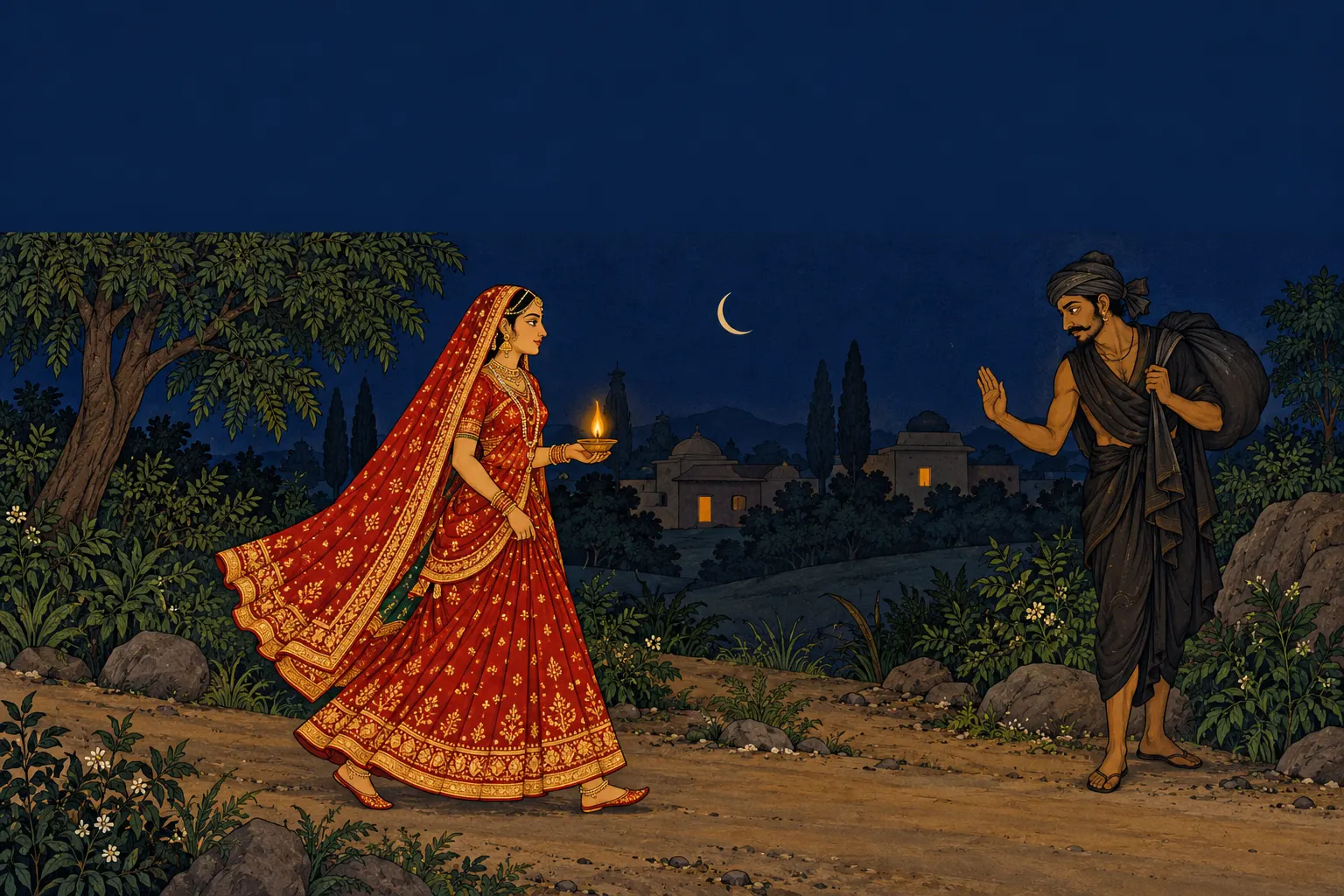
A new bride walking alone at midnight met three men — her husband, her lover and a thief — and the one with the least reason to let her go was the one who did
The Thief's Restraint, the Delicate Queens is chapter 5 of Vikram and Baital. Source: Baital Pachisi, tales 9 and 10. It is told in 2 scenes — The ninth tale: Madansena's promise; The tenth tale: three delicate queens — followed by 10 quiz questions.
The ninth tale: Madansena's promise
Vikram lifted the vetala down from the tree again and set him on his shoulder. 'Listen, King,' said the vetala. 'This is the ninth tale.'
In the city of Madanpur there was a king named Beerbar. In the same city lived a merchant named Hirandatt, whose daughter was Madansena. One spring day she went to walk in a garden with her friends. A little before her, Somdatt, the son of the merchant Dharmadatt, was coming back from a stroll in the same forest with a friend and wandered into that same garden. He saw Madansena and was bewitched. 'Brother,' he said to his friend, 'if I can have her, my life is fulfilled; if not, it is wasted.'
In the restlessness of his longing Somdatt went up to her and said, 'If you will not give me your love, I will give up my life for you.' 'Do not,' said Madansena. 'It would be a sin.' Somdatt said, 'Your glances have pierced my heart, and at this moment I cannot tell right from wrong. But if you give me your word, I will have new life.' Madansena said, 'In five days I am to be married. I will come to you first, and afterwards I will stay in my husband's house.' Having given this word and sworn to it, she went home, and Somdatt went to his.
On the fifth day she was married and her husband brought her home as his bride. After some days, the wives of her husband's elder and younger brothers sent her at night to her husband's room. She went in and sat quietly in a corner. Her husband saw her, took her hand and seated her on the bed. But as he was about to come close, Madansena moved his hand away and told him what promise she had made to Somdatt. When he heard it, the husband said, 'If you truly wish to go to him, then go.'
With her husband's leave she set out for Somdatt's house. On the road a thief saw her and came up to her gladly. 'At this midnight hour, in this darkness, dressed like this and wearing all these ornaments, where are you going alone?' he asked. 'To where my beloved lives.' 'And who is your protector here?' 'Kamdev, with his bow and arrows.' She then told the thief the whole story and said, 'Do not spoil my clothes and ornaments. I promise that when I come back from there I will give you all my jewels.' The thief thought: since she is going on the strength of a promise, why should I spoil her clothes? He let her pass and sat down where he was.
Madansena reached the place where Somdatt lay sleeping and woke him suddenly. He sat up in a start. 'Are you the daughter of a god, a sage or a naga? Tell me truly who you are and how you came to me.' 'I am a human woman,' she said, 'Madansena, the daughter of the merchant Hirandatt. Do you not remember that in the garden you took my word and my oath that I would leave my husband and come to you? I have come.' He asked, 'Did you tell your husband this?' 'I told him everything, and knowing it all, he himself let me come.'
Somdatt said, 'That is like ornaments without clothes, or a meal without ghee, or a song out of tune. In the same way dirty clothes spoil beauty, bad food reduces strength, a bad wife takes a man's life and a bad son ruins the family.' (The text gives some further remarks of Somdatt's about women, which are his own disparaging opinion and are left out here.) Then he said, 'I will have nothing to do with another man's wife.' At this she turned back. On the road she met the same thief again and told him everything. The thief praised her warmly and let her go. She came back to her husband and told him all, but he showed her no affection and said, 'The beauty of a cuckoo lies in its voice, of a woman in loyalty to her husband, of an ugly man in his learning, and of an ascetic in his endurance.'
When he had finished the tale, the vetala asked, 'King, of these three, whose quality is the highest?' King Vikram said, 'The thief's.' 'How so?' said the vetala. The king said, 'The husband saw that his wife's heart was elsewhere, and so let her go. Somdatt let her go out of fear of the king. But the thief had no reason at all to release her, and yet he let her pass unharmed. So the thief's quality is the highest.' No sooner had he heard it than the vetala flew back to the tree and hung there as before. The king took him down again, tied him up, set him on his shoulder and walked on.
The tenth tale: three delicate queens
'And now the tenth tale,' said the vetala.
In Bardman, in the Gaur country, King Dharmadhwaj ruled. (The text begins with a long episode about his father and the minister Abhaychand: a religious dispute and the minister's humiliation. It is left out here.) It was spring. The king went with his queens to walk in a garden, where there was a large pond full of blooming lotuses. Charmed by the sight, the king took off his clothes and went down to bathe. He plucked a flower, came to the bank and was about to give it to one of the queens when it slipped from his hand and fell on her foot, and the blow broke her foot. The king was alarmed. He came out of the pond at once and began to arrange medicines and treatment.
In the meantime night fell and the moon rose. As soon as the moonlight touched the second queen, blisters came up on her body. At the same moment the sound of a pestle came from some householder's house, and when it reached the third queen's ears she felt such a sharp pain in her head that she fainted.
When he had finished the tale, the vetala asked, 'King, which of the three was the most delicate?' The king said, 'The one who got a headache from the sound of the pestle and fainted was the most delicate.' At this the vetala vanished from his shoulder, and the king set out to bring him back again.
Note: This chapter is written directly from tales 9 and 10 of the popular Hindi tradition of the Baital Pachisi (Lallu Lal's text, in John Platts' 1871 English translation). In tale 9 the opening scene where Somdatt takes hold of Madansena's hand, and the account of the night after the wedding, are kept restrained, without their detail. Somdatt's disparagement of women and the husband's remark on 'beauty' are the opinions of those characters, not of this website. In tale 10 the first part of the text, a tale of a Jain minister and the king's change of religion and the minister's humiliation, is left out, since it is separate from the riddle of the delicate queens and mocks a religion. This riddle of three delicate queens is also in Chapter 9 of the Kathasaritsagara (there King Dharmadhwaj and queens Indulekha, Taravali and Mrigankavati), but here the queens are unnamed.
Source: Baital Pachisi — Lallu Lal's Hindi Baital Pachisi (1805), in the text rendered by Duncan Forbes, The Thief's Restraint, the Delicate Queens