
Chapter 10
The Deepest Love, Life in the Tiger
Three people reached one pyre and the vetala asked whose love was deepest; then four learned brothers made a tiger from bones — who was the greatest fool?
The Deepest Love, Life in the Tiger is chapter 10 of Vikram and Baital. Source: Baital Pachisi, tales 20 and 21. It is told in 2 scenes — The twentieth tale: Anangmanjari and Kamalakar; The twenty-first tale: the one who gave life to the tiger — followed by 10 quiz questions.
The twentieth tale: Anangmanjari and Kamalakar
Vikram took the vetala down from the tree again, set him on his shoulder and walked on. 'Now the twentieth tale, King,' said the vetala.
In Vishalpur ruled King Vipuleshwar. In his city lived a merchant named Arthdatt, whose daughter was Anangmanjari. He had married her to Munni, a merchant of Kanwalpur. Some days later Munni crossed the sea on a trading voyage, and in the meantime Anangmanjari came of age. One day she was standing in the pavilion, watching what passed on the road, when a Brahman's son named Kamalakar walked by. Their eyes met, and at that first glance the two fell in love. A little later Kamalakar, recovering himself, went in his restlessness to his friend's house. At home Anangmanjari too was in great distress without him, when her friend came and took charge of her; but she was beside herself. The friend sprinkled her with rose-water and held perfume to her nose, and as her senses returned she began to reproach Kamdev.
Evening fell and the moon rose. Looking at the moonlight she said, 'Moon, I used to hear that you hold nectar and shed it on the world. Today you too have begun to rain poison.' She said to her friend, 'Lift me up and take me away from here; the moonlight is burning me.' The friend took her to the pavilion and said, 'Do you feel no shame, speaking like this?' She said, 'Friend, I know it all, but Kamdev has made me shameless. However hard I try to be patient, the more I burn in the fire of separation, the more the house seems like poison.' The friend said, 'Keep your heart calm. I will take all your sorrow away.'
When her friend had gone home, Anangmanjari made up her mind to give up this body, so that in her next life she might find happiness with him. At that very moment her friend came back, stopped her and said, 'Everything can be won by living, nothing by dying.' 'Better to die than endure such pain,' she said. The friend said, 'Wait a little. I will go and bring him.'
The friend went to Kamalakar and saw secretly that he too was in torment from the separation. His friend was rubbing sandal into rose-water and applying it to his body, and fanning him with tender plantain leaves, yet he burned, saying, 'Bring me poison. I will give up my life; only then will I be free of this sorrow.' Seeing his state, she thought, 'However brave, learned, clever and steady a man may be, Kamdev drives him mad all the same.' Then she said, 'Kamalakar, Anangmanjari has sent for you. Come and give her life.' 'It is she who has given life to me,' he said.
He rose, and the friend led him to Anangmanjari. When he arrived, he saw her lying dead. He too cried out and fell, and his life left him. In the morning the household took the two to the cremation ground and laid them on a pyre. In the meantime her husband came back from abroad. Hearing the sound of weeping from the cremation ground, he went there and saw his wife lying on the pyre with a strange man. In the passion of his love, he too gave up his life beside the same pyre. When the people of the city heard of it, they said to one another, 'Neither eye has seen nor ear heard of such a wonder.'
When he had finished the tale, the vetala asked, 'King, tell me, whose love was deepest of the three?' The king said, 'The husband's.' 'Why?' said the vetala. The king said, 'He who saw his wife dead for another man's sake, yet put aside his anger and gave up his life for her out of love: he is the deepest lover.' The vetala laughed, vanished and was back on his branch, and the king took him down, tied him up, put him on his shoulder and walked on.
The twenty-first tale: the one who gave life to the tiger
As they walked on, the vetala said, 'Now hear the twenty-first tale, King.'
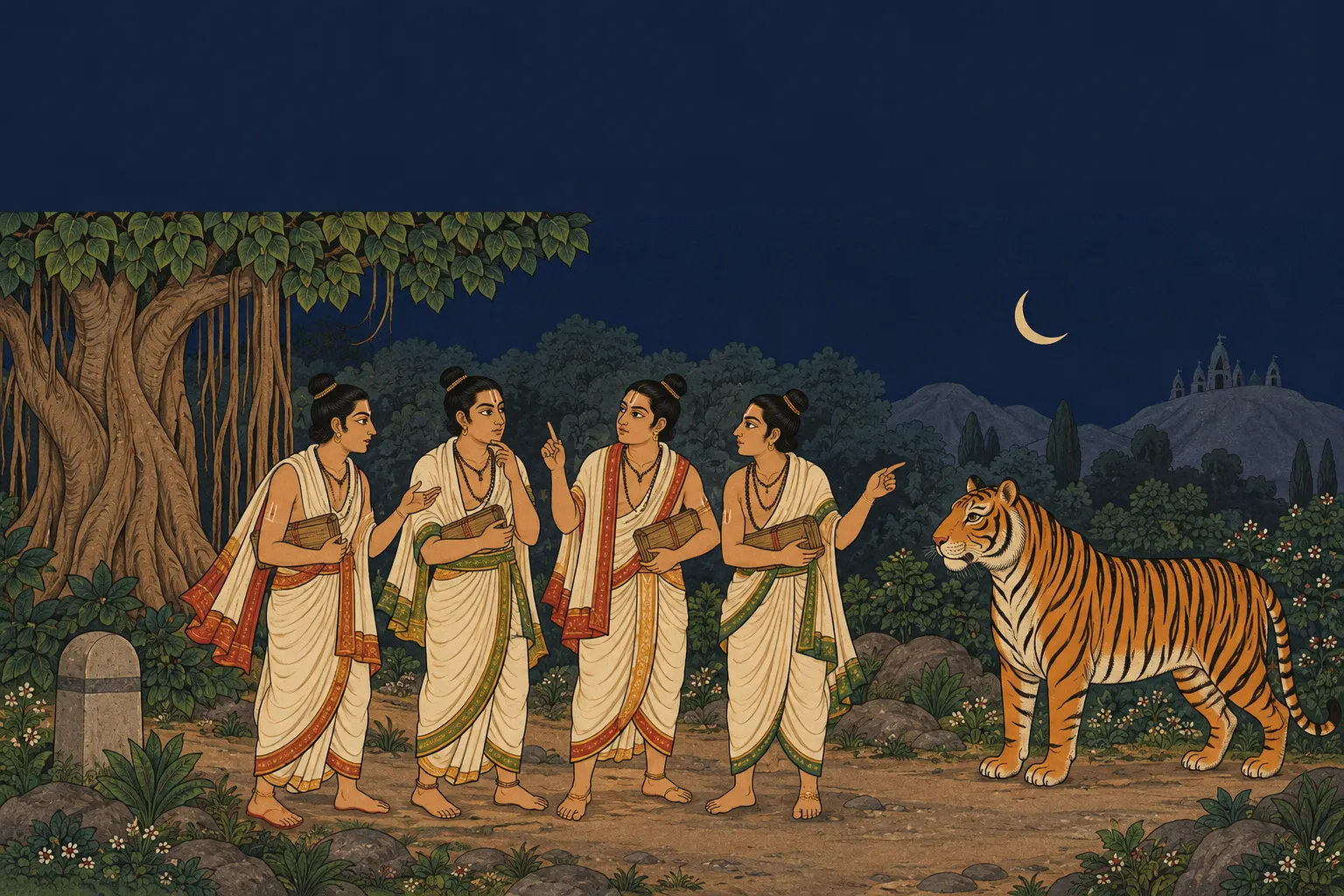
In the city of Jaysthal ruled King Vardhman. In the same city lived a Brahman named Vishnuswami, who had four sons. Each had some failing: one was a gambler, one a pleasure-seeker, one kept bad company, and the fourth was an unbeliever. One day the Brahman admonished his sons: 'Wealth does not stay in the house of a gambler. A man who gives himself to pleasure loses everything and in the end takes to theft. Those who learn nothing in childhood and waste their youth in pleasure repent in old age.' Hearing this, the four decided among themselves that for an unlearned man it is better to die than to live, so they would go to another land and study.
They went to another city, studied there for many years and became learned, and then set out for home. On the road they saw a Kanjar who had skinned a dead tiger and cut up its flesh and was tying its bones in a bundle, about to carry them off. 'Come,' the four said to one another, 'let us all test our learning.' One gave the Kanjar something, took the bundle and sent him away. Then they left the road, sat down and opened the bundle. One recited a spell and joined all the bones in their places. The second, in the same way, set flesh on the bones. The third set the skin on the flesh. The fourth breathed life into it. The tiger rose and ate all four.
When he had finished the tale, the vetala asked, 'King, tell me, who was the greatest fool of the four?' The king said, 'The one who gave it life. It is said that learning without wisdom is of no use; wisdom is greater than learning. Those who lack wisdom die just as the man who gave the tiger life died.' At this the vetala hung himself on the tree again, and the king took him down, tied him up, put him on his shoulder and walked on.
Note: This chapter is written from tales 20 and 21 of the popular Hindi tradition of the Baital Pachisi (Lallu Lal's text, in John Platts' 1871 English translation). Tale 20 has in the text the torment of love, the thought of self-harm, and the husband giving up his life on the pyre; here it is told with restraint, without any detail of method, only for the sequence of the tale. In tale 21 the father's long rebuke is shortened. Names are as in the text: Vipuleshwar, Arthdatt, Anangmanjari, Kamalakar, Munni, Vardhman, Vishnuswami.
Source: Baital Pachisi — Lallu Lal's Hindi Baital Pachisi (1805), in the text rendered by Duncan Forbes, The Deepest Love, Life in the Tiger