
Chapter 8
Jimutvahan and the Serpents
One prince went to be Garuda's meal in place of another, and the one who was to be the meal came back too — the vetala asked, whose sacrifice was greatest?
Jimutvahan and the Serpents is chapter 8 of Vikram and Baital. Source: Baital Pachisi, tale 15. It is told in 1 scenes — The fifteenth tale: Jimutvahan — followed by 10 quiz questions.
The fifteenth tale: Jimutvahan
Vikram took the vetala down from the tree again and walked on. 'Now hear the fifteenth tale, King,' said the vetala.
On Mount Himachal there stood a city of gandharvas, ruled by King Jimutketu. Longing for a son, he served the Kalpavriksha for a long time. At last the tree was pleased and said, 'Ask whatever you wish.' The king said, 'Give me a son, so that my kingdom and my name may endure.' 'So be it,' said the Kalpavriksha. After some time a son was born. The king held a festival, gave gifts, and had the priests called to name the child: Jimutvahan.
By the age of twelve Jimutvahan was worshipping Shiva. After mastering all the scriptures he grew wise, steady and fearless; in those days he had no equal. When he came of age he too won over the Kalpavriksha. 'Ask whatever you wish,' said the tree. Jimutvahan said, 'Take away all poverty from my people, and let everyone in my kingdom be equal in wealth and property.' The Kalpavriksha granted the boon. People became so prosperous that no one obeyed anyone's command and no one would work for anyone else.
The king's brothers and relatives said among themselves, 'Father and son are both lost in religion, and the people no longer obey them. Let us seize and imprison the two of them and take the kingdom.' They plotted together, and with an army they surrounded the palace. When the news reached the king, he asked his son, 'What shall we do?' The son said, 'Stay here at ease. I will go out and drive them off at once.' The king said, 'Son, this body is perishable and wealth does not last. Whoever is born has death walking beside him. It is not right to commit sin for a kingdom or for this body; even Yudhishthira felt remorse after the Mahabharata. Now we should give up the kingdom and do the work of dharma.' 'As you command,' said Jimutvahan. 'Give the kingdom to your relatives, and let us go and do penance.'
They handed the kingdom over to the relatives, and father and son went to Mount Malayachal, reached the summit, built a hut and settled there. There Jimutvahan became friends with a sage's son. One day the two went out walking on the mountain top and came upon a temple of Bhavani. In the temple a princess with a veena in her hands was singing before the Goddess. Their eyes met and each was captivated by the other. Out of modesty the princess composed herself and turned for home; Jimutvahan too, abashed in front of his friend, went back to his hut. The night passed in restlessness for both.
At dawn the princess set out for the Goddess's temple, and when Jimutvahan arrived he found her there. He asked her friend, 'Whose daughter is she?' The friend said, 'She is the daughter of King Malayketu. Her name is Malayavati, and she is not yet married.' Then the friend asked, 'And who are you, and where have you come from?' He said, 'I am Jimutvahan, the son of Jimutketu, king of the gandharvas. We lost our kingdom, and so father and son have come to live here.'
The friend told the princess all that had been said. She was grieved to hear it, went home and lay that night sunk in worry. The friend saw her state and told the queen. The queen said to the king, 'Maharaj, your daughter is of an age to marry. Why do you not look for a husband for her?' The king thought it over and at once called his son Mitravasu. 'Son, find a husband for your sister and bring him here. I have heard that Jimutketu, king of the gandharvas, has given up his kingdom and come to live here with his son Jimutvahan. I will give my daughter to Jimutvahan.' Mitravasu went to Jimutketu and said, 'My father has sent for your son. He wishes to give his daughter to him in marriage.' Jimutketu sent his son with him, and King Malayketu married them in the gandharva fashion. Then the three went to bow to the king and queen and received their blessing, and so the day passed.
The next morning the two princes, Jimutvahan and Mitravasu, went out walking on Malayagiri. At one spot Jimutvahan saw a very high heap of something white and asked his brother-in-law, 'Brother, what is this white heap?' Mitravasu said, 'Every day millions of nagas come up here from the underworld, and Garuda comes and eats them. This heap is made of their bones.' Hearing this, Jimutvahan said, 'Friend, you go home and eat. This is the hour of my worship, and I will stay here.' Mitravasu left.
Jimutvahan walked on and heard the sound of someone weeping. Following the voice, he found an old woman weeping under the weight of her sorrow. He went up to her and asked, 'Mother, why do you weep?' She said, 'Today is the turn of my son, the naga Shankhchud. Garuda will come and eat him. That is why I weep.' 'Mother, do not weep,' he said. 'I will give my life in place of your son's.' The old woman said, 'No, do not do this. You are my Shankhchud.'
She was still speaking when Shankhchud himself arrived and, hearing her, said, 'Maharaj, worthless wretches like me are born and die by the thousand, but a kind and righteous man like you is not born every day. Do not give your life for me. If you live, thousands will benefit; it makes no difference whether I live or die.' Jimutvahan said, 'True men do not say a thing and then fail to do it. Go back to where you came from.'
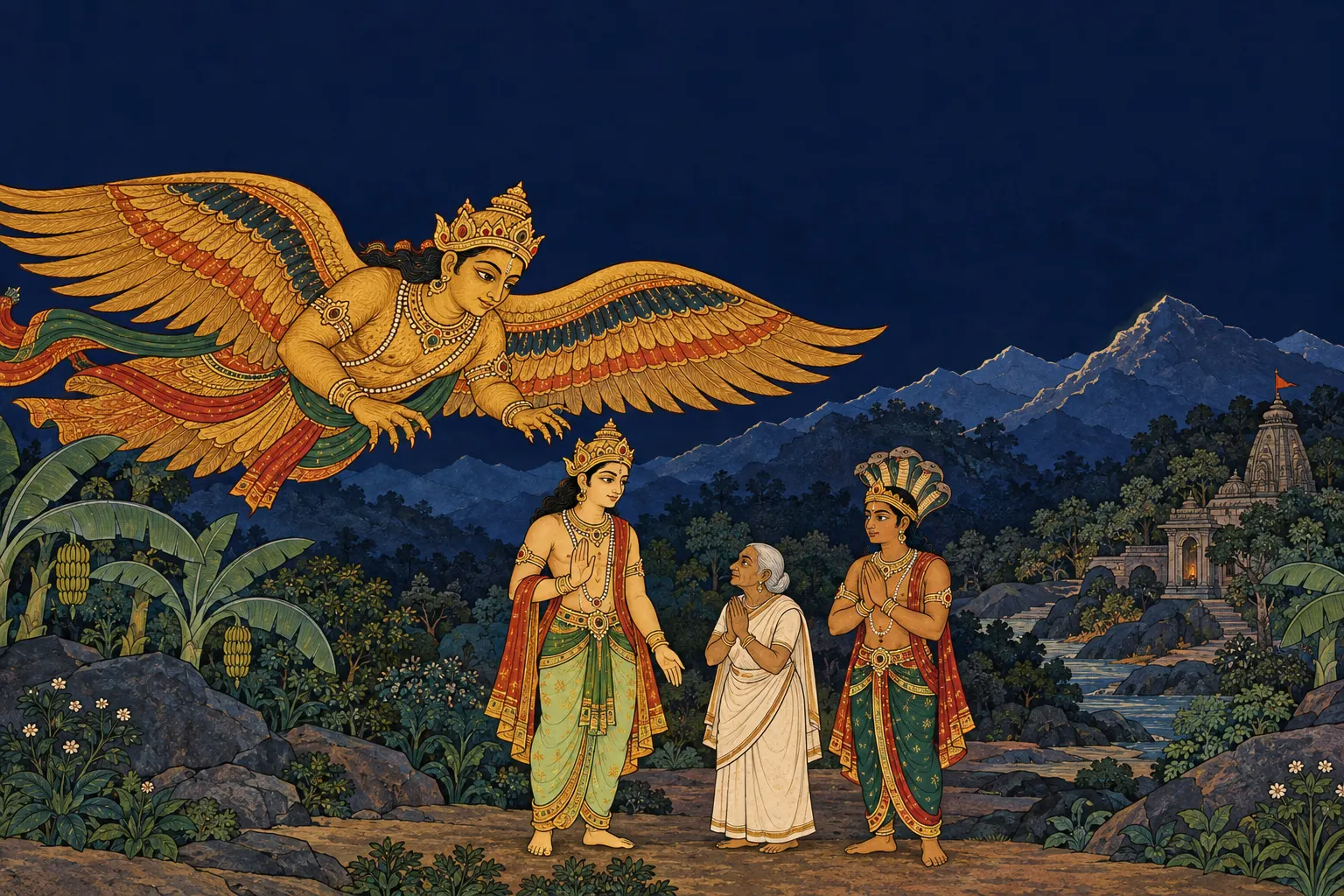
At this Shankhchud went off to worship the Goddess, and Garuda came down from the sky. The prince saw that each of his legs was as long as four bamboos, his beak as long as a palm tree, his belly like a mountain, his eyes like gateways and his wings like clouds. With open beak he swooped on the prince. The first time the prince escaped, but the second time Garuda seized him in his beak and rose, circling, high into the air. In the struggle, Jimutvahan's bracelet, on whose jewel his name was engraved, came loose and fell, blood-stained, before the princess. At the sight of it she fainted.
When she came to, she sent word of what had happened to her father and mother. They came, and when they saw the bracelet stained with blood they burst into tears, and the three set out to look for him. On the road Shankhchud joined them. He hurried ahead of them to the place where he had seen the prince and began to call out again and again, 'Garuda, let him go! Let him go! He is not your food. My name is Shankhchud. I am your food.'
Hearing this, Garuda came down in alarm and thought, 'I have eaten a Brahman or a kshatriya! What have I done?' He said to the prince, 'O man, tell me truly, why are you giving up your life?' The prince said, 'Garuda, trees stand in the sun themselves and give shade to others; they blossom and bear fruit for the sake of others too. Such is the nature of good men and of trees. What use is a body that serves no one else? Those who live for the good of others live well; to live merely for the sake of living is what dogs and crows do. Those who give their lives for a Brahman, a cow, a friend or a woman, or even for a stranger, surely dwell in heaven for ever.'
Garuda said, 'In this world everyone holds his own life dear, and very few give their lives to save the lives of others.' Then he said, 'I am pleased with your courage. Ask a boon.' Jimutvahan said, 'O god, if you are pleased, then from today stop eating nagas, and revive those you have already eaten.' Garuda fetched nectar from the underworld and sprinkled it over the nagas' bones, and they all rose up alive. And he said to Jimutvahan, 'By my favour your lost kingdom will be restored to you.'
Having granted the boon, Garuda flew home, Shankhchud went home too, and Jimutvahan met his father-in-law, his mother-in-law and his wife on the road. Together they went to his father. When his uncle, his cousins and all his relatives heard what had happened, they came to see him, fell at his feet to beg forgiveness, and took him away and seated him on the throne again.
When he had finished the tale, the vetala asked, 'King, tell me, whose sacrifice among these was the greatest?' The king said, 'Shankhchud's.' 'How so?' said the vetala. The king said, 'Shankhchud had gone away and was safe, yet he came back so that Garuda might eat him and the prince be saved.' The vetala said, 'Then why is the sacrifice of the one who gave his life for another not greater?' The king said, 'Jimutvahan was a kshatriya. Holding his life in his hand was second nature to him, so it was no hard thing for him to give it.' Satisfied, the vetala slipped away and hung himself on the tree again, and the king took him down, tied him up, put him on his shoulder and walked on.
Note: This chapter is written from tale 15 of the popular Hindi tradition of the Baital Pachisi (Lallu Lal's text, in John Platts' 1871 English translation). This tale of Jimutvahan is also found in the Sanskrit play Nagananda and in the Kathasaritsagara. Here Garuda's eating of the nagas and the heap of bones are told briefly in keeping with the text; the details are not described. Names are as in the text: Jimutketu, Jimutvahan, Malayketu, Malayavati, Mitravasu, Shankhchud.
Source: Baital Pachisi — Lallu Lal's Hindi Baital Pachisi (1805), in the text rendered by Duncan Forbes, Jimutvahan and the Serpents