
Chapter 2
The Lotus Signs, the Bed of Ashes
A princess told a stranger where to find her with nothing but a lotus — and three young Brahmans quarrelled over one girl so bitterly that the vetala asked the king: whose wife is she?
The Lotus Signs, the Bed of Ashes is chapter 2 of Vikram and Baital. Source: Baital Pachisi, tales 1 and 2. It is told in 2 scenes — The first tale: the lotus signs; The second tale: three young men and one girl — followed by 10 quiz questions.
The first tale: the lotus signs
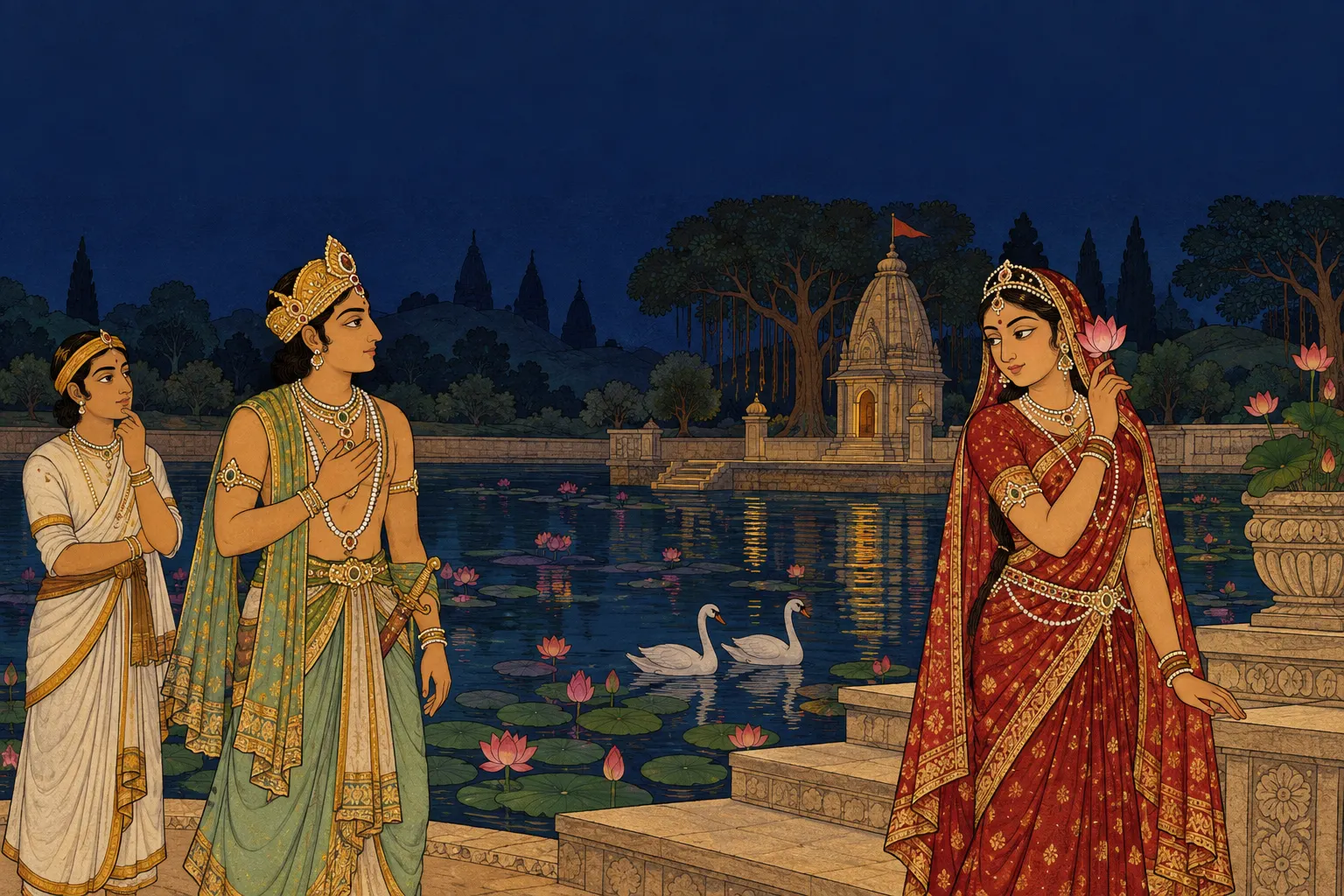
One day Vajramukut, son of King Pratapmukut of Banaras, went hunting with the minister's son and rode deep into a thick forest. There they came upon a lovely pond. Swans, ducks and cranes played along its edge, paved ghats surrounded it, lotuses bloomed on the water, and a cool breeze stirred in the dense shade of the trees. The two washed their hands and faces and climbed back up from the water. Close by stood a temple of Mahadev. They tied up their horses, went in and bowed.
While they were at their worship, a king's daughter came with her companions to bathe at another ghat of the pond. After her bath and prayers she strolled with her friends in the shade of the trees. The minister's son remained seated while the prince wandered nearby. Then the prince and the princess caught sight of each other, and he was bewitched. She took the lotus she wore on her head and held it to her ear, then bit it with her teeth, pressed it under her foot, and finally lifted it and held it to her heart. Then she climbed into her chariot with her friends and was gone.
The prince returned to his friend utterly dejected and, after some hesitation, told him what had happened. 'Friend, I have seen a girl of extraordinary beauty. I know neither her name nor her home. If I cannot find her I shall give up my life.' The minister's son took him home, but in his longing the prince forgot reading and writing, food and drink, sleep and the affairs of the kingdom. He drew her portrait, gazed at it and wept, and neither spoke nor listened to anyone.
Seeing his state, the minister's son said, 'Whoever walks the road of love either does not survive it, or suffers terribly if he does. That is why the wise stay off it.' The prince said, 'I have already set out on it, for joy or for sorrow.' The minister's son asked, 'When she left, did she say anything to you, or you to her?' The prince said, 'Neither of us said a word. But she made some signs: she took the lotus from her head and held it to her ear, bit it with her teeth, put it under her foot, then pressed it to her heart.' At this the minister's son said, 'I understand what these signs mean. I know her name, her country and everything else about her.'
He explained, 'Holding the lotus to her ear means she comes from the Karnat country. Biting it means she is the daughter of King Dantavat. Pressing it under her foot means her name is Padmavati. And holding it to her heart means that you live in her heart.' The prince said, 'Then take me there.' The two dressed, buckled on their weapons, took some jewels with them and rode off in that direction.
Many days later they reached the Karnat country. They were walking through the town below the royal palace when they saw an old woman spinning at her door. They dismounted and said, 'Mother, we are merchants from far away. Our goods are coming on behind us, and we have ridden ahead to find lodging. If you have room, we would like to stay.' The old woman looked at their faces, listened to their words and took pity on them. 'This house is yours for as long as you like.' They made camp, and in the course of conversation the minister's son asked, 'Mother, who is your family, and how do you live?' She said, 'My son does well in the king's service, and I was nurse to Princess Padmavati. I stay at home now because of my age, and the king pays for my keep. I go once a day to see the child.'
The prince's face lit up. 'When you go tomorrow, carry a message from me too.' 'Tomorrow?' said the old woman. 'I will take it now.' He said, 'Tell the princess that the prince she saw by the pond on the fifth of the bright half of Jeth has come.' The old woman took up her stick and went to the palace. The princess was sitting alone and bowed to her. The old woman blessed her and said, 'Child, I nursed you when you were small. My one hope now is to see you married and happy. The prince whose heart you stole at the pond on the fifth of the bright half of Jeth has come to my house. He asks you to keep the promise you made him, and I tell you he is worthy of you.'
Padmavati at once dipped her hands in sandal paste and slapped the old woman across the cheek. 'Get out of my house!' Grieved, the old woman went straight back to the prince and told him everything. He was stunned. The minister's son said, 'Do not worry, you have simply not understood. A slap with all ten fingers smeared with sandal means that when ten nights of moonlight have passed, she will meet you on a dark night.' Ten days later the old woman went again, and this time Padmavati smeared three fingers with saffron and said the same thing: 'Get out of my house!' The old woman came back disheartened once more, and the minister's son said, 'It means she wants three more days. On the fourth she will send for you.' Three days later, when the old woman went to ask, Padmavati pretended to be furious and pushed her out through the western window. The minister's son said, 'She is telling you to come tonight by that same window.'
After midnight the two put on dark clothes, tightened their turbans, took up their weapons and set out quietly. Near the window the minister's son waited outside and the prince went in. Padmavati herself stood waiting for him there. When their eyes met she smiled, closed the window and led him to an inner chamber, where incense and perfumes burned, a bed of flowers was spread and maids stood with folded hands. She busied herself with welcoming the prince. Several days passed in this way, and whenever he spoke of leaving, Padmavati held him back.
A month went by and the prince grew restless. Sitting alone at night, he thought, 'My country, my kingdom and my family I left behind long ago, but the friend who gave me this happiness, I have had no word of him for a month.' Just then Padmavati came in and asked, 'Maharaj, why are you sad?' He told her, 'I have a dear friend, the minister's son, by whose wit I won you, and who explained all your signs.' Padmavati said, 'Your thoughts are with him. I will have sweets made and sent over; go and share them with him, and put your mind at rest, and come back.'
The prince got up gladly and went to his friend. The sweets followed behind, and Padmavati had had poison mixed into them. The minister's son asked, 'Where did these sweets come from?' The prince said the princess had sent them. 'You have brought me poison,' said the minister's son. 'It is lucky you did not taste any yourself. A woman does not love her lover's friend. You were wrong to speak my name to her.' The prince could not believe it. 'Who would do such a thing? A man may not fear other men, but at least he fears God.' The minister's son tossed a round sweet to a dog. The dog ate it and died writhing. Seeing it, the prince's heart turned against her.
The minister's son said, 'What is done is done. Now we must find a way to take her home with us. Go to her tonight, show her great affection, and when she is asleep take off her jewels and come back quietly.' The prince did so and returned with the jewels. Then the minister's son became an ascetic, made the prince his disciple and sat down in the cremation ground. 'Take these jewels to the market to sell,' he said. 'If anyone seizes you, bring him to me.'
The prince showed the jewels to a goldsmith near the palace gate, who recognised them at once. 'These are the princess's jewels! Tell me the truth, where did you get them?' Ten or twenty people had gathered by now. The chief guard had the prince and the goldsmith seized and brought in with the jewels. The prince said, 'My teacher gave me these to sell. I do not know where they came from.' The guard had the teacher arrested too and took them all before the king.
The king asked the ascetic, 'Revered sir, where did you get these jewels?' The ascetic said, 'Maharaj, on the fourteenth night of the dark half I was in the cremation ground perfecting a spell to subdue a witch. When she came, I took her jewels. That is how they came to me.' The king went into the palace and had the queen make enquiries, and it was found that the princess's jewels were indeed missing. The king sent the guard to bring the ascetic back and asked him in private, 'Revered sir, what does scripture prescribe for such a woman?' The ascetic said, 'Maharaj, if a Brahman, a cow, a wife, a child or any dependant commits a base act, the rule is banishment from the country.'
At this the king had Padmavati put in a palanquin and left in the forest. The prince and the minister's son rode from their camp to that forest, took the princess with them and set out for their own country. After many days they reached the prince's father's house. There was great rejoicing among young and old, and the prince and princess lived happily.
When he had finished the tale, the vetala asked Vikram, 'Of these four, whose is the fault? If you do not decide it, you will go to hell.' King Vikram said, 'The fault is the king's.' 'How is it the king's?' asked the vetala. Vikram said, 'The minister's son did his duty to his master. The guard obeyed the king's order. The princess got what she wanted. But the king, without thinking, on the word of one ascetic, banished his own daughter from the country. The blame is his.' At these words the vetala vanished from his shoulder and flew back to hang from the same tree.
The second tale: three young men and one girl
When the king found no vetala on his shoulder, he went straight back, climbed the tree, tied up the corpse, set it on his shoulder and walked on. 'Then hear another tale, King,' said the vetala.
On the bank of the Yamuna stood a city called Dharmasthal, where Gunadhip was king. A Brahman named Keshav lived there, performing his worship on the riverbank. His daughter Madhumavati was very beautiful. When she came of marriageable age, her mother, father and brother all began to worry about finding her a husband. One day the father was away at a wedding and the brother was studying with his teacher in a village. In the meantime a Brahman's son came to the house. The mother liked his looks and his qualities and said, 'I will give you my daughter.' Meanwhile the father had promised the girl to another young Brahman, and the brother, at his teacher's, had promised his sister to a third.
Some days later the father and brother both returned, each bringing his young man, and the third was already in the house. Their names were Trivikram, Vaman and Madhusudan, and the three were equal in looks, character, learning and age. The Brahman looked at them and thought, 'One girl and three bridegrooms! To whom do I give her, and to whom not? The three of us have given our word to all three. What a strange thing to happen!' He was still turning it over when a snake bit the girl and she died.
When they heard, the father, the brother and the three young men ran to her, and brought every charmer, snake-handler and healer of poison they could find. Each looked at the girl and said she would not survive. One said that anyone bitten on the fifth, sixth, eighth, ninth or fourteenth day of the lunar fortnight does not live. Another said that one bitten on a Saturday or a Tuesday can hardly survive. Another said that poison that rises under certain stars cannot be drawn out, and another that a bite on the lip, cheek, neck, belly or navel is fatal. The fifth said, 'Even Brahma could not revive her, so what can we do? Perform her last rites now; we will go.' The charmers left, and the Brahman took the girl's body, committed it to the fire with the proper rites and returned home.
Then the three young men each went his own way. One gathered her burnt bones, tied them up, became an ascetic and wandered from forest to forest. The second tied up a bundle of her ashes, built a hut on the spot and lived there. The third also became an ascetic, with a bag on his shoulder and a rosary round his neck, and roamed from country to country. One day, in some land, he went to a Brahman's house to beg for food. The householder seated him respectfully and food was being served when a sad event occurred in that house, which is left out here. At the sight the ascetic rose without eating and said, 'How can I eat in a house where such a thing has happened?' The householder went inside, brought out a book of the knowledge that revives the dead, recited the spell and undid what had happened.
Seeing this marvel, the ascetic thought, 'If that book came into my hands, I could revive my beloved too.' He ate and stayed on. That night, when everyone was asleep, he rose quietly, went into the room, took the book and ran. After many days of walking he came to the very place where the Brahman's daughter had been burned. There he found his two companions sitting, who recognised him and asked, 'Brother, you have wandered from country to country. Did you learn any art?' 'I have learned the art of bringing the dead back to life,' he said. 'Then revive our beloved,' they said. He said, 'Gather the ashes and the bones.' They collected them all. The ascetic read the spell from the book and the girl sat up. Then Kamdev blinded all three, and they began to quarrel among themselves.
When he had finished the tale, the vetala asked, 'King, tell me, whose wife did that woman become?' Vikram said, 'The one who built the hut and stayed beside the ashes.' The vetala said, 'If the bones had not been kept, how could she have been revived? And if the third had not come back with the knowledge, who would have revived her?' The king said, 'The one who kept the bones stands in a son's place, and the one who gave her life stands in a father's. So the one who built the hut and stayed beside the ashes will be called her husband.' At that the vetala flew back and hung himself on the tree, and the king followed him, tied him up, put him on his shoulder and walked on.
Note: This chapter is written directly from tales 1 and 2 of the popular Hindi tradition of the Baital Pachisi (Lallu Lal's text, in John Platts' 1871 English translation). In tale 1 the full account of the prince and princess in the bedchamber is left out, as is the part where the princess is identified by a mark (a trident) on her body; the story is kept up to the missing jewels. The incident involving a child in the house where the ascetic refused food is also left out. The king's 'banishment' and the ascetic's 'punishment for such a woman' are the views of characters, not of this website. The minister's son's line that 'a woman does not love her lover's friend' is likewise that character's. Tale 2 is like the first tale of Chapter 8 of Somadeva's Kathasaritsagara (Mandaravati), but names and details differ.
Source: Baital Pachisi — Lallu Lal's Hindi Baital Pachisi (1805), in the text rendered by Duncan Forbes, The Lotus Signs, the Bed of Ashes