
Chapter 6
The Minister's Worry, the Snake's Poison
A singer on a golden tree rising from the sea, and a king who forgot his kingdom after winning her — why did the minister die? And who put poison in the milk-rice?
The Minister's Worry, the Snake's Poison is chapter 6 of Vikram and Baital. Source: Baital Pachisi, tales 11 and 12. It is told in 2 scenes — The eleventh tale: the golden tree and the minister; The twelfth tale: poison in the milk-rice — followed by 10 quiz questions.
The eleventh tale: the golden tree and the minister
Vikram took the vetala down from the tree again and walked on. 'Now the eleventh tale, King,' said the vetala.
In the city of Punyapur ruled King Vallabh, and his minister was Satyaprakash, whose wife was named Lakshmi. One day the king said to the minister, 'A king who does not enjoy the company of beautiful women might as well not reign.' With that he handed the whole burden of government to the minister and sank into pleasure, day and night.
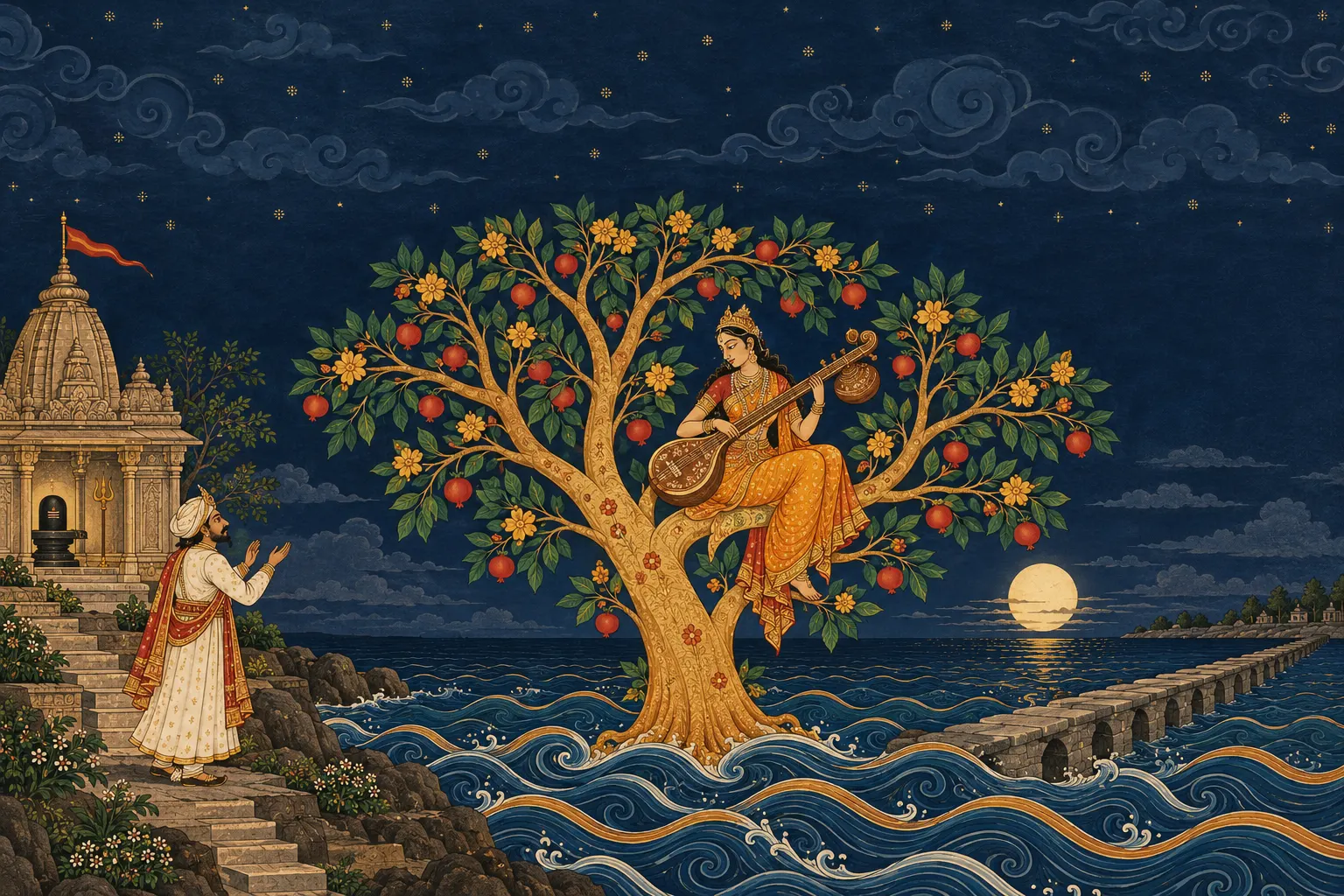
One day the minister was sitting dejected when his wife said, 'My lord, you look very weak.' He said, 'The worries of the kingdom wear me down day and night, while the king spends all day on his pleasures.' She said, 'You have carried the kingdom for a long time. Take leave of the king and go on a pilgrimage for a few days.' The minister said nothing. Then, at court, he went to the king, asked leave and set out. Walking on, he came to the seashore at Setubandh Rameshwar. After his darshan of Mahadev, he came out of the temple and his eyes fell on the sea. A golden tree had risen out of the water, with emerald leaves, topaz flowers and coral fruit, and on it sat a very beautiful woman with a veena in her hands, singing in a sweet voice. After a while the tree sank back into the sea.
The minister turned back, returned to his city and went before the king. With folded hands he said, 'Maharaj, I have seen something marvellous.' 'Tell me,' said the king. The minister said, 'Maharaj, the elders say one should not tell what is beyond anyone's understanding and what nobody will believe. But I saw it clearly with my own eyes, and so I tell you. At the place where Lord Raghunath once bridged the sea, a golden tree rose from the water, with emerald leaves, topaz flowers and coral fruit, and on it a very beautiful woman sat singing to a veena. After a while the tree sank into the sea.'
Hearing this, the king handed the whole kingdom to the minister and set out alone for the sea. After many days he reached it and worshipped Mahadev, and as he came out of the temple the same tree and the same woman rose from the water. The king leapt into the sea and sat on the tree. The woman carried him down to the underworld and, looking at him, said, 'Brave man, why have you come here?' 'Drawn by your beauty,' said the king. She said, 'If you keep away from me during the dark fortnight, I will marry you.' The king agreed. Even so, she took a solemn promise from him before she married him.
When the dark nights came she said, 'Maharaj, do not stay with me tonight.' The king went off with his sword, hid some distance away and kept watch. At midnight a demon came and seized her in his arms. The king ran at him with his sword. 'Wicked demon, do not lay a hand on my wife before my eyes! Fight me first. I was afraid only until I saw you.' He struck such a blow that the demon's head was cut off and lay writhing on the ground. The woman said, 'Brave man, you have done me a great service.' Then she said, 'Not every mountain holds jewels, not every city has true heroes, not every forest grows sandalwood, and not every elephant has a pearl in its forehead.'
The king asked, 'Why did this demon come to you on the fourteenth night?' She said, 'My father is Vidyadhar, and I am his daughter Sundari. It was my father's rule never to eat without me. One day at mealtime I was not at home, and in anger my father cursed me: on the fourteenth day of every dark fortnight a demon would come and embrace me. I said, "Father, you have cursed me, but now show mercy." He said, "When a fearless man comes and kills that demon, you will be free of the curse." Now I am free. I want to go to my father and touch his feet.'
The king said, 'If you feel you owe me anything, first come and see my kingdom, and then go to your father.' She agreed, and the king brought her to his capital. Drums and music sounded through the city, and every house sang its congratulations. The king gave generously in charity. Some days later Sundari said, 'Maharaj, now I will go to my father.' Sadly the king said, 'Very well, go.' Seeing him sad she said, 'Maharaj, I will not go.' 'Why have you given up the thought of going to your father?' he asked. She said, 'I have now become one of the human race, and my father is a god. If I go now, he will not honour me.' The king was overjoyed at this and gave away hundreds of thousands of rupees. When the minister heard all this, he died of grief.
When he had finished the tale, the vetala asked, 'King, tell me, why did the minister die?' King Vikram said, 'The minister saw that the king had sunk back into pleasure, that the cares of the kingdom had left his mind, that the people had lost their protector and that no one would listen to him any more. That worry was his undoing.' At this the vetala hung himself on the tree again. The king took him down as before, set him on his shoulder and walked on.
The twelfth tale: poison in the milk-rice
'King Vikram, now hear the twelfth tale,' said the vetala.
In the city of Chudapur ruled King Chudaman. His family priest was Devswami, and Devswami's son was Hariswami, as handsome as Kamdev, as learned as Brihaspati and as rich as Kubera. He had married a Brahman's daughter, Lavanyavati.
One summer night the two were sleeping soundly on the roof of their house. The veil slipped from the woman's face, and at that very moment a god passing through the sky in his chariot happened to see her. He brought the chariot down, laid the sleeping woman in it and flew away. After a while Hariswami woke and found his wife gone. In alarm he came down, searched the house, then searched every lane of the city, but she was nowhere to be found. He kept asking himself, 'Who took her, and where has she gone?'
When every effort failed he returned in despair and searched the house again, but she was not there. Without her the house seemed empty to him, and he began to cry out in distress, 'Alas, my beloved! Alas, my beloved!' In the pain of separation he gave up his household, tied a loincloth round his waist, rubbed cow-dung ash on his body, hung a rosary round his neck, left the city and set out on pilgrimage. Wandering from village to village and city to city, one day at noon he reached a certain city.
Faint with hunger, he made a cup of palash leaves, went to a Brahman's house and said, 'Please give me a little food as alms.' (They say that a man in love sees neither duty nor caste nor food; he eats wherever he can get it.) The Brahman took the cup, went inside and came back with it filled with rice cooked in milk. Hariswami carried the cup to the edge of a pond, where a great banyan stood. He set the cup down by its root and went down to the pond to wash his hands and face.
At that moment a black snake came out of the banyan's root, put its mouth in the cup and slid away, so that its poison dissolved in all the milk-rice. When Hariswami finished washing and came back, he knew nothing of this, and he was very hungry. He ate the milk-rice, and the poison spread through his body at once. He went to the Brahman and said, 'You gave me poison, I am dying.' With that he staggered, fell and died. The Brahman, seeing him dead, drove his wife out of the house. 'Go, you are the murderer of a Brahman!'
When he had finished the tale, the vetala asked, 'King, tell me, which of them bears the sin of the Brahman's death?' The king said, 'It is the snake's nature to carry poison in its mouth, so the snake bears no sin. The Brahman gave alms because he saw a hungry man, so he bears none. The Brahman's wife gave alms at her husband's word, so she bears none. And Hariswami ate the milk-rice without knowing, so he too is blameless. Whoever blames any one of them is himself the sinner.' At this the vetala went back to the tree, and the king took him down, tied him up and carried him away from that place.
Note: This chapter is written directly from tales 11 and 12 of the popular Hindi tradition of the Baital Pachisi (Lallu Lal's text, in John Platts' 1871 English translation). In tale 11 the text's account of the king's marriage to Sundari and the condition of 'staying away in the dark fortnight' is very brief; the demon's killing is one sentence, and any further detail of the demon's embrace is left out. Lines such as 'my father is a god and I have now become human' are said by the character. In tale 12 the text's detail that the wife was driven out as 'a murderess of a Brahman' is the language of a character's anger, not of this website. Names are as in the text: Vallabh, Satyaprakash, Sundari, Vidyadhar, Chudaman, Devswami, Hariswami, Lavanyavati.
Source: Baital Pachisi — Lallu Lal's Hindi Baital Pachisi (1805), in the text rendered by Duncan Forbes, The Minister's Worry, the Snake's Poison