
Chapter 11
A New Body, Three Fastidious Brahmans
An old Brahman wept, then laughed, before entering a young body, to everyone's surprise; and three brothers put their fastidiousness to trial before a king — the vetala asked, who is the most delicate?
A New Body, Three Fastidious Brahmans is chapter 11 of Vikram and Baital. Source: Baital Pachisi, tales 22 and 23. It is told in 2 scenes — The twenty-second tale: Narayan's new body; The twenty-third tale: three fastidious Brahmans — followed by 10 quiz questions.
The twenty-second tale: Narayan's new body
Vikram took the vetala down from the tree again, set him on his shoulder and walked on. 'Now the twenty-second tale, King,' said the vetala.
In the city of Vishwapur ruled King Vidagdha. In his city lived a Brahman named Narayan. One day he thought, 'My body has grown old, and I know the art of entering another's body. Why not leave this old body, enter the body of some young man and enjoy life?' Having decided, he set about entering a young body; but before he entered it, he first wept and then laughed, and only then did he go in and return home. His household knew all that he had done. He told them, 'Now I have become an ascetic.'
He went on to explain that one who dries up the spring of hope with the fire of austerity is the true ascetic. People of the world grow old, he said; the body withers, the teeth fall out, they walk with sticks, and still their desire is not quenched. Day comes, night comes, a month passes, a year is completed; a man is a child, then old, and never knows who he is or who the others are. One comes, another goes, and in the end all go. This world is like a dream, as hollow as the new leaf inside a plantain. Those who take pride in wealth, youth or learning are fools. Then he said, 'Now I will go on a pilgrimage.' His relatives were delighted to hear it.
When he had finished the tale, the vetala asked, 'King, tell me, why did he first weep and then laugh?' The king said, 'He wept at the memory of his mother's love in childhood, the pleasures of youth, and the attachment that had grown from living so many days in that body. And he laughed with joy because his art had succeeded and he had entered a new body.' At this the vetala hung himself on the tree again, and the king took him down, tied him up, put him on his shoulder and walked on.
The twenty-third tale: three fastidious Brahmans
As they walked, the vetala said, 'Now hear the twenty-third tale, King.'
In the city of Dharmpur ruled King Dharmaj. In his city lived a Brahman named Govind, who knew the four Vedas and the six shastras and kept all his religious duties. He had four sons, Haridatt, Somdatt, Yagyadatt and Brahmadatt, all learned, clever and obedient to their father. After some time the eldest son died, and Govind himself was close to death with grief.
Then the king's family priest, Vishnusharma, came and began to console him. 'A man suffers in his mother's womb,' he said. 'In youth he suffers the pain of separation from those he loves, and in old age the pain of a failing body. Born into this world, sorrows are many and joys few; the world is the root of sorrow. A man may climb to the top of a tree, sit on a mountain peak, hide under water or sink into the underworld, and still death will not let him go. Wise or foolish, rich or poor, strong or weak, everyone is taken by death. In the first age lived great kings like Mandhata; in the second, Ramchandra, who bridged the sea, conquered Lanka and killed Ravana; in the third, Yudhishthira, whose fame people still sing. Death spared not even these. Grief is therefore vain. The right thing is to do the work of dharma.'
Vishnusharma's words made the Brahman resolve to perform meritorious and pious acts. He said to his sons, 'I will sit down to a sacrifice. Go and bring me a turtle from the sea.' At their father's command they went to a fisherman and said, 'Take a rupee and catch us a turtle.' He caught one and gave it to them. Then the eldest said to the second, 'You pick it up.' The second said to the youngest, 'Brother, you pick it up.' The youngest said, 'I will not touch it. The smell will cling to my hands; I am very fastidious about food.' The second said, 'I am very fastidious about women.' The eldest said, 'And I am fastidious about beds.'
The three went on quarrelling in this way. Leaving the turtle where it lay, they went on bickering to the king's gate and said to the gatekeeper, 'Three Brahmans have come asking for justice. Tell the king.' The gatekeeper told the king. The king summoned them and asked, 'Why are you quarrelling?' The youngest said, 'Maharaj, I am very particular about food.' The second said, 'Lord of the earth, I am very particular about women.' The eldest said, 'Incarnation of justice, I am particular about beds.'
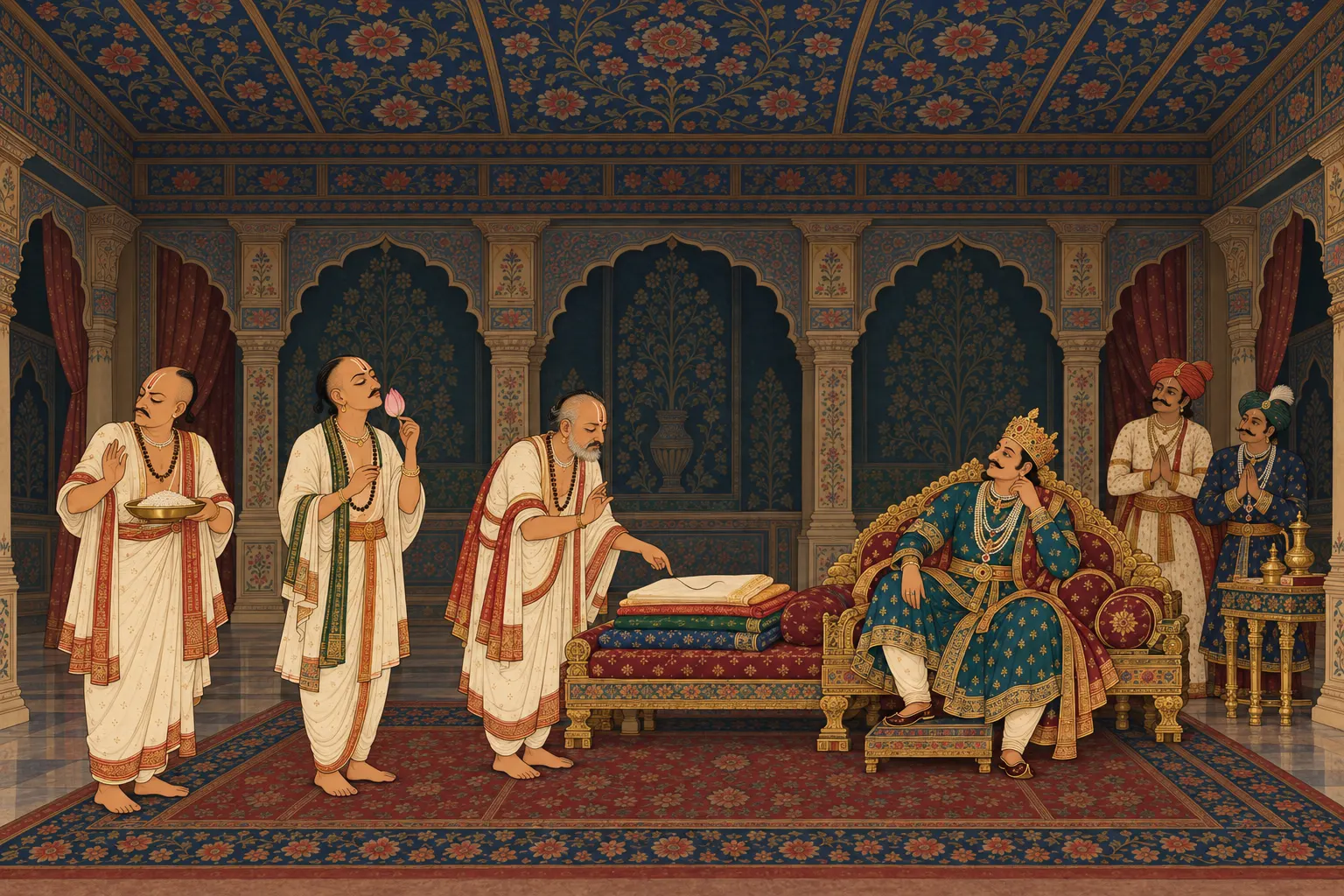
The king said, 'Each of you will be put to the test.' 'Very well,' they said. The king called his cook and said, 'Prepare many kinds of dishes and give this Brahman a really good meal.' The cook prepared the food, took the Brahman who was fastidious about food and seated him before the dishes. He was about to put the first morsel in his mouth when a foul smell rose from it. He put it down, washed his hands and went back to the king. 'Did you eat?' asked the king. 'Maharaj, there was a bad smell in the food, and I did not eat.' 'What was the smell?' 'Maharaj, this rice was grown in a cremation ground. It smelled of corpses, and so I did not eat it.' The king asked his steward, 'From which village does this rice come?' 'From Shivpur, Maharaj.' The king had the village's landholder summoned and asked, 'On what land was this rice grown?' 'On a cremation ground, Maharaj.' Hearing this, the king said to the Brahman, 'You are truly a connoisseur of food.'
Then the king sent for the one who was fastidious about women. A room was prepared with everything needed, a beautiful woman was seated near him, and the two began to talk. The king watched from behind a lattice. After a while the Brahman caught the smell of her breath, turned his face away and went to sleep. The king saw this, went back to his palace and slept. Early in the morning he came to court, summoned the Brahman and asked, 'Did you pass the night pleasantly?' 'Maharaj, I found no pleasure.' 'Why?' 'There was a smell of goat's milk on her breath, and it distressed me greatly.' Hearing this, the king called the old woman who had brought the girl and asked, 'Where did you find her? Who is she?' She said, 'She is my sister's daughter. Her mother died when she was three months old, and I brought her up on goat's milk.' The king said, 'You are truly a connoisseur of women.'
Then the king had a very fine bed prepared and made the Brahman who was fastidious about beds sleep on it. When morning came, the king sent for him and asked, 'Did you sleep well?' 'Maharaj, I did not sleep all night.' 'Why?' 'In the seventh fold of the bedding there was a hair, which pricked my back, and so I could not sleep.' The king looked in the seventh fold of the bedding and, sure enough, found a hair. 'You are truly a connoisseur of beds,' he said.
When he had finished the tale, the vetala asked, 'King, tell me, who was the greatest connoisseur of the three?' The king said, 'The one who was fastidious about beds.' The vetala said no more; he flew back and hung himself on the tree, and the king took him down, tied him up, put him on his shoulder and walked on.
Note: This chapter is written from tales 22 and 23 of the popular Hindi tradition of the Baital Pachisi (Lallu Lal's text, in John Platts' 1871 English translation). Tale 22's art of changing bodies is as in the text; the test about women in the text is longer, and is kept here restrained and brief. In tale 23 Vishnusharma's long sermon is shortened. Names are as in the text: Vidagdha, Narayan, Dharmaj, Govind, Vishnusharma, Haridatt, Somdatt, Yagyadatt, Brahmadatt.
Source: Baital Pachisi — Lallu Lal's Hindi Baital Pachisi (1805), in the text rendered by Duncan Forbes, A New Body, Three Fastidious Brahmans