
Chapter 7
Laughter Before the Gallows
The thief the king caught at night laughed loudly as he neared the gallows, then wept bitterly — the vetala asked, why?
Laughter Before the Gallows is chapter 7 of Vikram and Baital. Source: Baital Pachisi, tale 13. It is told in 1 scenes — The thirteenth tale: the thieves of the night and the king — followed by 10 quiz questions.
The thirteenth tale: the thieves of the night and the king
Vikram took the vetala down from the tree, put him on his shoulder and walked on. 'Now the thirteenth tale, King,' said the vetala.
King Ranadhir ruled the city of Chandrahriday. Among his subjects was a merchant named Dharmadhwaj, whose daughter Shobhani had grown into a woman of extraordinary beauty, lovelier with each passing day. In those days thefts began to occur every night in the city. The merchants, in distress, went together to the king and said, 'Maharaj, thieves have thrown the city into turmoil. We can no longer live here.' The king said, 'What is done is done. From now on you will suffer no more. I will take strong measures against the thieves.' He called the watchmen, set them to guard the city and ordered that any thief be seized on sight, without question.
The watch was set at night, yet the thefts went on. The merchants came to the king again. 'Maharaj, you have posted watchmen, but the thieves have not grown fewer. There is a theft every day.' The king said, 'Go home now. From tonight I will guard the city myself.' When night fell, the king set out alone on foot through the city with sword and shield. After a little while he saw a thief coming toward him. 'Who are you?' he asked. 'I am a thief. Who are you?' 'I am a thief too,' said the king. The man was delighted. 'Then come, let us steal together.'
The two went chatting into one quarter of the city, stole from several houses and with the loot reached a well outside the city. They climbed down into the well and came to a great city in the underworld. The thief left the king sitting at the gate and went home with the loot. Just then a maid came out of his house and, seeing the king, said, 'Maharaj, how did you end up here with this villain? You had better leave as soon as you can, before he comes back, or he will kill you the moment he returns.' 'I do not know the way,' said the king. 'Which way do I go?' The maid showed him the way, and the king returned to his palace.
The next day the king took his whole army down by the same well to the underworld city and surrounded the thief's house. But the thief had slipped out another way and gone to the king of that city, a demon. 'A king has marched against my house to kill me,' he said. 'Help me, or I will leave your city and go elsewhere.' The demon said, 'You have given me food, and I am pleased with you.' So saying, he went to where the king's army stood around the house and began to eat soldiers and horses. At the sight of the demon the king fled, and those who could run escaped; all the rest went into the demon's belly.
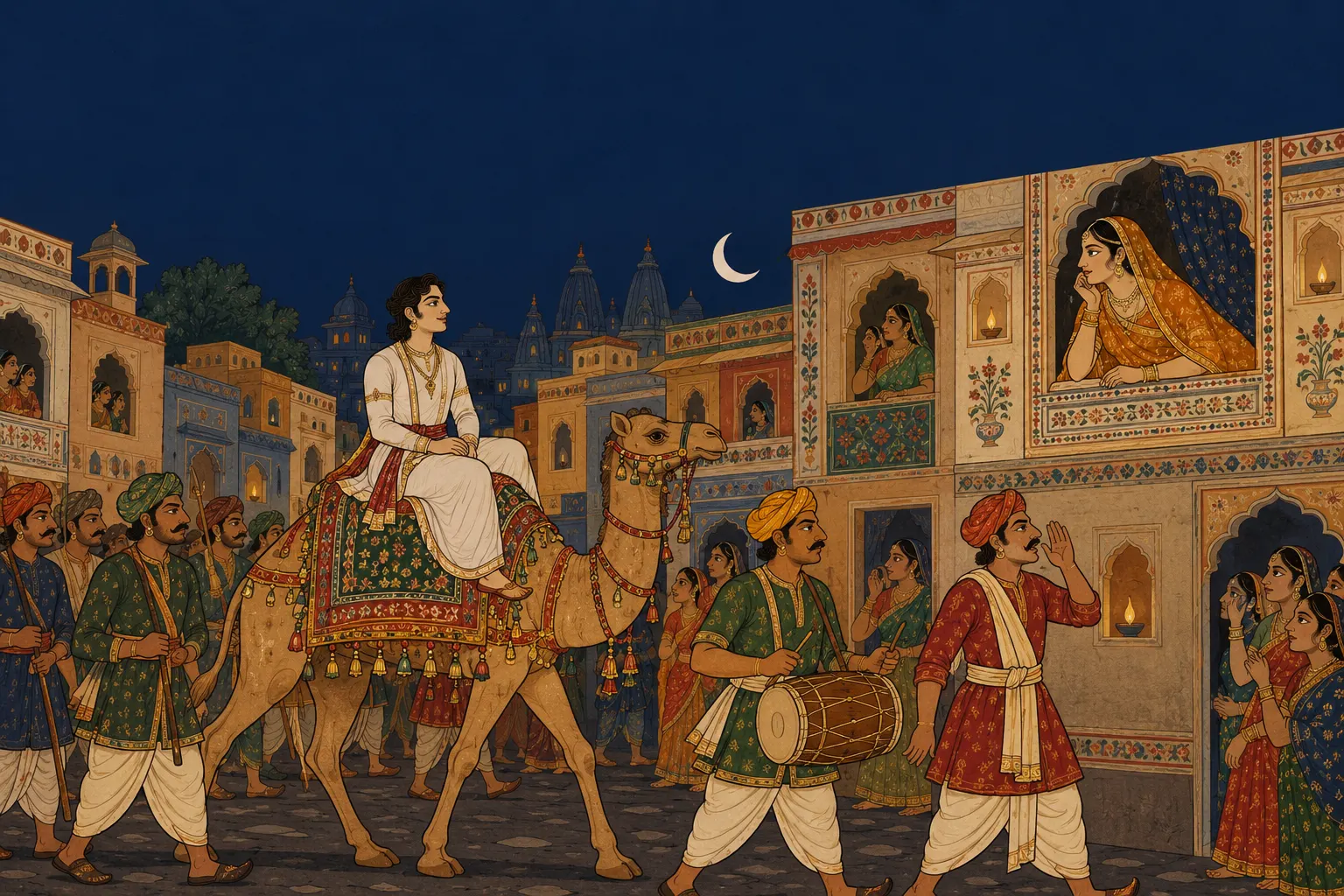
As the king was running away alone, the thief called after him, 'You are a Rajput, and you run from a fight?' At this the king stopped, and the two faced each other. In the end the king beat him, tied his hands behind him and brought him into the city. Then he had him bathed, dressed in fine clothes, seated on a camel and led through the whole city with a crier, and ordered a gallows to be built for him. The people of the city looked at him and said, 'This is the thief who robbed the whole city. Now the king will put him on the gallows.'
When the thief reached the house of the merchant Dharmadhwaj, the sound of the drum made Shobhani ask her maid, 'What is this proclamation?' The maid said, 'The king has caught the thief who has been robbing the city. Now he will be put on the gallows.' She ran to the window too, and the moment she saw the thief's handsome figure and his bearing, she was bewitched. She went to her father and said, 'Go to the king at once and have that thief released.' The merchant said, 'He robbed the king's whole city, and because of him the king's whole army died. How will the king release him because I ask?' She said, 'Even if you must give the king everything you own, get him released. And if he does not come, I will give up my own life too.'
At this the merchant went to the king and said, 'Maharaj, take five hundred thousand rupees from me and let the thief go.' The king said, 'He has robbed the whole city, and my whole army was killed because of him. I will not release him at any price.' When the king would not agree, the merchant went home in despair and told his daughter, 'I said all that I could say, but the king would not agree.'
In the meantime the thief had been paraded round the city and brought to stand by the gallows. There he heard about the merchant's daughter's state. He laughed loudly at first, and then he wept bitterly. The people put him on the gallows. When Shobhani heard of the thief's death, she came to that very place to give up her life for him. She had a pyre built, had the thief taken down from the gallows, laid his head in her lap and sat there silently, ready to burn. Just as the fire was about to be lit, the Goddess herself came out of the nearby temple and said, 'Daughter, I am pleased with your courage. Ask a boon.' 'Mother, if you are pleased, bring this thief back to life,' she said. 'So be it,' said the Goddess, and brought nectar from the underworld and revived him.
When he had finished the tale, the vetala asked, 'King, tell me, why did the thief first laugh and then weep?' The king said, 'I know the reason for the laughter and the reason for the tears. Listen, vetala. The thief thought: this girl is ready to give everything she has to the king for my sake, and how will I ever repay her? That thought made him weep. Then he thought: even at the hour of death, she loved me. God's illusions are beyond measure: he gives wealth to the unlucky, learning to the low-born, a beautiful wife to a fool, and rain to the mountains. That thought made him laugh.' At this the vetala hung himself on the tree again, and the king took him down, tied him up, put him on his shoulder and walked on.
Note: This chapter is written directly from tale 13 of the popular Hindi tradition of the Baital Pachisi (Lallu Lal's text, in John Platts' 1871 English translation). The thief's being put on the gallows and Shobhani's sitting on the pyre are in the text; they are told here with restraint, only for the sequence of the tale. The details of the king's night watch and the army's defeat are the text's, in places abbreviated. Names are as in the text: Ranadhir, Dharmadhwaj, Shobhani, Chandrahriday.
Source: Baital Pachisi — Lallu Lal's Hindi Baital Pachisi (1805), in the text rendered by Duncan Forbes, Laughter Before the Gallows