
Chapter 3
The Servant's Bargain, the Demon on the Mountain
A servant who asked for a thousand tolas of gold a day, and one night a weeping 'Rajlakshmi' in the cremation ground — then a girl, three suitors, and a demon on a Vindhya peak
The Servant's Bargain, the Demon on the Mountain is chapter 3 of Vikram and Baital. Source: Baital Pachisi, tales 3 and 5. It is told in 2 scenes — The third tale: Veerbar and the king's fortune; The fifth tale: a girl, three suitors and a demon — followed by 10 quiz questions.
The third tale: Veerbar and the king's fortune
The next time, the king lifted the vetala down from the tree, set him on his shoulder and walked on. 'Listen, King,' said the vetala. 'This is the third tale.'
In the city of Bardwan ruled King Rupsen. One day he was sitting in the room beside the gate when he heard a clamour of voices outside. 'Who is at the gate,' he asked, 'and what is all this noise?' The gatekeeper said, 'Maharaj, this is the gate of a wealthy man, so all sorts of people come and sit here hoping for money, and they talk among themselves. That is the noise.' The king said nothing.
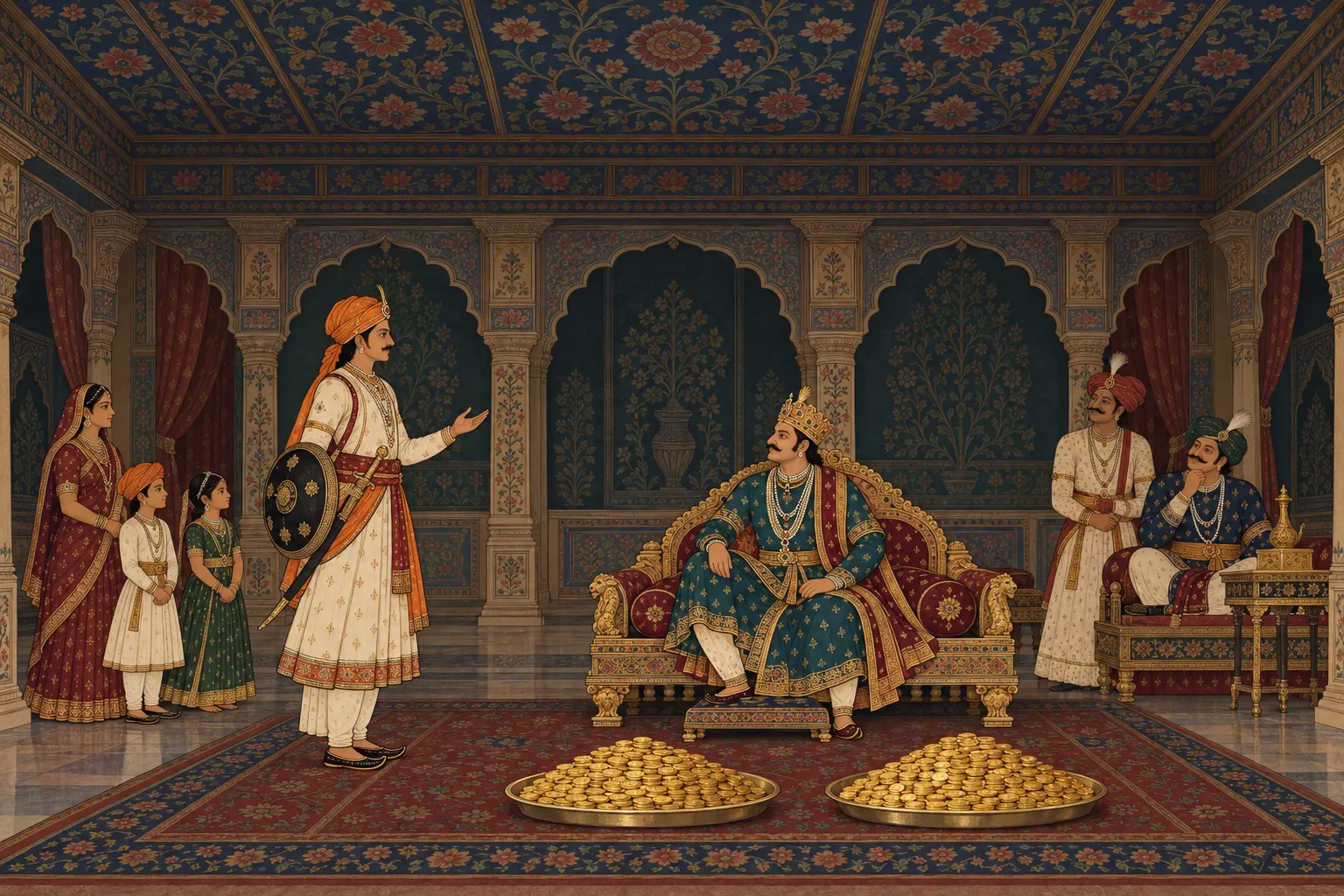
Just then a Rajput named Veerbar arrived at the gate from the south, looking for service. The gatekeeper asked his business and told the king, 'Maharaj, an armed man is standing at the door asking for a post. If you wish, I will bring him in.' The king had him called and asked, 'Rajput, what will you need each day?' Veerbar said, 'Give me a thousand tolas of gold a day, and I shall manage.' 'How many are with you?' asked the king. 'My wife is the first, my son the second, my daughter the third, and myself the fourth. There is no fifth.' The courtiers turned aside to hide their laughter. But the king wondered why the man had asked for so great a sum, and in the end decided that wealth spent freely always brings some return. He told the treasurer, 'Let Veerbar be paid a thousand tolas of gold from my treasury every day.'
Every day Veerbar carried the gold to his lodging and divided it in two. Half he gave to Brahmans. The other half he divided again: one part went to pilgrims, hermits, Vaishnavas and beggars, and with the rest he had food cooked to feed the poor. On whatever remained he lived with his wife and children. Every night he stood guard by the king's bed with sword and shield. When the king woke and called, 'Is anyone there?', he answered at once, 'Maharaj, Veerbar is here. What is your command?' Whatever the king ordered, he carried out.
One night the sound of a woman weeping came from the direction of the cremation ground. 'Is anyone there?' called the king. 'I am here, Maharaj,' said Veerbar. 'Command me.' The king said, 'Someone is weeping over there. Go and find out who she is and why she weeps, and come back quickly.' The king's thought was that a man who wants to test a servant should set him tasks at odd hours: if he does them, he is of use, and if not, he is worthless. He put on black clothes and quietly followed Veerbar to see how brave he was.
In the cremation ground Veerbar found a beautiful woman covered in jewels from head to foot. She danced, leapt and ran, beating her head against the ground and crying 'Alas, alas!', yet there was not a single tear in her eyes. 'Who are you,' Veerbar asked, 'and why do you weep so?' 'I am Rajlakshmi,' she said. 'Why do you weep?' he asked. She said, 'Base deeds are being done in the king's house, so calamity will come there and I shall have to leave. A month from now the king will die in great suffering. That is the grief that makes me weep. I have enjoyed so much happiness in that house that I cannot help feeling regret. And nothing can turn it aside.'
Veerbar asked, 'Is there any remedy by which the king might be saved and live a hundred years?' She said, 'Four kos to the east there is a temple of the Goddess. If you offer your own son's head to her with your own hand, the king will rule a hundred years exactly as he does now, and no misfortune will touch him.'
Veerbar went home, and the king quietly followed. Veerbar woke his wife and told her everything. She woke the son, and the daughter woke too. The mother said to her son, 'Son, by the sacrifice of your head the king's life will be saved and his kingdom will endure.' The son said, 'Mother, this is first your command, second the service of my master, and third a chance to give this body to the Goddess. There is nothing greater for me. It is not right to delay.' Veerbar asked his wife, 'If you give up your son willingly and gladly, I will take him.' She said, 'I have no tie to son or daughter, brother or kin, mother or father. My happiness is in you, and the books of conduct say that a wife's duty is to serve her husband.' The son said, 'Father, a life that serves the master's cause is gain in both worlds.' Then the daughter said, 'If a mother gives her daughter poison, a father sells his son and the king takes everything, to whom can we turn?'
Talking together in this way, the four went to the Goddess's temple, and the king followed unseen. In the temple Veerbar bowed to the Goddess, folded his hands and prayed, 'O Goddess, by the sacrifice of my son, may the king live a hundred years.' And he offered his son to her. (In the text the daughter, the wife and Veerbar himself then give up their lives; those details are kept restrained here.) When the king saw that all four were gone, he said to himself, 'A man's whole family has died for my sake. A kingdom that costs a man his entire household is a disgrace.' He raised his sword to give up his own life. At that moment the Goddess came, caught his hand and said, 'Son, I am pleased with your courage. Ask any boon you wish.' The king said, 'Mother, if you are pleased, bring these four back to life.' 'So be it,' said the Goddess, and Bhavani brought the water of life from the underworld and revived all four. The king then gave Veerbar half his kingdom.
When he had finished the tale, the vetala said, 'Blessed is the servant who cared nothing for his own life or his family's, for his master's sake, and blessed is the king who clung to neither kingdom nor life. Now tell me, King: of these five, whose virtue was highest?' King Vikram said, 'The king's.' 'Why?' asked the vetala. The king said, 'It is a servant's very duty to give his life for his master. But the king gave up his kingdom for his servant and did not value his own life at so much as a blade of grass. His was the greater virtue.' At this the vetala flew back and hung himself on the tree.
The fifth tale: a girl, three suitors and a demon
(The fourth tale is left out of this book.) When the king had taken the vetala down again, the vetala said, 'Now listen to this, King.'
In Ujjain there lived a king named Mahabal, and his envoy was Haridas. Haridas had a very beautiful daughter named Mahadevi. As she grew old enough to marry, Haridas began to worry. One day his daughter said, 'Father, marry me to a man who has every virtue.' He said, 'I will give you only to one who knows all the arts.' Some days later the king summoned Haridas and said, 'In the south there is a king named Harichand. Go to him, ask after his health on my behalf, and bring back news.' Haridas went, delivered the message and stayed on there.
One day a Brahman's son came to him and said, 'I have come to ask you for something.' 'What is it?' asked Haridas. 'Give me your daughter in marriage.' 'I will give her only to a man with every virtue.' 'I know all the arts.' 'Then show me a sample of your skill.' The Brahman's son said, 'I have built a chariot that will carry you wherever you wish in a moment.' 'Come in the morning with the chariot,' said Haridas. In the morning he brought it, and the two climbed in and reached Ujjain.
Before he arrived, however, another Brahman's son had come to Haridas's eldest son and said, 'Give me your sister in marriage.' The son had answered, too, that he would give her to a man skilled in all the arts. 'I know all the arts,' said the suitor, and the son had given him his word. A third Brahman's son had gone to the girl's mother and received the same answer. He had said, 'I have studied all the scriptures, and I can shoot an arrow that finds its mark by sound alone, without seeing.' The mother, too, had promised him the girl.
So the three suitors arrived together. Haridas was at a loss: 'One girl and three bridegrooms. To whom do I give her, and to whom not?' While he was still anxious, a demon came in the night, seized the girl and carried her to the top of a Vindhya mountain. (They say that excess in anything is not good. Sita was very beautiful, so Ravana carried her off; King Bali gave very great gifts, so he became poor; Ravana in his pride destroyed his whole family.)
In the morning the girl was nowhere in the house, and everyone began to fear the worst. The three suitors heard the news and came. One of them was a man of knowledge. Haridas asked him, 'O learned one, tell me, where has my daughter gone?' After thinking a while he said, 'A demon has carried your daughter off and set her down on a mountain peak.' The second said, 'I will kill that demon and bring her back.' Then the third said, 'Take my chariot and go and fetch her.' The second at once climbed into the chariot, reached the place, killed the demon and brought the girl home. Then the three began to quarrel among themselves. Haridas thought, 'All three have done me a kindness. To whom do I give her, and to whom not?'
When he had finished the tale, the vetala said, 'King Vikram, now tell me: of the three, whose wife did the girl become?' The king said, 'The one who killed the demon and brought her back.' 'The three were equal in merit,' said the vetala. 'Why him?' The king said, 'The other two simply did her a kindness, and have been repaid. But this one fought the demon, killed him and brought her back. He is the one who earned her.' At these words the vetala hung himself on the same tree again. The king went after him, tied him up, put him on his shoulder and carried him on as before.
Note: This chapter is written directly from tales 3 and 5 of the popular Hindi tradition of the Baital Pachisi (Lallu Lal's text, in John Platts' 1871 English translation). In tale 3 the text's account of the sacrifice of the son, daughter, wife and Veerbar is left out; only what the sequence of the tale needs is given. The wife's and children's words about 'serving the husband' and 'serving the master' belong to those characters, not to this website. Tale 4 (whose riddle rests on a verdict like 'the woman's fault is greater') has not been included in this book. Tale 3 is like Veeravara in Chapter 8 of the Kathasaritsagara, and tale 5 like the Somaprabha tale there, but names, order and details differ. The Ravana and Sita example appears in the original tale in just this way.
Source: Baital Pachisi — Lallu Lal's Hindi Baital Pachisi (1805), in the text rendered by Duncan Forbes, The Servant's Bargain, the Demon on the Mountain