
Chapter 12
Bhagiratha
Sixty thousand men were already ash, and saving them meant bringing a river down out of the sky
The ones who followed the horse
King Sagara performed an ashvamedha sacrifice, and during it the sacrificial horse disappeared.
He sent his sixty thousand sons to search for it. They dug through the earth in every direction, and tradition connects the name Sagara with the sea they are said to have opened up.
Eventually they found the horse beside the hermitage of the sage Kapila, who was sitting in meditation.
They did not stop to ask what had happened. They assumed the sage had stolen it and rushed at him.
Kapila opened his eyes, and the sixty thousand sons were reduced to ash.
The generations it took
But their story was not over. Their remains could not be released until the waters of the Ganga reached them — and the Ganga was not yet flowing on earth.
Sagara's grandson Anshuman tried to bring the river down and failed. Anshuman's son Dilipa tried after him and failed as well.
Then came Dilipa's son, Bhagiratha.
He gave up his kingdom and undertook penance for ancestors he had never met.
A condition, and another condition
The Ganga agreed to descend, but raised a problem.
If she fell from the heavens with her full force, the earth would not survive the impact.
So Bhagiratha began another penance, this time to Shiva.
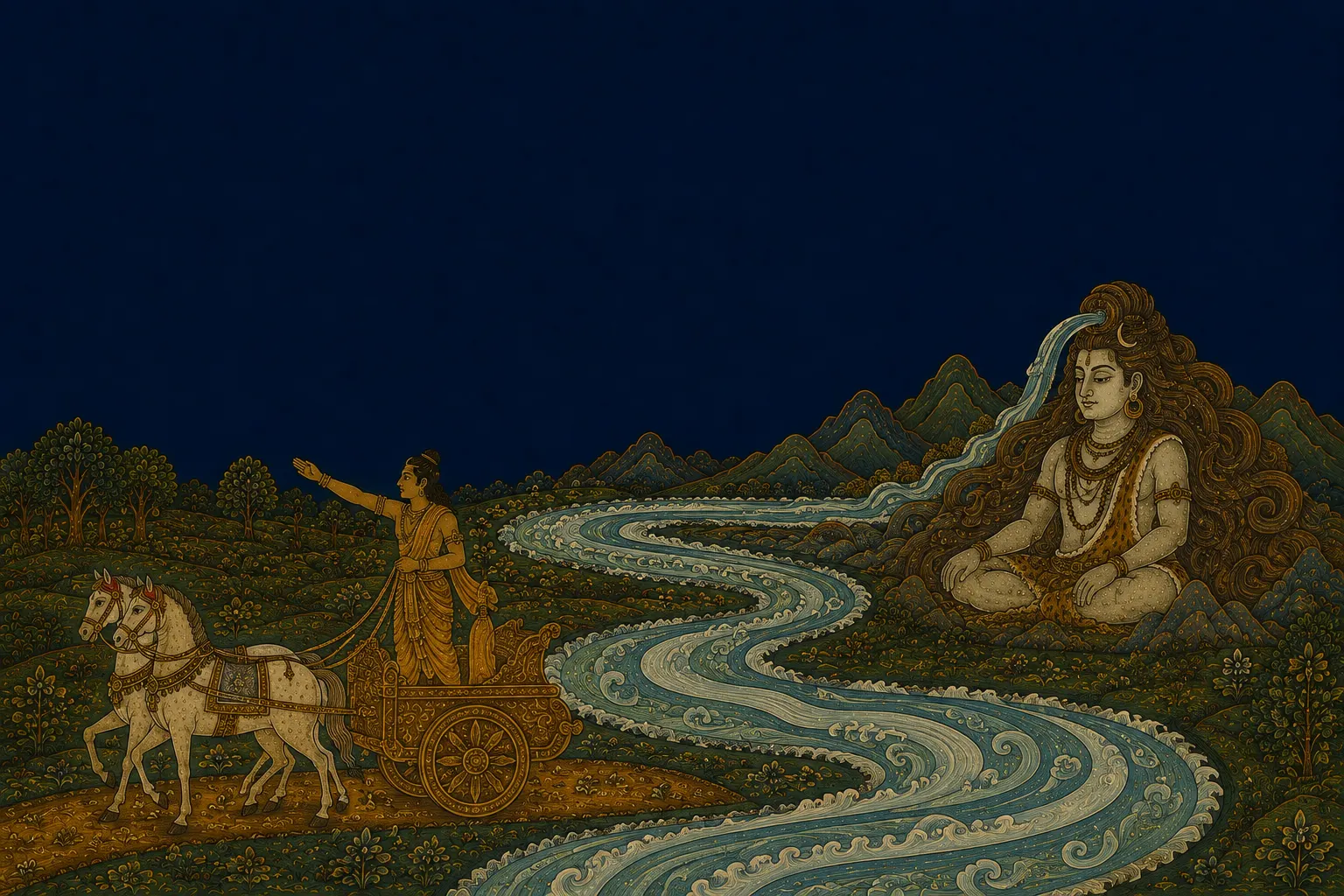
Shiva received the falling river in his matted hair and released only as much as the earth could bear.
The chariot in front
What follows is one of the story's most memorable images.
Bhagiratha drives ahead in his chariot while the Ganga follows his path. Wherever he turns, the river turns.
Along the way, the river floods the hermitage of the sage Jahnu. He drinks up her waters and later releases them, giving rise to the name Jahnavi.
At last the Ganga reaches the ashes of Sagara's sons.
The task is finally complete — generations after the mistake that made it necessary.
Note: The story of Sagara's sons, Kapila and Bhagiratha is in the Vishnu Purana (fourth amsha), and the same story is also found in the Bala Kanda of the Valmiki Ramayana and in the Mahabharata — which is to say it returns in all three. The episode of the Ganga being held in Shiva's hair is part of those same accounts. The roots of the Ganga's names — Bhagirathi and Jahnavi — are tied to this story, and the name "Sagara" for the sea to Sagara's sons.
Source: from several texts, Bhagiratha