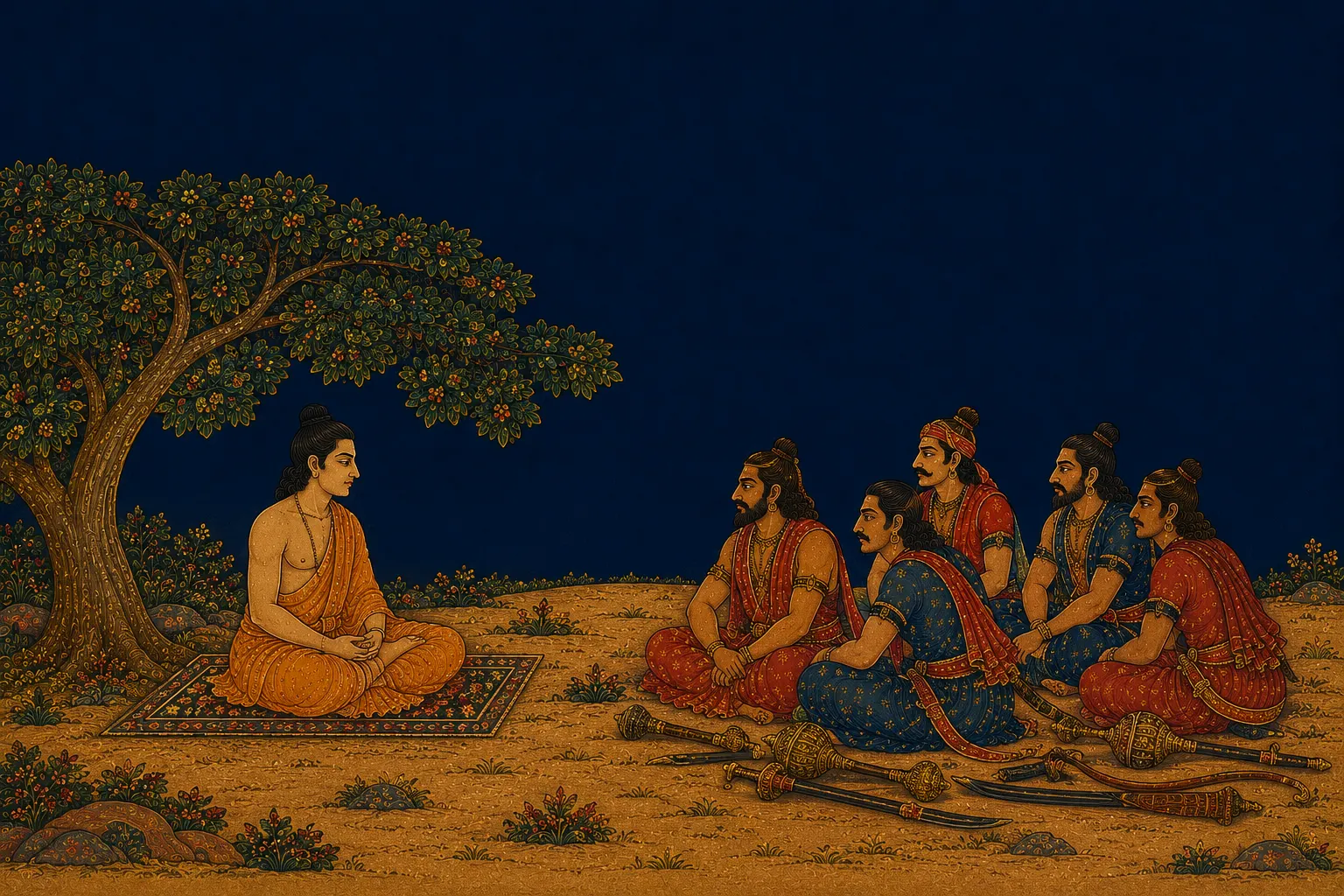
Chapter 9

Buddha

This chapter is about a claim, and about who is making it — keeping the two apart

First, plainly

This chapter is not a history of Buddhism.

It is about something more specific: how Vaishnava traditions came to place the Buddha within lists of Vishnu's avatars, and why those traditions do not all agree.

Buddhist tradition itself does not regard the Buddha as an avatar of Vishnu. So what follows should be read as a claim made within particular Vaishnava texts and traditions, not as a belief shared by Buddhism.

What the Vishnu Purana says

The Vishnu Purana contains an episode in which the asuras have become powerful because they continue to follow Vedic observances.

The devas are losing and cannot overcome them by force.

Then a figure called Mayamoha emerges from Vishnu.

Mayamoha goes among the asuras and persuades them to abandon the practices from which their strength is said to come.

They do so. Their strength declines. The devas prevail.

That form, and that name

That Mayamoha episode later became associated, in different ways, with both Buddhist and Jain traditions. It is one textual strand.

A separate strand appears in the Bhagavata Purana, which names Buddha directly in its list of avatars without presenting that identification as the same Mayamoha episode.

Later Dashavatara traditions widely placed Buddha in the ninth position. How that named Buddha-avatar and the Mayamoha story relate to one another has been interpreted differently across texts and traditions.

The distinction matters because the Mayamoha episode is not a story of rescue or liberation. Within that narrative, the figure comes to mislead the asuras away from Vedic observance.

And the list is not one list either

That tension helps explain why the ninth position varies more than the others.

Some lists place Buddha there. Others place Balarama.

And the Bhagavata Purana does not limit Vishnu's avatars to ten at all; it gives a longer list and says the manifestations are beyond counting.

This gatha follows the most widespread Dashavatara order while making clear that it is not the only one.

Note: The third amsha of the Vishnu Purana has the Mayamoha episode — the asuras grow strong by keeping the Vedic observance, and a form issuing from Vishnu persuades them to give it up, at which their strength drops. This episode was later connected to both the Buddhist and Jain traditions. The Bhagavata Purana separately gives the Buddha's name directly in its own avatar list, without tying it to Mayamoha. In later Dashavatara traditions the Buddha became widely established as the ninth avatar; how the Mayamoha episode and the named Buddha-avatar relate to each other has been understood differently across texts. This is a matter for Vaishnava tradition; Buddhist tradition does not hold the Buddha to be an avatar of Vishnu, and the claim is not its own. The ninth place is in any case the least settled — some lists put Balarama there, and the Bhagavata Purana does not stop at ten but counts twenty-two. The episode is recorded here as the text has it, without choosing an interpretation.

Source: from several texts, Buddha

Now — how much stayed with you?

Fact

Why had the asuras grown strong in that episode of the Vishnu Purana?

  • Because they had a large army
  • Because they had been given a boon
  • Because they were keeping the Vedic observance, and their strength was growing from it
  • Because the devas were fighting among themselves
Read the whole story — Where the strength came from

This is the strangest part of the episode, and it should not be softened.

Here the asuras are strong not from breaking the rule but from keeping it.

Which is why the way to beat them is not a fight. The way is that they stop keeping it — and the whole episode that follows rests on that.

Who am I?

I am a form that came out of Vishnu, and my work was not to fight. My work was to persuade — so that those who listened would give up what their strength came from. Who am I?

  • Narasimha
  • Vamana
  • Mayamoha, connected to the Buddhist and Jain traditions
  • Kalki
Read the whole story — A name that gives itself away

The word "Mayamoha" opens the episode by itself — maya and moha, which is to say the one who casts a confusion.

The Purana does not present this form as a deliverer. Its work is plainly to lead astray.

Which is why reading this episode alongside the other Dashavatara stories creates a difficulty — and the difficulty is real, and should not be hidden.

Why is that?

Why does this chapter say plainly at the start that it is not about Buddhism?

  • Because Buddhism is not in India
  • Because Buddhist tradition does not hold the Buddha to be an avatar of Vishnu
  • Because the Vishnu Purana never names the Buddha
  • Because the story is false
Read the whole story — Whose claim it is, is also a fact

This site's method is the same everywhere: tell the story, and say alongside it which text or tradition it belongs to.

Here that method matters most, because the claim concerns the founder of a living religion, and that religion does not accept it.

So it is neither hidden here nor presented as something everyone holds. It is a Vaishnava tradition's saying, and that is exactly how much has been said.

The texts disagree

Where are the differences at the ninth place of the Dashavatara list?

  • No difference anywhere
  • Rama appears at the ninth place in some
  • The ninth place is always left empty
  • In some lists the Buddha is there, in others Balarama
Read the whole story — Where the list shifts most

The Dashavatara list looks settled from outside, but at the ninth place it is least settled of all.

In some places the Buddha stands there, in others Balarama — and in the Balarama lists, Krishna's brother is counted as an avatar in his own right.

The Bhagavata Purana steps out of the argument: it does not stop at ten, counts twenty-two, and says the number may be endless.

What happened?

What happened to the asuras after Mayamoha persuaded them?

  • They grew even stronger
  • They gave up that observance, their strength dropped, and the devas won
  • They made a truce with the devas
  • They killed Mayamoha
Read the whole story — A defeat without a battle

There is no fight in this episode. No weapon is lifted.

The defeat comes only from the fact that the losing side stopped doing the thing its strength came from.

It is the one episode in this whole gatha where the avatar's work is not to save but to weaken somebody — which is why it stands apart from the other nine.

Riddle

I am on this list, and my own tradition does not put me on it. Who am I?

  • The Buddha
  • Balarama
  • Parashurama
  • Kalki
Read the whole story — One name, two places

This is one of very few places where the same person stands entirely differently in two traditions.

On one side he is the founder of a religion with its own whole body of texts, and one that does not accept this avatar claim.

On the other he is the ninth name on a list. This gatha says both things and does not set either above the other.

Fact

What does the Bhagavata Purana say about the list of avatars?

  • That there are ten, and the count is fixed
  • That twenty-two avatars can be counted, and that the count can go further still
  • That there are only four avatars
  • That no list of avatars can be made at all
Read the whole story — A count that does not close

The first skandha of the Bhagavata Purana carries a long list of avatars, and the number there runs to twenty-two.

It also says that this count is not complete — the avatars are beyond counting.

So "ten avatars" is a very widespread tradition, not the texts' closed accounting. This gatha repeats that, and this chapter is its clearest example.

Why is that?

Why does this episode feel unlike the other nine avatar stories?

  • Because here the avatar's work is not to save but to lead astray
  • Because there is no asura in it
  • Because it is in no text
  • Because Vishnu's name never appears
Read the whole story — The one reversed episode

In the other nine the work is plain: something is sinking, so lift it; somebody is oppressing, so stop them.

Here the work runs the other way. Here somebody is separated from his own strength, and by persuasion at that.

Which is why there has been unease about this episode inside the tradition as well, and why some lists put Balarama in that place instead.

Put it in order

What is the correct order of this chapter's points?

  • Mayamoha going → the asuras growing strong → the devas winning → the devas losing
  • The devas winning → the asuras growing strong → Mayamoha → losing
  • The asuras giving up the observance → Mayamoha going → the devas losing → winning
  • The asuras growing strong on the Vedic observance → the devas losing → Mayamoha going → the asuras giving up the observance → the devas winning
Read the whole story — A plain order, a tangled meaning

The order of events is the easiest part of this chapter. The hard part is deciding what to make of it.

Several readings of it run in tradition, and they do not agree with each other.

No single reading has been chosen in this gatha. The episode is recorded as the text has it — and it is also recorded that there is no agreement about it.

Later tradition

What kind of thing is the Buddha's place in the Dashavatara?

  • It is an addition of Vaishnava tradition, which Buddhist tradition does not accept
  • It comes from the Rigveda
  • It is a shared belief of both traditions
  • It is in no tradition at all
Read the whole story — An addition, and where it came from

This chapter rests on one thing: recording a story is one matter, and saying whose story it is matters even more.

In Vaishnava lists the ninth place is the Buddha's. There is no such claim in Buddhist texts, and that tradition does not hold it.

So it is written here not as "true" or "false" but as "whose saying it is" — which is what is done with every disagreement on this site.