
Chapter 11
Dhruva
A child was lifted off a lap, and walked from there until he came to rest in the sky
The lap he did not get
King Uttanapada had two queens, Suniti and Suruchi, and Suruchi was the one he favoured.
One day five-year-old Dhruva, Suniti's son, tried to climb onto his father's lap.
Suruchi stopped him.
"This place is not yours," she said. "You were not born from me. If you want such a place, perform penance and be born as my son in another life."
The king said nothing.
To his mother
Dhruva went to his mother.
Suniti did not pretend the insult had not happened. But she also did not tell him that a king's affection could simply be demanded back.
Instead, she pointed him toward something larger: seek a place no one can take away from you.
That same night, a five-year-old child left home.
In the forest
Narada met him on the way and tried to persuade him to return. Dhruva was too young, he said, for such severe penance.
Dhruva would not turn back.
So Narada gave him a mantra and taught him how to proceed.
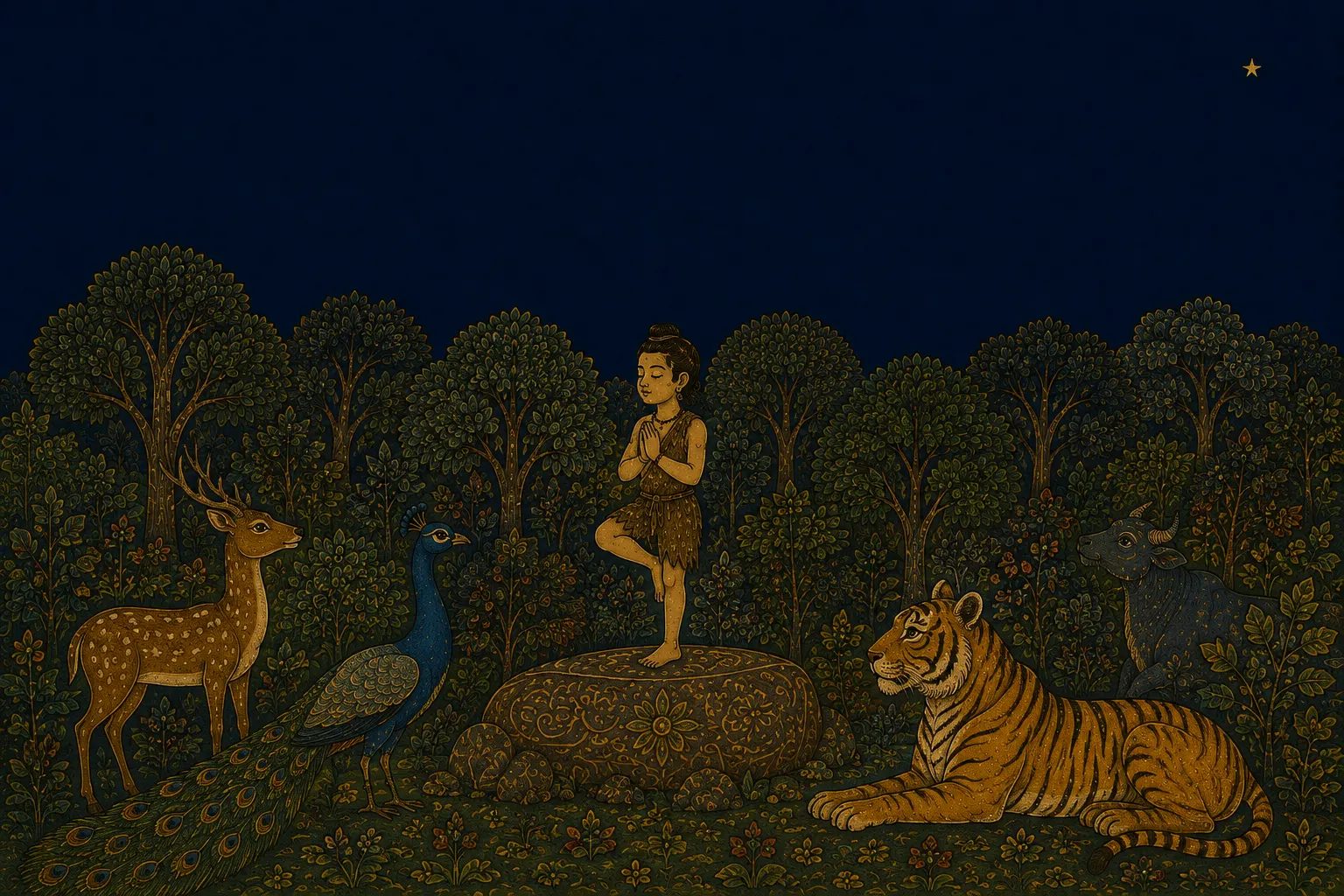
The austerity intensified month by month: first fruit, then leaves, then water, then air. By the fifth month Dhruva was standing on one leg and controlling even his breath.
At last Vishnu appeared before him.
The one who came to ask, and did not ask
And then comes the turn that gives the story its force.
Dhruva no longer asks for the thing that sent him into the forest.
His father's lap, the rivalry with Suruchi, the humiliation — all of it has become too small.
Instead, he is granted a place in the sky that does not move while the other stars turn around it.
That fixed point is remembered as Dhruva, the Pole Star.
Note: Dhruva's story is found in the Vishnu Purana (first amsha) and the Bhagavata Purana (fourth skandha) — it is the Puranas' own story and does not come from the Ramayana or the Mahabharata. The detail of the months of penance and Narada's giving of the mantra come at length in the Bhagavata. The connection of this story to the pole star is recorded in the texts themselves and is not a later addition.
Source: from several texts, Dhruva