
Chapter 14
Jada Bharata
A king gave everything up, and in the end was defeated by a fawn
The one who gave it all up
Bharata had been a powerful king. He divided his kingdom among his sons and withdrew to the forest.
There he devoted himself to austerity, discipline and solitude.
At the riverbank
Then, one day, a doe came to drink at a river just as a lion roared nearby.
Startled, she leapt across the water. Her fawn fell into the river. The doe made it to the other side, but collapsed and died a short distance away.
Bharata rescued the fawn.
What happened slowly
At first, that was all he did.
Then he fed it. Sheltered it from the sun. Kept it near him at night.
Gradually, care became attachment. Even during meditation, Bharata found himself wondering where the deer had gone, whether it had returned, whether some predator had taken it.
He had come to the forest to free himself from attachment. Now attachment had found him again, in the form of a small animal.
And the next birth
And when Bharata died, his mind was still fixed on the deer.
So, the story says, his next birth was as a deer.
In that life he remembered what had happened before and understood how he had arrived there.
Jada Bharata
When he was born human again, he refused to repeat the same mistake.
He attached himself to nothing, showed no interest in ordinary work, and allowed people to assume he was simple-minded. The name stuck: Jada Bharata.
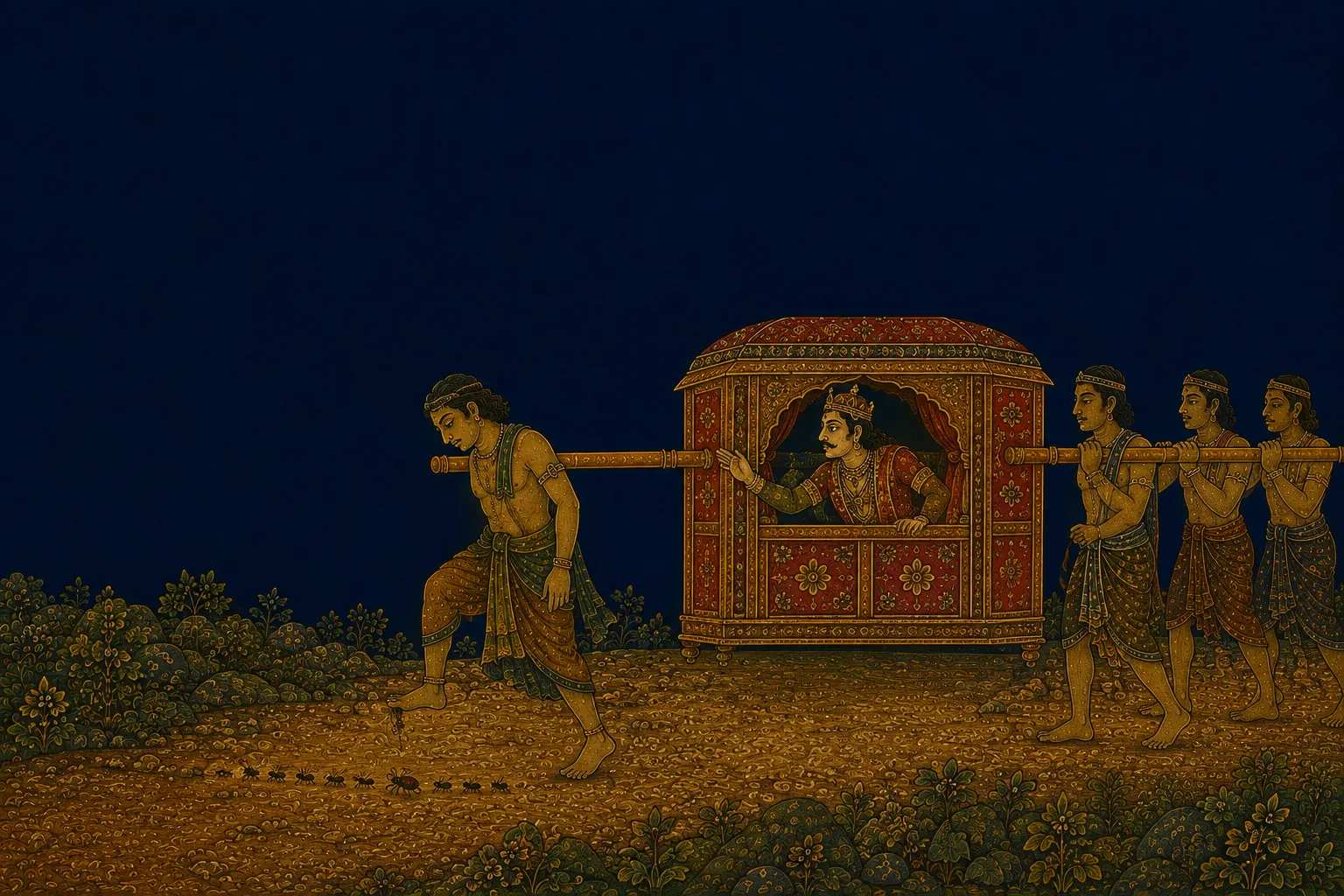
One day he was seized and forced to help carry a king's palanquin.
He walked strangely because he was watching the ground, stepping carefully around insects. The palanquin lurched with every uneven step.
The king grew angry and rebuked him. Then the man everyone had taken for a fool began to speak.
What follows is the longest and most philosophical part of his story.
Note: The story of Jada Bharata is found in the second amsha of the Vishnu Purana and the fifth skandha of the Bhagavata Purana, and the Bhagavata gives it several chapters — particularly the conversation with King Rahugana. Note that this Bharata is not the Bharata of the Ramayana; he is said to be the son of Rishabhadeva, and tradition traces the name "Bharatavarsha" to him. The rule that the thought at the end decides what follows is found in both the Puranas and the Gita, and this story sets it out as a story.
Source: from several texts, Jada Bharata