Chapter 10

Kalki

The only avatar with no story at all — only a description

The one that has not happened

Each of the first nine avatars comes with a story: a flood, a sinking earth, a pillar, three strides, a war.

With Kalki, none of that has happened yet.

There is no completed story, only a description of a future figure.

That is why this chapter is the shortest, and why it should remain so.

What the texts say

Both the Vishnu Purana and the Bhagavata Purana describe a time near the end of the Kali Yuga.

By then, the texts say, social and moral order has badly deteriorated.

At that time, Kalki will be born in a brahmin household in a village named Shambhala.

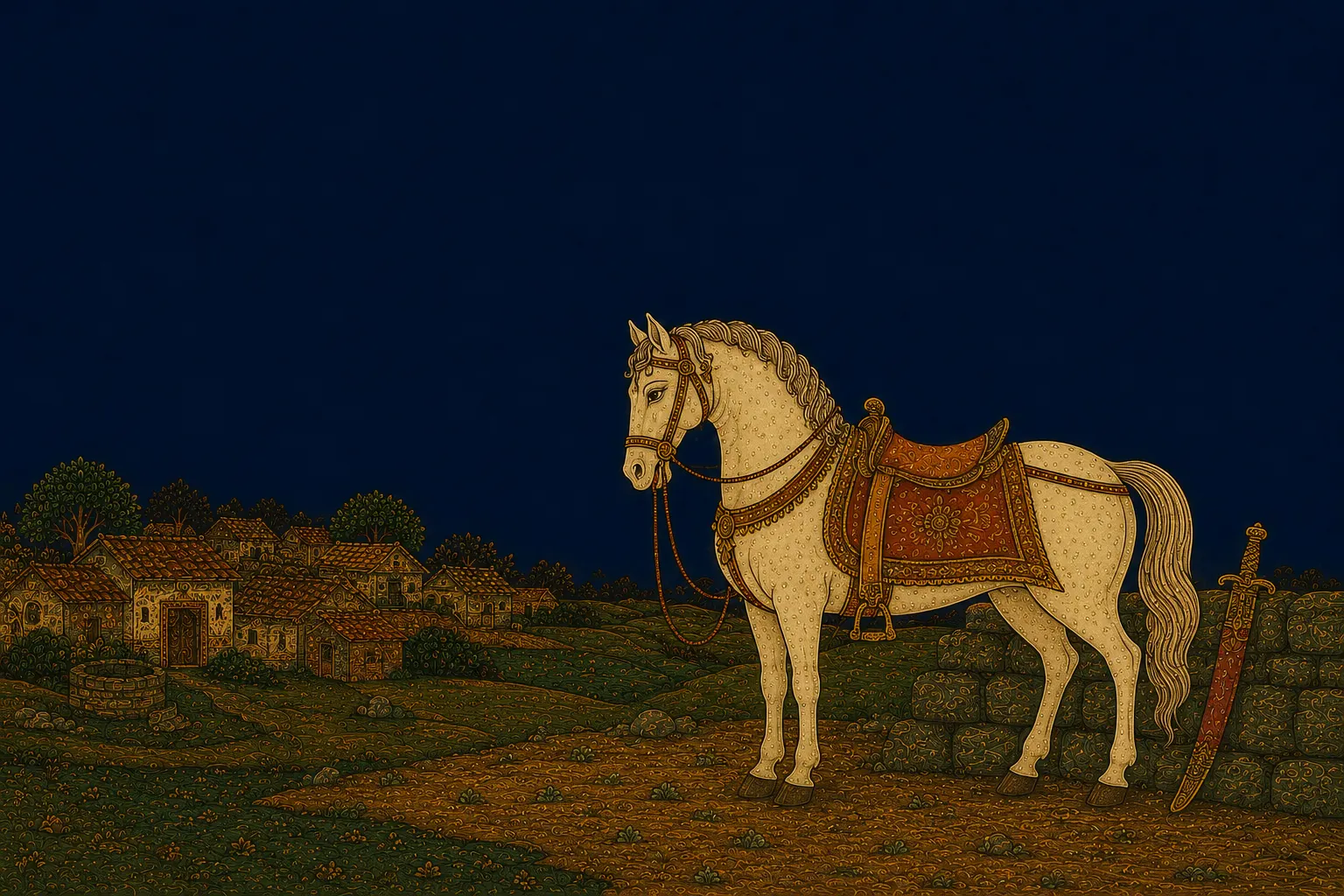
A white horse

The descriptions repeatedly associate him with a horse, a sword and the ending of the age.

Unlike the earlier avatars, Kalki does not come to explain, to bargain, or to rescue something already sinking.

His role is to bring an age to its close.

And again

And that is where the sequence curves back toward its beginning. After the Kali Yuga comes Satya Yuga, and the cycle begins again.

The first chapter was about renewal after a deluge. This one is about renewal after the end of an age.

They share the same pattern, but they are not the same event.

Note: The description of Kalki is found in the Vishnu Purana (at the end of the fourth amsha, with the description of the Kali Yuga) and in the Bhagavata Purana (twelfth skandha). It would be wrong to call it a story — it is a description placed in the future, and it holds not events but signs: the village of Shambhala, birth in a brahmin household, a white horse, a sword, and the ending of an age. This chapter has been kept deliberately short, because the texts hold no more than that, and inventing what is not there is not this site's method.

Source: from several texts, Kalki

Now — how much stayed with you?

Fact

What is the most basic thing about Kalki that sets him apart from the other nine?

  • That he has no story
  • That he is not counted an avatar of Vishnu
  • That his description is in no text
  • That he has already come
Read the whole story — A description, not a story

Events attach to the other nine avatars — a sinking earth, a pillar, a sacrificial hall.

Nothing attaches to the tenth, because it has not happened. What there is, is a description: when he will come, what he will look like, what he will do.

Which is why this chapter is deliberately short. Exactly as much as the texts say.

Who am I?

I am the name of a village, and according to the texts the tenth avatar will be born there. What am I?

  • Dwarka
  • Ayodhya
  • Mathura
  • Shambhala
Read the whole story — A village that was named

This detail is interesting because it is so concrete — the rest of the description is general, but the place is named plainly.

Both major texts agree on the name, and it is one of very few things in a description of the future that carries a name at all.

Everything else — the time, the conditions, the work — is given in general terms, with no date.

What happened?

What do the texts say about the time when Kalki will come?

  • That everyone will be happy then
  • That a given word will be worth nothing, and whoever has more will be taken to be right
  • That there will be no war then
  • That the earth will have drowned by then
Read the whole story — A description of the everyday

The description of the Kali Yuga comes at length in the texts, and its weight falls not on any cataclysm but on ordinary things breaking down.

Little speech and much display, promises worth less, power taken for rightness — these are what get listed again and again.

Which is why the description has felt like their own time to people in every century, and it is useful to remember while reading it that it was not written about any one of them.

Riddle

My colour is white, I appear in every description of the tenth avatar, and I say nothing at all. What am I?

  • The white horse Kalki comes on
  • Kalki's sword
  • The village of Shambhala
  • The boat Manu sat in
Read the whole story — Three things that keep returning

Three things appear in nearly every description of Kalki: a white horse, a sword, and the ending of an age.

The other details shift text to text, but these three hold, and these three are what the pictures show as well.

Which is why this avatar is the most easily recognised of them all, while having no story at all.

Why is that?

How does this gatha's last chapter join up with its first?

  • Because the same asura is in both
  • Because there is a white horse in both
  • Because both share the same shape
  • Because the village of Shambhala appears in both
Read the whole story — A list that is a circle

The Matsya chapter rests on a deluge, after which the world begins again.

The Kalki description rests on an age ending, after which Satya Yuga returns and the cycle begins again.

Which is why the Dashavatara has long been read as a cycle as well as a row — and the first and last chapters of this gatha point to the same shape, without being the same event.

Fact

Which texts is the description of Kalki found in?

  • Only in later folk tradition
  • Only in the Ramayana
  • In none of them
  • In both the Vishnu Purana and the Bhagavata Purana
Read the whole story — A future that is written down

The end of the fourth amsha of the Vishnu Purana describes the Kali Yuga, and this avatar comes with it.

The twelfth skandha of the Bhagavata Purana has the same, with some further detail.

Which is to say it is not an addition of some later tradition. It is in the same texts the rest of this gatha comes from.

Who said it?

"This avatar does not come to explain, nor to ask, nor to lift" — which three chapters does this point back to?

  • Rama, Krishna and Parashurama
  • Matsya, Kurma and Narasimha
  • Buddha, Vamana and Varaha
  • Kalki, Buddha and Rama
Read the whole story — Everything already done

Read as a row, each avatar in this gatha has a different piece of work — lifting, holding, digging, tearing, asking, persuading.

For the tenth, none of these is left. His work is described as unlike all of them: closing an account.

Which is why his description is the shortest and the plainest of them all.

The texts disagree

What position does this gatha take on the Dashavatara list?

  • That the list of ten is the only one, and settled
  • That the most widespread list has been taken, while saying it is not the only one
  • That no list can be trusted
  • That the Bhagavata's list of twenty-two is the right one
Read the whole story — Choosing a list, and saying why

The method on this site is the same throughout — a text or a list is chosen, and alongside it is written what the others say.

The widespread list of ten has been taken here, because it is the one most recognised.

But the dispute at the ninth place, and the Bhagavata's count of twenty-two, are both recorded — not hidden.

Put it in order

What is the widespread order of the ten avatars?

  • Matsya → Varaha → Kurma → Vamana → Narasimha → Parashurama → Krishna → Rama → Buddha → Kalki
  • Kurma → Matsya → Varaha → Narasimha → Vamana → Rama → Parashurama → Krishna → Buddha → Kalki
  • Matsya → Kurma → Varaha → Narasimha → Vamana → Parashurama → Rama → Krishna → Buddha → Kalki
  • Matsya → Kurma → Narasimha → Varaha → Vamana → Parashurama → Rama → Buddha → Krishna → Kalki
Read the whole story — From water to man

There is a slope visible in this order — the first three are tied to water, the fourth is half animal, the fifth is the first whole human, and after that all are human.

That reading is a later one and not a claim the texts make. But the list supports it, which is why the reading spread so far.

The first ten chapters of this gatha follow that order, and the six after them belong to people who never descended — they stayed.

Why is that?

Why is this chapter the shortest of them all?

  • Because Kalki matters less
  • Because that is all the texts have about him
  • Because his description is in no text
  • Because his story is in another chapter
Read the whole story — As much as there is, and no more

One of this site's rules is that where the texts say little, nothing is padded out to make it longer.

What exists about Kalki is a description, and turning it into a story would mean inventing something.

So this chapter is short, and its being short is itself a piece of information.