Chapter 8

Krishna

This avatar knew who he was — and that is the whole difference

The third birth

The curse of Jaya and Vijaya runs through three births.

First they appear as Hiranyaksha and Hiranyakashipu, whose stories belong to Varaha and Narasimha.

Then as Ravana and Kumbhakarna in the Ramayana.

Their third and final birth is as Shishupala and Dantavakra, in Krishna's time.

So a thread that began several chapters ago closes here.

The same shape, again

Krishna's own story begins in Mathura with a ruler who has been warned about the manner of his death.

Kamsa responds as rulers in these stories often do: he tries to seal every route by which the prediction might come true. He imprisons, counts births and watches the same door again and again.

And, as so often happens in these stories, the attempt to prevent the prophecy becomes part of the path by which it is fulfilled.

What is different

But Krishna differs sharply from Rama.

Rama does not stand within his own story and declare who he is. Krishna does.

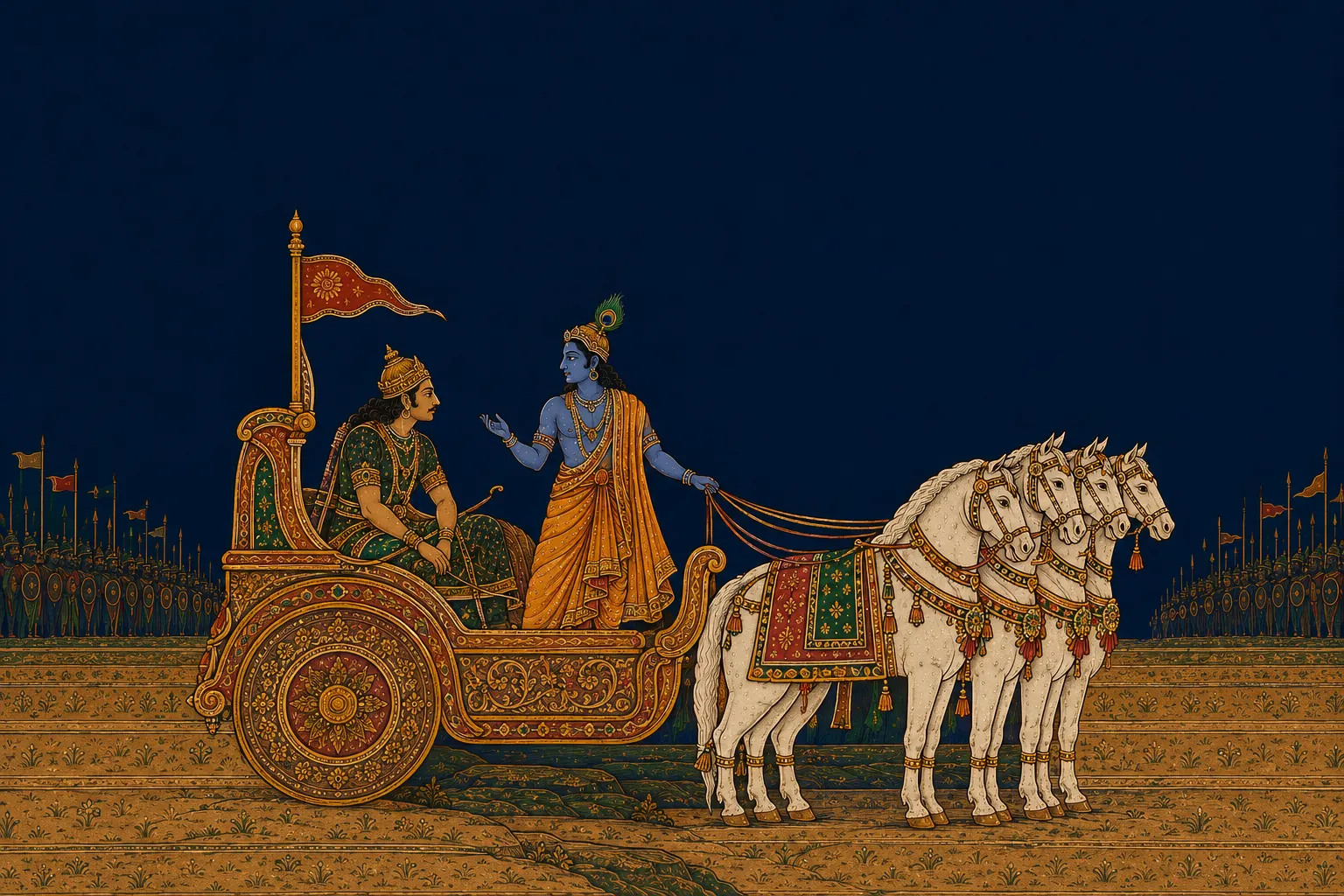
On the battlefield of Kurukshetra, he tells Arjuna directly, and that conversation becomes the Bhagavad Gita, standing apart within the Mahabharata.

This is why Krishna is read differently from the earlier avatars: here, the figure inside the story speaks openly about his own divine identity.

Where the rest of the story is

His childhood in Gokul, Kaliya, Govardhan, Mathura and Dwarka belongs to the Krishna-Leela section of this site.

Kurukshetra belongs to the Mahabharata.

This chapter does not repeat those stories. Its purpose is simply to place Krishna within the larger sequence.

Note: Krishna is counted eighth among the ten avatars, and his whole story is on this site separately in Krishna-Leela — so this chapter does not repeat it. The fifth amsha of the Vishnu Purana is entirely Krishna's story. The difference worth noticing is that the Mahabharata has no childhood for Krishna; that comes in the Harivamsha and the tenth skandha of the Bhagavata Purana, which is to say in a later layer. The three-birth frame of Jaya and Vijaya is the Bhagavata's. The greatest variation in the Dashavatara list is at the ninth place, where some lists have Balarama in Buddha's stead.

Source: from several texts, Krishna

Now — how much stayed with you?

Fact

What place does Krishna hold in the widespread list of ten avatars?

  • Seventh
  • Ninth
  • Tenth
  • Eighth
Read the whole story — Eighth, and eighth

One coincidence is worth noticing — Krishna is the eighth avatar in the list, and also Devaki's eighth child.

The coincidence is not a claim the texts make, but tradition repeats it often.

The first chapter of Krishna-Leela begins with exactly that prophecy about an eighth child.

Who am I?

I am the third and last birth of Jaya and Vijaya's curse, and my end came at Krishna's hands. Who am I?

  • Ravana
  • Hiranyakashipu
  • Kamsa
  • Shishupala
Read the whole story — The chain closes

According to the Bhagavata, Jaya and Vijaya chose three births as enemies over seven as devotees, because that way the return would take less time.

All three births are spread across this site — the first in Vishnu-Puran, the second in the Ramayana, the third in Krishna-Leela and the Mahabharata.

Which is what makes this frame special for this site: it ties three separate epics together with a single thread.

Why is that?

What is held to be the biggest difference between the Rama and Krishna avatars?

  • Krishna had weapons and Rama did not
  • Rama never claims inside the story to be Vishnu, and Krishna does
  • Rama's story is long and Krishna's short
  • Krishna is a god and Rama a man
Read the whole story — What was said, and what was not

This difference is one of craft, and it is a large one. Rama's story is seen from outside — the reader knows, the characters do not.

In Krishna's story that curtain is drawn back. He says it himself, and the listener is standing on the same chariot.

Which is why Rama's story reads like a life, and Krishna's has a part in it that speaks straight to the reader.

Fact

In which text are Krishna's childhood exploits found at greatest length?

  • In the Mahabharata
  • In the tenth skandha of the Bhagavata Purana
  • In the Rigveda
  • In the Ramayana
Read the whole story — A childhood that was added later

In the Mahabharata, Krishna is a statesman, a charioteer and an adviser. Butter, Gokul, the gopis — none of it is there.

That whole childhood comes in the Harivamsha, which is called an appendix to the Mahabharata, and then appears at its fullest in the tenth skandha of the Bhagavata Purana.

Which is to say the Krishna best known today — of the flute and the butter — is a later layer of the story, and one more example of the shape that keeps appearing in this gatha.

What happened?

What was the second birth of the Jaya–Vijaya curse?

  • Ravana and Kumbhakarna
  • Shishupala and Dantavakra
  • Kamsa and Jarasandha
  • Hiranyaksha and Hiranyakashipu
Read the whole story — Three births, three epics

The first birth is in the Varaha and Narasimha chapters — in this gatha.

The second is in the Ramayana, where the two brothers are in Lanka.

The third is in Krishna's time. All three can be read on this site, and one curse joins them.

Riddle

I stood on a chariot, just before a war began, and said what no other avatar on this list has said. Who am I?

  • Rama
  • Parashurama
  • Vamana
  • Krishna
Read the whole story — Words spoken on a chariot

The Bhishma Parva of the Mahabharata carries the passage known separately as the Gita — the war is halted, and a charioteer is talking to the man he drives.

That is the one place where the avatar says what he is, and it is what separates him from the other nine.

On this site that portion is in the Mahabharata, in the Bhishma Parva chapter.

Who said it?

"The attempt to escape became the road by which the end arrived" — which figures does this shape repeat with in this gatha?

  • Hiranyakashipu, Ravana and Kamsa
  • Only Kamsa
  • Only Ravana
  • None of them
Read the whole story — One shape, three times

Hiranyakashipu closed every route in his boon, and the end came from between those very conditions.

Ravana did not count men or vanaras, and it was those two who came.

Kamsa doubled the guard and kept a count, and the one he feared came through at the eighth of that count. All three times the defence became the road.

Why is that?

Why has Krishna been given only one chapter in this gatha too?

  • Because his whole story is on this site separately in Krishna-Leela, in eighteen chapters
  • Because his story matters less
  • Because the Vishnu Purana does not have his story
  • Because his story is not complete in any one text
Read the whole story — Avoiding repetition

The fifth amsha of the Vishnu Purana is entirely the story of Krishna — which is to say that if this gatha followed that text to the letter, eighteen chapters would have to be written over again.

That same story is already on this site, with all its source distinctions.

So this chapter is a door and not a wall — exactly as the previous chapter was for Rama.

The texts disagree

What difference is found around Krishna in some lists?

  • Krishna is left out of the list
  • Krishna is called the tenth avatar
  • Some lists count Balarama as an avatar, and in places he stands where Buddha does
  • Krishna is called the first avatar
Read the whole story — A list that keeps shifting

The Dashavatara list looks fixed and is not. The largest difference is at the ninth place, where some have Buddha and others Balarama.

The Bhagavata Purana steps out of the argument altogether: it counts twenty-two rather than ten, and says the count can go further still.

Which is why this gatha takes the most widespread list while saying it is not the only one. The next chapter sits on exactly that disputed place.

Put it in order

What is the correct order of the three births of Jaya and Vijaya?

  • Ravana–Kumbhakarna → Hiranyaksha–Hiranyakashipu → Shishupala–Dantavakra
  • Shishupala–Dantavakra → Ravana–Kumbhakarna → Hiranyaksha–Hiranyakashipu
  • Hiranyaksha–Hiranyakashipu → Ravana–Kumbhakarna → Shishupala–Dantavakra
  • Hiranyaksha–Hiranyakashipu → Shishupala–Dantavakra → Ravana–Kumbhakarna
Read the whole story — One thread, three ages

This order passes through three different places on this site, and the same two return every time.

In each birth they come up against Vishnu and are beaten, and according to the story this was the road they chose — because the return was quicker on it.

The frame is the Bhagavata's, and it is the only thread that ties three of this site's epics together at once.