Chapter 2

Kurma

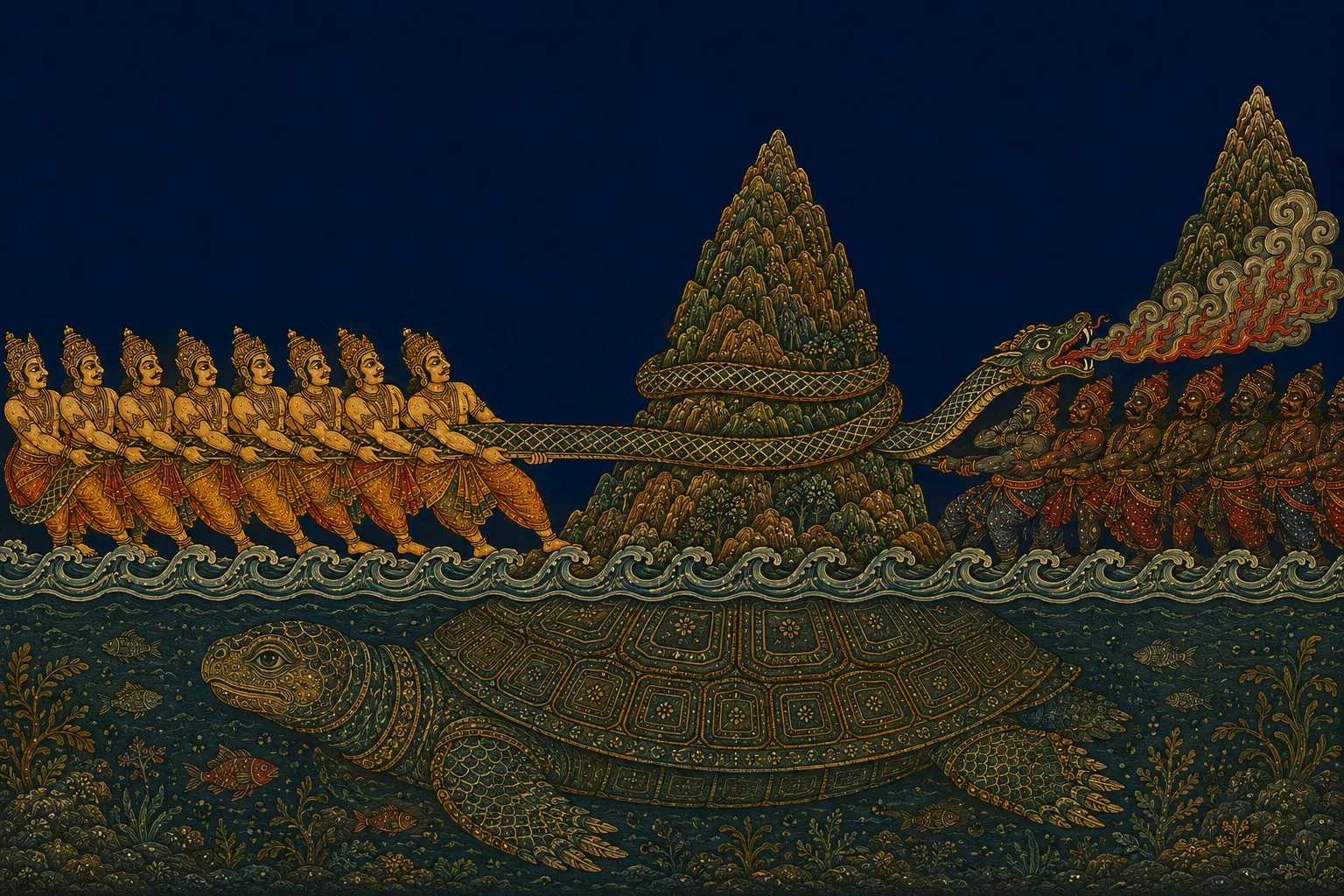
Devas and asuras stood at opposite ends of one rope, and beneath them the mountain was sinking

The ones who were losing

The devas were losing strength. With every battle they gave up a little more ground.

Only one hope remained: amrita, the nectar of immortality, hidden somewhere in the cosmic ocean.

But no one could churn an ocean alone. So the devas turned to the very asuras they had been fighting.

A bargain was struck: they would churn the ocean together and divide whatever emerged.

No one expected the agreement to survive until the end.

The churn and the rope

Mount Mandara was uprooted to serve as the churning rod, and the serpent Vasuki became the rope.

The asuras refused to hold the tail; they insisted on the head. The devas did not argue and took the other end.

The churning began.

Smoke and fire poured from Vasuki's mouth, scorching the asuras at the head.

The mountain that began to sink

Then the mountain began to sink. There was nothing firm beneath it, only the soft floor of the ocean.

The rope slackened. The churning stopped.

At that moment, an enormous tortoise rose beneath the water and settled under the mountain. Mandara rested on its back.

The churning began again.

What came up first

But the first thing to emerge was not amrita.

It was halahala — a poison so deadly that even its fumes drove both sides back.

No one stepped forward until Shiva did. He drank the poison, and its effect marked his throat blue. From that came the name Neelkanth.

The ocean was churned again.

And then everything

Then came its treasures: Kamadhenu, Airavata, Uchchaihshravas, the Kaustubha jewel, the Parijata tree, the apsaras, and Lakshmi, who emerged and chose Vishnu.

Last came Dhanvantari, carrying the pot of amrita.

And with that, the bargain collapsed. The asuras seized the pot.

Note: The churning of the ocean is one of those episodes found in several major texts — the Vishnu Purana (first amsha), the Bhagavata Purana (eighth skandha) and the Adi Parva of the Mahabharata. The basic shape is the same everywhere: the truce, Mandara, Vasuki, the sinking mountain, the tortoise, the halahala, the treasures and the amrita. But the list of what emerged does not match — the count is held to be fourteen, yet the names shift from text to text, and what is taken here is what appears in almost every list. The Mohini and Rahu episode is in the Bhagavata and the Mahabharata.

Source: from several texts, Kurma

Now — how much stayed with you?

Why is that?

Why did the devas make a bargain with the asuras they were fighting?

  • Because the ocean could not be churned alone, and without amrita they were losing steadily
  • Because the asuras had asked for a truce
  • Because Vishnu ordered the two sides to join
  • Because the asuras knew where the amrita was
Read the whole story — Working with the enemy

This is the most practical moment in the whole gatha — no devotion in it, no miracle, only the arithmetic that it cannot be done alone.

Nobody wanted the bargain and both sides knew it would break. It was made anyway.

Which is why the ending does not surprise. The pot being seized was written into that bargain from the start.

Fact

What served as the churning staff and the rope?

  • Mount Mandara and the serpent Vasuki
  • Mount Govardhan and Shesha
  • The Himalaya and the Ganga
  • Kailasa and Vasuki
Read the whole story — The same Vasuki, again

This is the second time Vasuki has become a rope in this gatha — first for Manu's boat on the night of the deluge, now for the churning staff.

Both times the work is the same: holding two things together while everything else is moving.

The choice of Mandara is not incidental either — the story needed a mountain that could be pulled up, and that is the one that then begins to sink.

Who am I?

I came when the mountain began to sink. I did nothing at all; I simply settled underneath. Who am I?

  • Vasuki
  • Varaha
  • Kurma
  • Dhanvantari
Read the whole story — The one who did nothing

Of the ten avatars Kurma is perhaps the least dramatic — he does not fight, does not speak, asks for nothing.

His entire work is to stay put, under the water, where neither of the two lines standing above him is even looking at him.

The story leaves it exactly like that. The mountain turns again and the churning goes on — and nobody is told what is underneath.

What happened?

What was the first thing to come out of the ocean?

  • Lakshmi
  • The pot of amrita
  • The halahala poison
  • Airavata
Read the whole story — Poison first, then everything else

This order looks very deliberate — the first thing to surface is the one thing nobody wants.

Both lines stepped back. There was no claimant for the halahala, while everything else was fought over.

That is the sharpest part of the episode: the bargain to share held only as long as there was something worth sharing.

Who said it?

Who drank the halahala, and what happened to him?

  • Vishnu, and he turned blue
  • Shiva, and the poison's effect showed at his throat, which turned blue
  • Brahma, and nothing happened to him
  • Indra, and he fell unconscious
Read the whole story — Neelkanth

Shiva drinks the poison, and its clearest mark is left at his throat — the blue colour. "Deliberately holding it in his throat" is a later popular gloss; the original account simply says the poison was drunk and the throat turned blue.

The name "Neelkanth" comes from that, and it is one of very few names that comes not from a victory but from an injury.

Worth noticing: this is a chapter about Vishnu, and its greatest act is Shiva's. The texts do not hide that.

The texts disagree

How many things came out of the churning of the ocean?

  • Exactly seven, in every text
  • Only the amrita; the rest is later tradition
  • Exactly twenty-one
  • The count is held to be fourteen, but the lists do not fully match text to text
Read the whole story — Fourteen, more or less

"Fourteen treasures" is the most widespread count, and nearly every list has Lakshmi, Kamadhenu, Airavata, Uchchaihshravas, the Kaustubha, the Parijata, Dhanvantari and the amrita.

But the remaining names shift from text to text — sometimes the moon is added, sometimes Varuni, sometimes a conch or a bow.

So the number is worth remembering and the list is not. What is recorded here is what appears almost everywhere, with the caveat that there is no single list.

Who am I?

I came out of the churning, and the moment I did I went and stood beside Vishnu. Who am I?

  • The Ganga
  • Urvashi
  • Lakshmi
  • Kamadhenu
Read the whole story — Where the pair began

Lakshmi rising from the sea and choosing Vishnu directly is the moment tradition treats as the beginning of that pairing.

Which is why the churning is not only the story of the amrita; several things come out of it that return in later stories.

Airavata goes to Indra, Uchchaihshravas is counted first among horses, and the Kaustubha hangs at Vishnu's throat.

Why is that?

Why did the asuras choose Vasuki's head end?

  • Because the grip was better there
  • Because the devas handed them that end
  • Because Vishnu told them to
  • Because holding the tail seemed an insult to them
Read the whole story — A question of pride

This small detail is the most human thing in the whole story — before the work even began, the quarrel was about which end carried less honour.

The asuras chose the head, and the fire and smoke from Vasuki's mouth fell on them throughout the churning.

The devas did not argue. The story does not say they knew — only that they took the tail.

Put it in order

What is the correct order of this chapter's events?

  • The halahala → the truce → Mandara sinking → the amrita
  • The truce → Mandara and Vasuki → the mountain sinking and Kurma → the halahala → the treasures and the amrita
  • Kurma arriving → the truce → the churning beginning → the halahala
  • The amrita → the halahala → the treasures → the truce
Read the whole story — One task, halted twice

What is worth noticing in this order is that the churning stops twice — first when the mountain sinks, then when the poison comes up.

Both times the work goes on only because somebody takes on what nobody else will — once Kurma, once Shiva.

And the moment there is nothing left worth taking on, the bargain breaks. The pot is seized, and the next story starts there.

Later tradition

What happened after the amrita was seized, and where is that episode found?

  • Nothing; the asuras drank it
  • Vishnu took the form of Mohini and, on the pretext of sharing it out, gave the amrita to the devas
  • The devas won the pot back in battle
  • This episode is in no text
Read the whole story — Mohini, and a theft

This episode is in both the Bhagavata Purana and the Mahabharata — Vishnu comes in the form of a woman, both sides hand over the job of sharing it out, and the amrita reaches the devas.

In the middle of it an asura named Rahu slipped into the devas' line and took a mouthful. The sun and the moon recognised him and his head was struck off — but the mouthful had been taken, so the head lived on.

The traditional explanation of eclipses attaches to this: Rahu goes on trying to swallow the very two who gave him away.