
Chapter 1
Matsya
A fish so small came into a king's cupped hands that he could barely see it
Something moved in his cupped hands
The king was standing at the riverbank, making a water offering. He cupped his hands, filled them with water, and was just about to let it fall when something moved between his palms.
It was a fish, no bigger than the tip of a finger.
"Don't put me back," it said. "There are bigger fish out there. They'll eat me."
The king placed it in a water jar and thought no more about it.
The one no vessel could hold
By morning, the fish had outgrown the jar.
He moved it to a larger pot. That became too small. Then a well. Then a tank. By evening, even the tank could no longer contain it.
At last the king carried the fish to the sea. Only then did it speak again.
"Listen carefully. In seven days, the waters will rise and everything will be submerged."
A boat, and seven men
The instructions were simple: build a boat, bring aboard the seven sages, gather every kind of seed and living creature, and wait for the flood.
The king asked only one question. "What will I tie the boat to?"
"To my horn," said the fish. "The rope will be provided."
When the water came
On the seventh day, sky and sea seemed to merge into one.
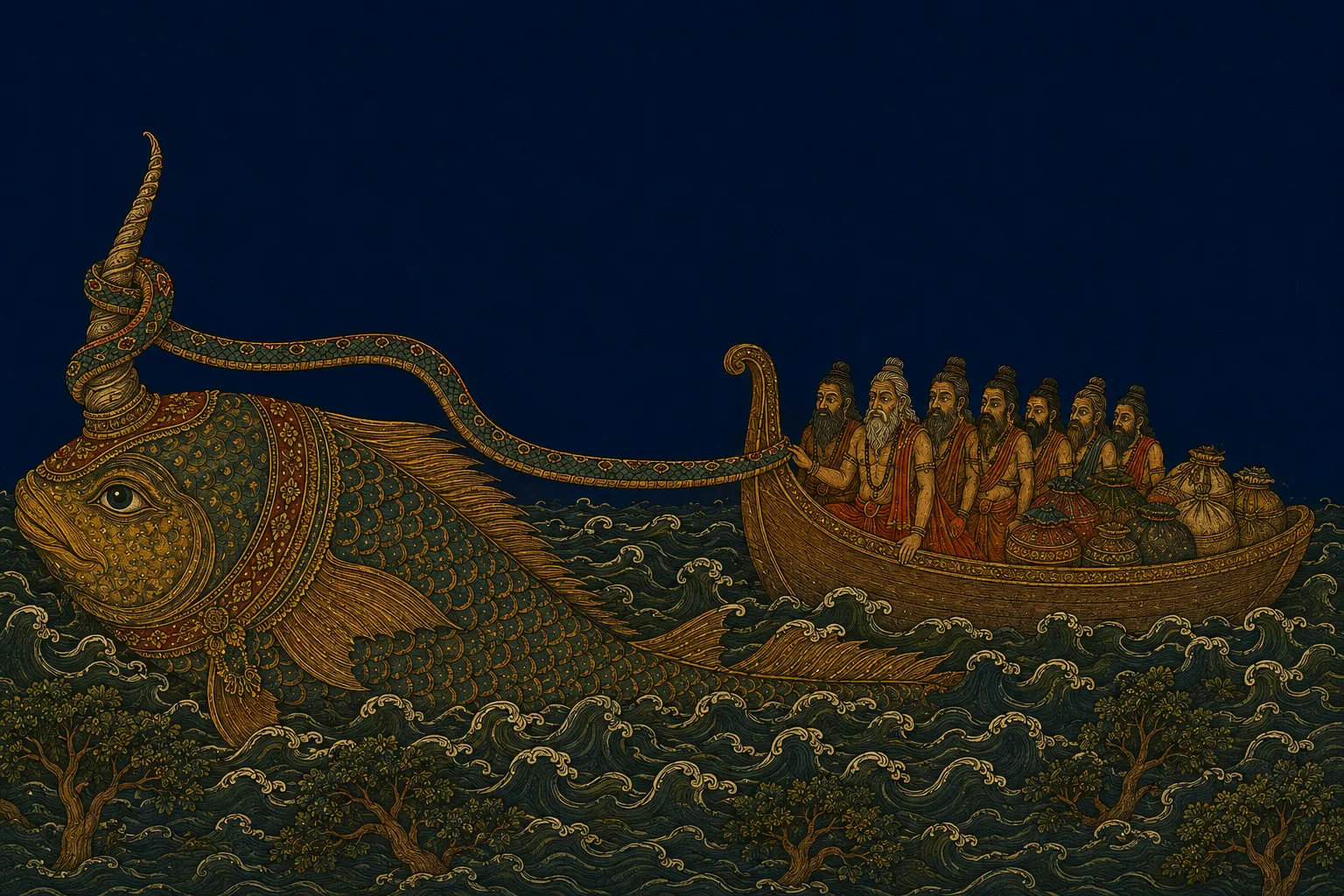
The boat rose with the water. Above the waves appeared the single horn of the enormous fish, and the serpent Vasuki served as the rope that bound the boat to it.
Through the night of the deluge, the fish pulled the boat across a world with no shore and no direction — only water, darkness, and trust in whatever was leading them forward.
When the waters finally receded, the world could begin again from what had been preserved aboard that one boat.
Note: The oldest known form of this story is in the Shatapatha Brahmana, and there the fish is not called an avatar of Vishnu — it is simply a fish whose life is saved. The same story is told at length in the Vana Parva of the Mahabharata and in the Matsya Purana, and the avatar identification is the Puranic layer. The Bhagavata Purana (eighth skandha) calls the king Satyavrata and adds the episode of the asura Hayagriva stealing the Vedas, which is absent from the older forms. Nor is the list of ten avatars a single list — the Bhagavata counts twenty-two, and in some lists Balarama stands where Buddha does.
Source: from several texts, Matsya