
Chapter 4
Narasimha
There was no hole in the boon — which is exactly why the whole thing was one
What was asked for, item by item
Hiranyaksha was dead, but his brother Hiranyakashipu did not rush into revenge. He went away to perform severe penance.
Years later, Brahma appeared before him and offered a boon.
Hiranyakashipu knew he could not ask for immortality, so he tried to close every possible path to death.
"Let me not die at the hands of man or beast. Not by day or by night. Not indoors or outdoors. Not on the ground or in the sky. Not by any weapon, whether thrown or held. Not by a god, and not by an asura."
Brahma granted the boon.
Hiranyakashipu returned believing he had made himself untouchable. He forbade the worship of Vishnu throughout his kingdom.
The enemy inside the house
Then his own son was born.
Prahlada spoke Vishnu's name constantly.
He was reasoned with, scolded, sent to teachers and brought back again. Nothing changed.
So persuasion gave way to violence. He was poisoned, placed beneath elephants, left among snakes, thrown from a height and put into fire.
Every attempt failed.
"So he is in this pillar?"
At last Hiranyakashipu demanded to know where this god of Prahlada's was.
"Everywhere," the boy said.
Hiranyakashipu pointed to a pillar in the hall.
"In this too?"
"In this too."
On the threshold, at dusk
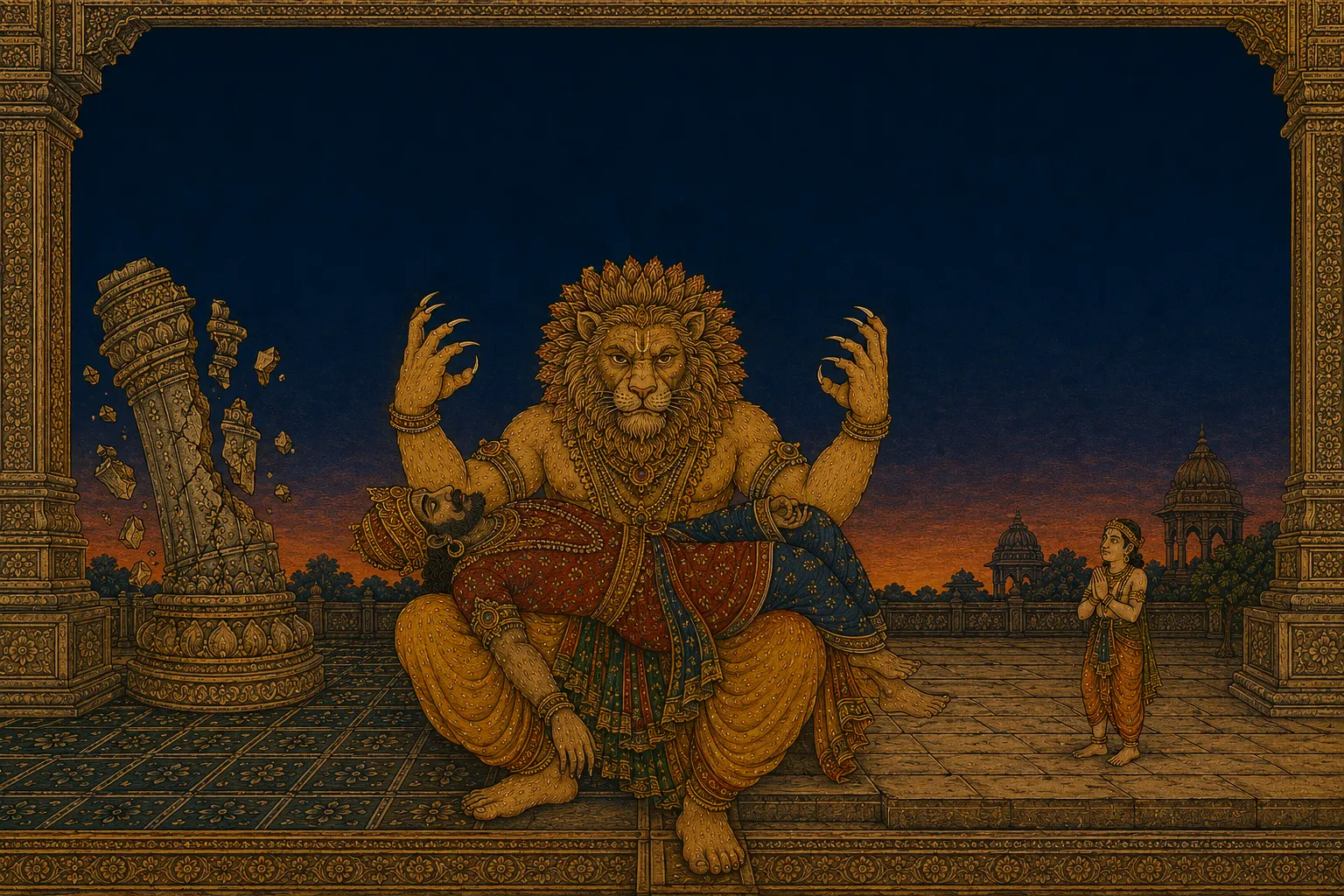
He struck the pillar with his sword.
It split open.
What emerged was neither man nor lion, but something between the two.
Narasimha carried Hiranyakashipu to the threshold — neither indoors nor outdoors.
It was twilight — neither day nor night. He placed him across his thighs — neither earth nor sky.
And he used no weapon at all, only his claws.
The one who was left
Every condition of the boon remained intact, and still Hiranyakashipu died.
But Narasimha's fury did not immediately subside. The hall emptied.
The one person who finally approached was Prahlada, the child for whom the whole intervention had taken place. He folded his hands, and Narasimha grew calm.
And in time, Prahlada became king on the very throne from which his father had tried to destroy him.
Note: The Narasimha story is told at greatest length in the Bhagavata Purana (seventh skandha), and is also in the Vishnu Purana, the Harivamsha and the Matsya Purana. The wording of the boon's conditions shifts a little from text to text, but the shape is everywhere the same — conditions made in pairs, and the space left between them. The Holika episode, to which the festival of Holi is tied, runs very strongly in tradition, but in this check it could not be confirmed from a named chapter — so it is written here as tradition. The Jaya–Vijaya frame, joining Hiranyaksha and Hiranyakashipu to Ravana–Kumbhakarna and Shishupala–Dantavakra, is the Bhagavata's.
Source: from several texts, Narasimha