
Chapter 6
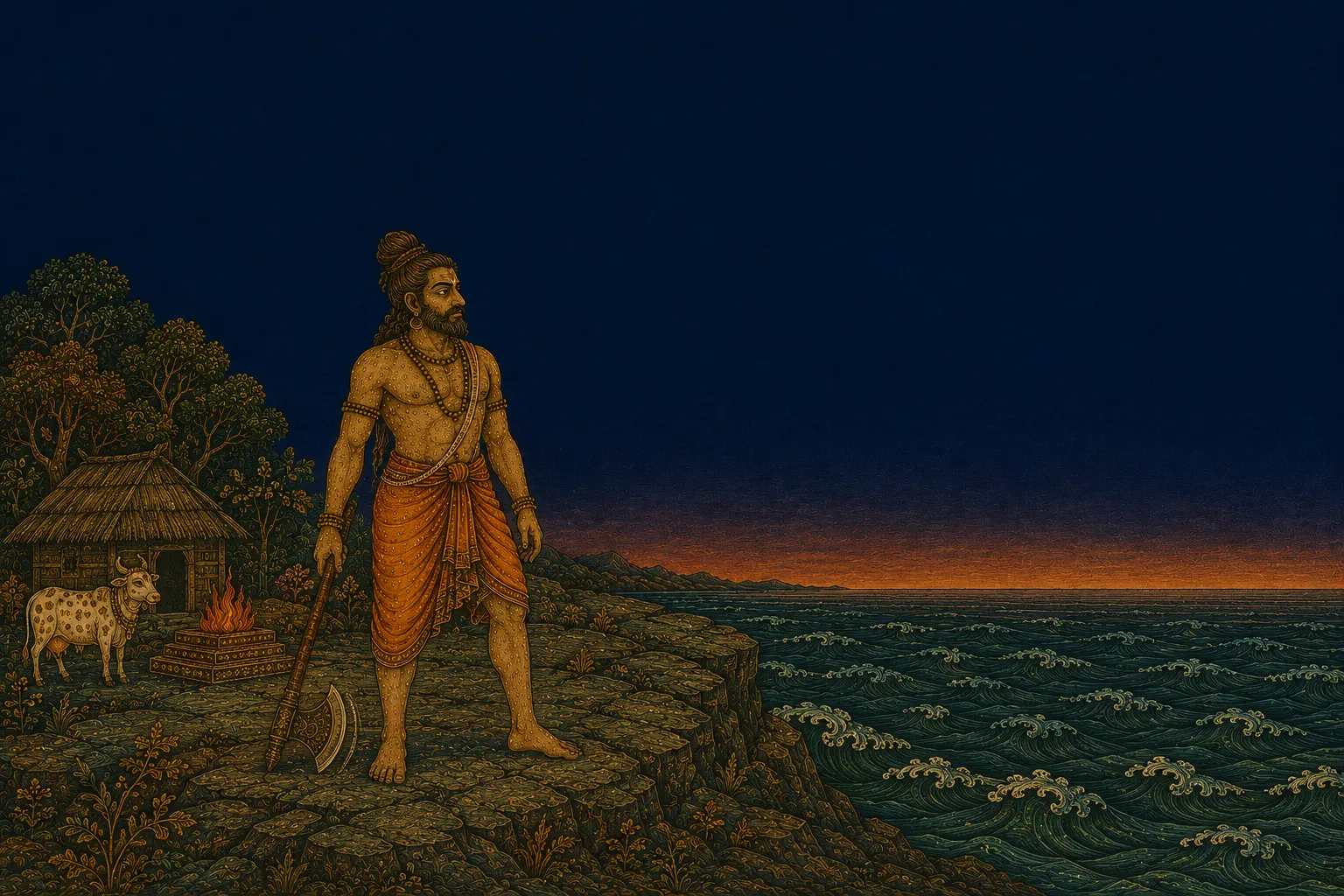
Parashurama
His father said kill your mother, and the son picked up the axe
A cow, and a king
At Jamadagni's hermitage lived Kamadhenu, the miraculous cow said to provide whatever was asked of her.
One day King Kartavirya Arjuna stopped at the hermitage after a hunt. To his astonishment, the small household was able to feed his entire army.
When he left, one thought stayed with him: a cow with such power belonged, in his view, with a king rather than a sage.
So Kamadhenu was taken by force.
The order that was given
That was only one of the events that shaped Jamadagni's youngest son.
On another day, Jamadagni became suspicious of his wife Renuka after a moment's delay and a wandering thought. He ordered his sons to kill her.
The elder sons refused and were cursed in turn.
Then the command came to the youngest.
Rama — later known as Parashurama — obeyed.
The boon that was asked for
Pleased, Jamadagni offered him a boon.
Parashurama asked for his mother to be restored to life, for her memory of the killing to be erased, and for the curses on his brothers to be lifted.
All three requests were granted.
But one person still remembered exactly what had happened: Parashurama himself.
Twenty-one times
Later, Kartavirya's sons came to the hermitage and killed Jamadagni.
Parashurama returned to find his father dead and his mother beating her breast in grief — twenty-one times.
He remembered the number.
Tradition says that he then campaigned against the kshatriyas twenty-one times — in the epics' own language, "clearing the earth of kshatriyas." It is an epic formulation, not a modern demographic claim.
The one who did not stop, and then stopped
Yet the story does not end with revenge.
In the end, tradition says, Parashurama laid down his axe, gave away the lands he had won, and withdrew to the mountains.
And even then, his story was not over. He is counted among the Chiranjivis, the immortals of tradition. That is why he appears again in later stories — before Rama, before Bhishma, before Karna.
The same man each time, carrying the memory of what he had done.
Note: Parashurama's story is found in the Mahabharata (Vana Parva and Shanti Parva) and in several Puranas including the Bhagavata. The order about Renuka and the boon asked for afterwards run together in tradition; the texts offer no moral justification for the episode. "He cleared the earth of kshatriyas twenty-one times" is repeated everywhere, but has not been taken to mean the same thing everywhere — and it is recorded here as written, without deciding how literal it is. Parashurama's being a Chiranjivi, and his returning in both the Ramayana and the Mahabharata, is recorded in both epics.
Source: from several texts, Parashurama