Chapter 13

Pururavas and Urvashi

There were three conditions for living together — one night, two of them broke, and that was enough

The conditions

Urvashi was an apsara. Pururavas was a mortal king.

They agreed to live together, but Urvashi set three conditions.

Her two lambs must remain with her and never be taken away.

She would eat only the food she chose.

And Pururavas must never appear naked before her.

He agreed, and for years the arrangement held.

What happened in the night

The gandharvas, however, wanted Urvashi back.

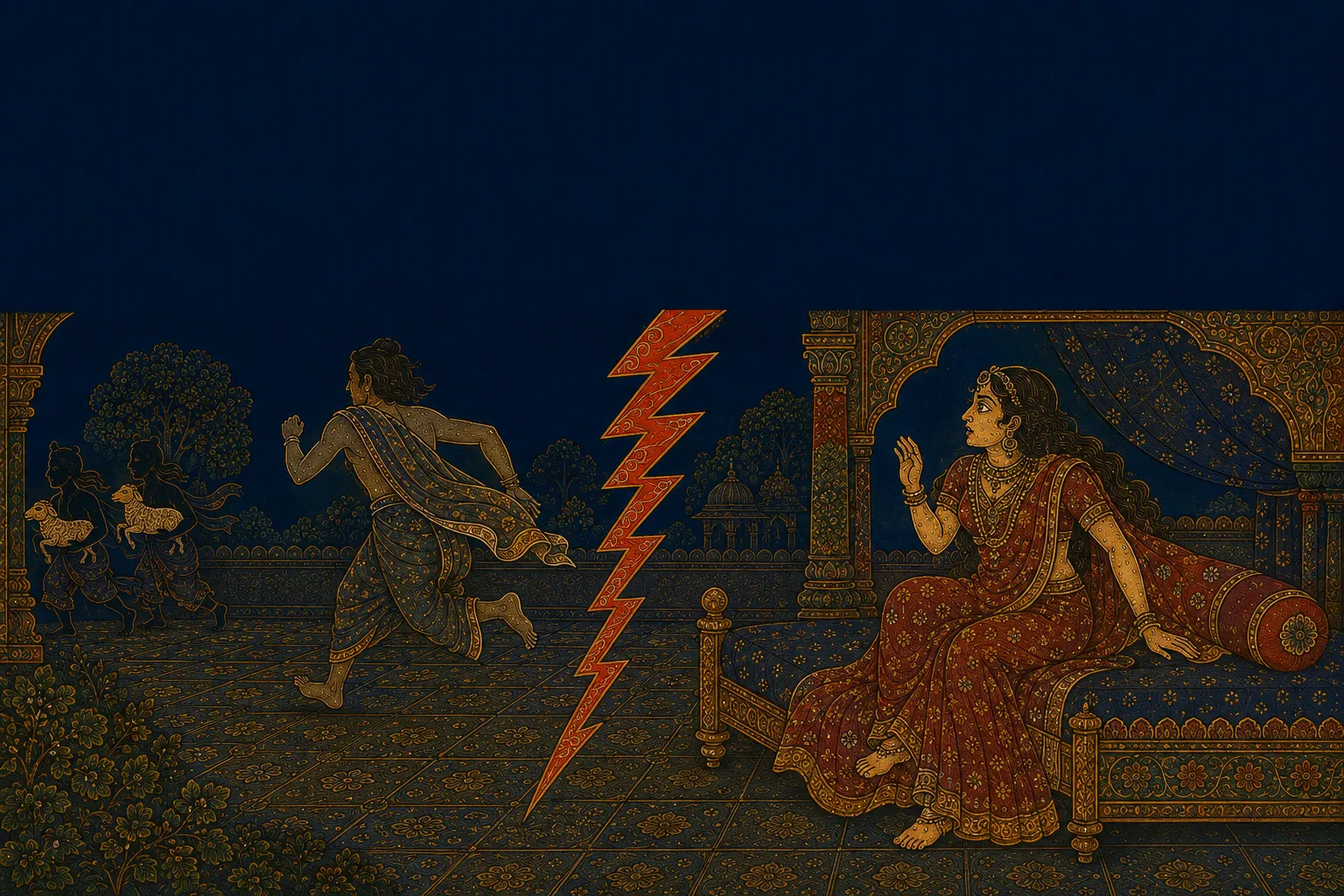
One night they stole the two lambs.

Urvashi woke and cried out that someone was taking them. Pururavas sprang up and ran into the darkness exactly as he was.

At that instant, the gandharvas lit the sky with a flash of lightning.

For a moment there was light.

Urvashi saw him naked.

Morning

Two of the conditions had been broken in the same chain of events. The third — the condition about food — had not been touched.

There is no dramatic quarrel in the story. By morning, Urvashi is gone.

Pururavas sets out to find her. The king is now simply a man looking for the woman he has lost.

At the edge of a lake

Eventually he finds her beside a lake with other apsaras and begs her to return.

She refuses.

The oldest surviving version of their exchange is a dialogue hymn in the Rigveda, and Urvashi's answer there is blunt and unsparing.

Later versions soften the story. Kalidasa's play softens it most of all, giving the pair a happy reunion.

The oldest form is the hardest.

Note: The oldest form of the Pururavas and Urvashi story is a dialogue hymn in the tenth mandala of the Rigveda, where the conversation is recorded directly and Urvashi refuses to return. The story also comes in the Shatapatha Brahmana, and in the fourth amsha of the Vishnu Purana alongside the genealogy. Kalidasa's play Vikramorvashiyam is built on this story and ends happily — which is to say the oldest form is the harshest and the later forms keep softening it. Pururavas is counted at the root of the lunar line, from which Yayati and then the Kuru line follow.

Source: from several texts, Pururavas and Urvashi

Now — how much stayed with you?

Fact

What conditions had Urvashi set for living together?

  • That her two lambs stay with her, that the food be of her choosing, and that Pururavas never be seen by her unclothed
  • That she never have to leave the capital
  • That Pururavas take no second wife
  • There were no conditions
Read the whole story — Conditions that look strange

On a first reading all three look minor and odd — two lambs, food, and one sight.

But the whole frame of the story rests on them — that night two conditions break together, tied to each other: the lambs are stolen, so he gets up, so he is seen. The third condition (food) is never touched that night.

That is what makes this story so tightly built. There is no separate mistake for each; one move breaks two, and two was enough.

What happened?

How did the condition break?

  • Pururavas told her himself
  • Urvashi broke the condition herself
  • The gandharvas stole the lambs, Pururavas ran out in the dark, and they threw down lightning
  • Somebody told Urvashi
Read the whole story — A move that worked completely

The gandharvas did not attack Pururavas. They only touched the thing he would get up for at once.

Everything else followed by itself — the haste, the dark, and a flash.

No villain shouts in this story and no battle is fought. It is all settled in a few moments.

The texts disagree

Where is the oldest form of this story found, and what is different there?

  • In a dialogue hymn of the Rigveda, where Urvashi plainly refuses to return
  • In the Bhagavata Purana, and there is no difference
  • In Kalidasa's play, and that is the oldest
  • In the Vishnu Purana, and that is the only source
Read the whole story — The oldest form, and the hardest

There is a hymn in the tenth mandala of the Rigveda that is entirely a conversation between these two — no story, only dialogue.

There Pururavas pleads and Urvashi does not put him off; she refuses outright. Her answer is hard, and there is no comfort in it.

This is one of very few places in this gatha where the oldest form is the least kind — and the later texts go on softening it.

Why is that?

Why did the gandharvas steal the lambs instead of attacking Pururavas directly?

  • Because they could not fight
  • Because breaking the condition was enough, and for that they only had to get Pururavas up in a hurry
  • Because they wanted the lambs
  • Because Urvashi had told them to
Read the whole story — Not a fight, an arrangement

This is among the cleverest moves in the gatha — working on the condition everything rests on, rather than beating anybody.

The gandharvas did not need to defeat Pururavas. They needed one moment in which he would get up without thinking.

The same manner has appeared in this gatha before — in the Vamana chapter the win came not from strength but from inside the terms.

Who am I?

I was an apsara, I agreed to live together on conditions, and the moment a condition broke I was gone. Who am I?

  • Rohini
  • Urvashi
  • Renuka
  • Suniti
Read the whole story — A leaving with no quarrel in it

There is no dramatic scene of Urvashi's going. No reproach, no curse.

There was a condition, the condition broke, and she did not stay. The story says it that coldly.

That coldness is what makes it memorable, and it is clearest of all in the Rigvedic dialogue.

Riddle

I caused two conditions to break in one night, and I did nothing at all myself. What am I?

  • The two lambs
  • That lake
  • The lightning
  • The clothing
Read the whole story — The smallest thing, the largest result

The least important thing in this story is its hinge — two lambs, with no other purpose.

They were in the first condition precisely because she was attached to them, and that attachment was later used.

In terms of craft it is very clean: what looks most trivial at the start decides everything at the end.

Who said it?

"Is there no man here?" — who said this, and when?

  • The gandharvas, taunting
  • Pururavas, to the gandharvas
  • Urvashi, waking, as the lambs were being carried off
  • Nobody; it is a later addition
Read the whole story — A call that was part of the trap

Urvashi knew nothing. She was genuinely calling out for her lambs.

And that call became the last part of the gandharvas' move — because it is what got Pururavas up without thinking.

The story blames nobody. All three did what anyone would have done, and the condition broke anyway.

Fact

What is Pururavas's connection to this gatha and to later stories?

  • He is the first king of the solar line
  • He has no connection to any later story
  • He is Rama's ancestor
  • He is counted at the root of the lunar line, whose story runs on as far as the Mahabharata
Read the whole story — A genealogy that joins the stories

The fourth amsha of the Vishnu Purana is largely genealogy — the solar and lunar lines, generation by generation.

Pururavas stands near the beginning of that lunar line, and Yayati comes later in the same line — the very next chapter is his.

And out of that same current comes the Kuru line, which is to say the Mahabharata. So these stories are not separate; they are links in one list.

Put it in order

What is the correct order of this chapter's events?

  • The theft of the lambs → the conditions → the lightning → the lake
  • The conditions → years together → the theft of the lambs and the lightning → Urvashi leaving → the meeting at the lake
  • The meeting at the lake → the conditions → the theft of the lambs → the lightning
  • The lightning → the theft of the lambs → the conditions → Urvashi leaving
Read the whole story — Years, and then a few moments

The largest part of this order is the part where nothing happens — years of living together, which the story settles in one sentence.

Then everything happens in a few moments: the theft, the call, the running, the flash.

And after that the story slows again — the searching, and at last the conversation which in its oldest form is recorded as a whole hymn.

Why is that?

What is the largest difference between the oldest form and the later ones?

  • In the oldest the conditions are not spelled out this clearly
  • In the oldest Pururavas is not a king
  • In the oldest Urvashi comes back
  • In the oldest form the ending is hard, and the later forms keep softening it
Read the whole story — Stories grow kinder

In the Rigvedic dialogue Urvashi refuses plainly to return, and it ends there.

The Puranas add something to the story, and in Kalidasa's play the two are reunited.

This is the inverse of the shape that keeps appearing in this gatha. Elsewhere stories grow more dramatic with time; here they grow kinder.