Chapter 5

Vamana

The one who asked was the smallest there, and he asked for the smallest thing

The asura nobody had a complaint against

Bali belonged to Prahlada's line — he was the grandson of the child who had survived Hiranyakashipu.

And Bali was not remembered as a cruel king. He had conquered the three worlds, yet his subjects were content, sacrifices continued, and no one was turned away empty-handed from his door.

That generosity was both his greatest virtue and the opening through which the story would turn.

Indra had lost his kingdom, but Bali's rule gave him little ground for complaint.

A boy at the sacrifice

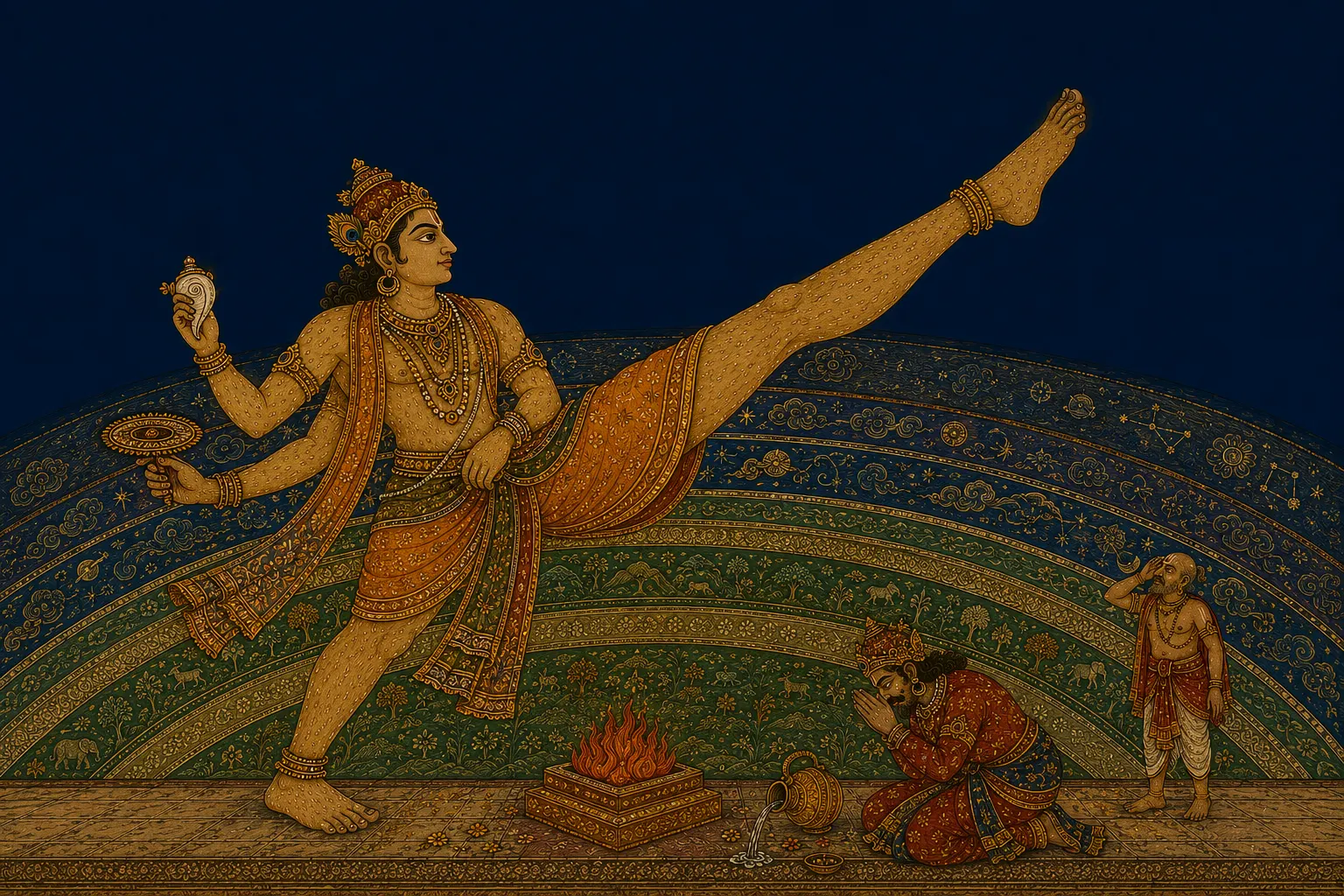
During one of Bali's great sacrifices, a young brahmin boy entered the assembly. He was small, carrying a wooden parasol and a water-pot, and seemed too insignificant to attract much notice.

Bali asked what he wanted.

Gold? A village? Elephants?

"Three paces of land," the boy replied. "Measured with my own feet."

Bali laughed at how little he had asked for.

The teacher stopped him

But Shukracharya recognised him.

He pulled Bali aside. "This is no ordinary brahmin boy. Refuse him."

Bali would not.

"Refusal has no place at my door," he said. "And if this is Vishnu himself, why should I hold back?"

The ritual water of the pledge began to pour. According to later Puranic tradition, Shukracharya blocked the spout of the vessel, and the boy cleared it with a blade of kusha grass, costing Shukracharya an eye.

Three paces

Once the water fell, the gift was complete.

Then the child began to grow.

His first stride covered the earth.

His second covered the sky.

The vast form looked down at Bali.

"Where shall I place the third?"

What was left to give

There was nothing left.

Bali bowed his head.

"Here."

The third step fell upon him, and Bali was sent to Sutala. According to the Bhagavata Purana, he retained rule there, and Vishnu himself took responsibility for protecting him.

Kerala's Onam tradition adds another beloved memory of Bali: that once a year he returns to visit his people.

Note: The Vamana story is told at greatest length in the Bhagavata Purana (eighth skandha), and is also in the Vishnu Purana and other Puranas. But "Vishnu's three paces" are far older than these — in the Rigveda, Vishnu measures the whole expanse in three strides, and there is no dwarf form there, no Bali and no gift. The dwarf's asking and the whole Bali story are the Puranic layer. The detail of Shukracharya's eye comes from the Puranic tradition. The connection of Onam and Bali Pratipada to this story is living tradition rather than a claim of the texts — and both festivals treat Bali not as a defeated king but as one who returns.

Source: from several texts, Vamana

Now — how much stayed with you?

Who am I?

I am of Prahlada's line, I won all three worlds, and nobody had a complaint against my rule. I was not defeated — I was asked. Who am I?

  • Hiranyakashipu
  • Shukracharya
  • Bali
  • Hiranyaksha
Read the whole story — The enemy who was not bad

In this gatha Bali is the only one against whom no cruelty is listed. The texts show him as generous, truthful and a good king.

Which is what sets this story apart from the other avatar stories — here there is nobody to stop, only something to take back.

And even the taking back does not come from a fight. Bali does not lose, he gives — which is what makes the story both uncomfortable and memorable.

Why is that?

Why did Vamana ask only for three paces of ground when Bali was ready to give gold, villages, anything?

  • Because that was genuinely all he needed
  • Because Bali would have refused a larger request
  • The story gives no direct reason, but a request that small drawing no question, and the size of the foot never being fixed, are what make the turn possible
  • Because Shukracharya had advised it
Read the whole story — A small request, an open condition

This is a reading: the one thing left unspecified in the request turned out to be the thing that mattered — whose paces, and how large. The text does not spell out this motive itself; it simply gives the request and its result.

Bali heard what was said: three paces, which is to say nothing at all. Shukracharya heard what had not been said.

The whole story turns on that play in the words, exactly as the previous chapter turned on the conditions of a boon. Both times the win comes not from strength but from inside the terms.

Fact

What did Shukracharya do to stop the water of the pledge, and what did it cost him?

  • He caught hold of Bali's hand
  • He went into the spout of the water-pot, and lost an eye to a blade of kusha grass
  • He had the sacrifice stopped
  • He cursed Vamana
Read the whole story — The teacher who lost

Shukracharya is the only character in this story who knew from the start what was happening — and he is the one who could not stop it.

His attempt was small and clever too: a gift is completed only when the pledge-water falls on the hand, so he stopped the water.

Tradition attaches Shukracharya's being one-eyed to this episode — as popular as the episode is, the texts do not tell it identically.

What happened?

What was measured in the two paces?

  • The whole earth in the first, the whole sky in the second
  • Only the earth, in both paces
  • All three worlds, so the third pace was never needed
  • Nothing, because Bali stopped him
Read the whole story — A measuring that ran out

The moment comes very plainly in the story — two paces, and everything is finished.

The question asked after it is not a taunt; it is a real question: where do I put the third.

The whole story rests on that question, because the one answering had nothing left to give but himself.

Who said it?

"Where do I put the third?" — who asked it, and what answer came?

  • Vamana in his vast form, and Bali offered his own head
  • Bali, and Vamana said Sutala
  • Shukracharya, and Bali fell silent
  • Indra, and Vamana said nothing
Read the whole story — When all that is left to give is yourself

This is the highest moment in the story, and there is no fight in it — only a question and a gesture.

Bali could have said the gift was complete, that everything had gone in two paces. He did not say it.

Which is why tradition counts Bali not as a defeated king but as the foremost of givers — and that place came from this one sentence.

The texts disagree

Where is the idea of "Vishnu's three paces" first found, and what is different there?

  • In the Rigveda, where Vishnu takes three strides
  • In the Bhagavata Purana, and there is no difference
  • In the Ramayana
  • In the Mahabharata, where Bali's name never appears
Read the whole story — At first there were only three strides

In the Rigveda, Vishnu's most recognisable act is exactly this — taking three strides, with which he measures the whole expanse. He is called Trivikrama for it.

But there is no boy there, no sacrificial hall, no Bali, no pledge-water. There are only three strides, and their meaning is extent.

The dwarf form, the asking, and the whole Bali story are the Puranic layer built around those strides. This is the third time in this gatha — after Matsya and Varaha — that an old idea later becomes an avatar story.

Riddle

I had measured everything in two. There was nothing left to measure the third time, and I measured anyway. Who am I?

  • Shukracharya
  • Bali
  • Indra
  • Vamana, in the vast Trivikrama form
Read the whole story — The third pace

The first two paces measure space. The third measures no space at all — it falls on the man who would not stop giving.

Which is why the story does not present it as a defeat. Under that same pace Bali receives the rule of Sutala. The tradition of his annual return belongs to the later Onam tradition.

The Trivikrama form — one leg raised high, up to the sky — is among the most recognisable postures in Indian sculpture.

Later tradition

Which festival is the tradition of Bali's return tied to?

  • The night of Diwali, across the country
  • Holi
  • Navratri
  • Onam in Kerala, when Bali is held to come once a year to see his people
Read the whole story — The king who returns

Onam is Kerala's largest festival, and its whole feeling comes from this story — Mahabali comes once a year to look at his people.

What is worth noticing is that Bali is no villain there. He is the king whose time is held to have been the best time, and the festival is a welcome for him.

Bali Pratipada in Maharashtra is tied to the same story. One story, and two different festivals in two different places — both named for the one who lost.

Put it in order

What is the correct order of this chapter's events?

  • Three paces → Bali's victory → Vamana's arrival → Sutala
  • Bali winning all three worlds → Vamana coming to the sacrifice and asking for three paces → Shukracharya's attempt to stop it → two paces → the third pace and Sutala
  • Shukracharya's attempt → Vamana's arrival → Bali's victory → three paces
  • Vamana's arrival → three paces → Bali's victory → Sutala
Read the whole story — All of it inside one sacrifice

A long stretch of this story happens in one place — in the sacrificial hall, at the door of giving.

Between the arrival and the sending to Sutala there is no battle in it, no army, no weapon.

That is what sets this chapter apart from the other avatar stories: everything is settled by one promise and one measurement.

Fact

Who comes after Vamana in the widespread list of ten avatars?

  • Rama
  • Parashurama
  • Narasimha
  • Krishna
Read the whole story — Where the form changes

The first four avatars are animals or half-animals — fish, tortoise, boar, half-lion. Vamana is the first who is fully human, however small.

Every avatar after him is human as well: Parashurama, Rama, Krishna, Buddha, Kalki.

Which is why this list is often read as a rising sequence — water to land, animal to man. That reading is a later one and not the texts' own claim, but the list supports it.