
Chapter 3
Varaha
The earth had been dragged down into the water, and the one who went looking was the size of a thumb
The one who took the earth away
No one seemed able to stop Hiranyaksha.
He drove away the devas, disrupted the sacrifices, and then went further than anyone expected: the earth itself was forced beneath the waters of the deluge.
There was no land left above the surface. No ground. No direction. Nowhere to stand.
Brahma sat wondering what could be done.
The size of a thumb
Then something emerged from his nostril.
It was a tiny boar, no larger than the joint of a thumb. Brahma watched as it began to grow.
First it outgrew his palm. Then a man. Then an elephant.
Within moments, Varaha stood in the sky as large as a mountain, and his roar shook the directions.
Under the water
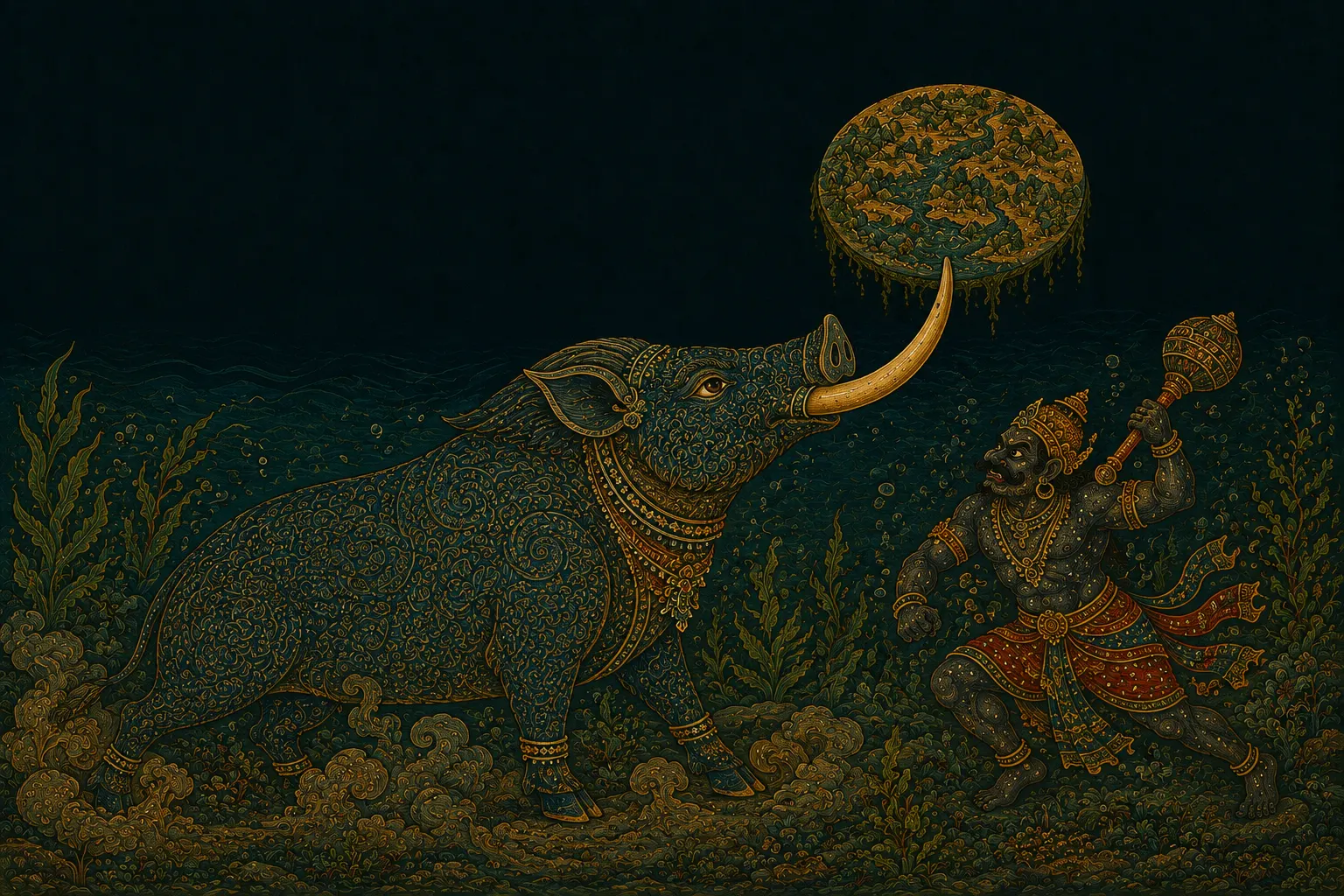
He plunged into the water.
Below was darkness. There was nothing to see, but a boar does not need sight alone to find what is buried. Varaha followed the scent downward until he found the earth.
He lifted it on his tusk — covered in mud, but whole.
Where he put it down
Varaha rose from the waters and placed the earth safely on the surface.
It did not sink.
The enemy in front
Only then did Hiranyaksha confront him and mock the animal form he had taken.
Varaha did not argue. The earth was already safe. One task remained.
He fought Hiranyaksha and killed him.
The story ends not with the killing, but with the earth restored — placed back where life could begin again.
Note: The Varaha story is in both the Vishnu Purana (first amsha) and the Bhagavata Purana (third skandha); the detailed fight with Hiranyaksha is the Bhagavata's, where the avatar emerges from Brahma's nose the size of a thumb and grows. The idea of an enormous boar raising the earth out of the water is older than either, and in the earliest tradition it is attached to Prajapati or Brahma — the Vishnu avatar identification comes later, exactly as it did with Matsya. The Jaya–Vijaya curse frame, which binds Hiranyaksha–Hiranyakashipu to Ravana–Kumbhakarna and Shishupala–Dantavakra, is the Bhagavata's.
Source: from several texts, Varaha