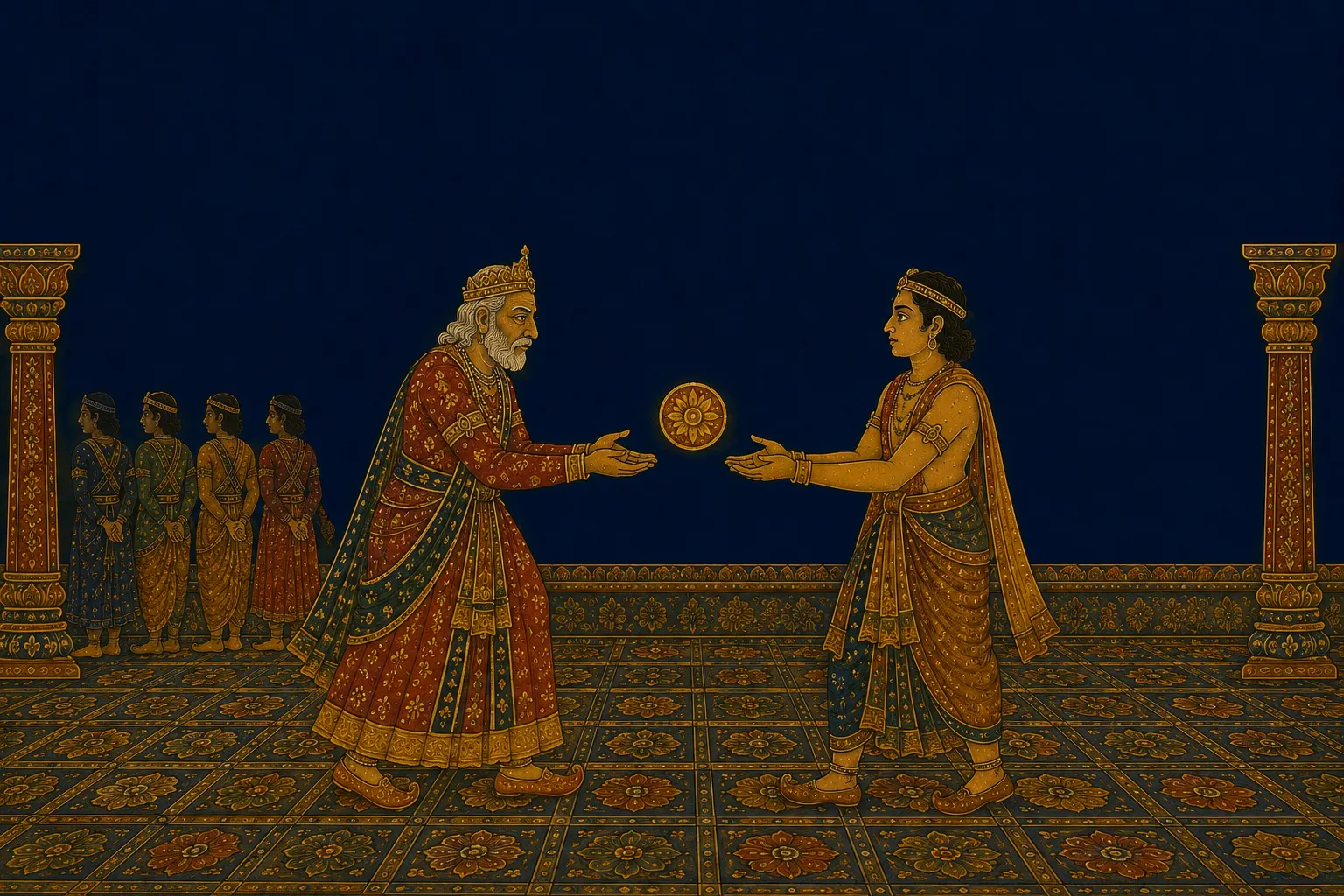
Chapter 15

Yayati

He asked his son for his youth, and came back a thousand years later to return it

The curse

Yayati was a king of the lunar line.

He was married to Devayani, the daughter of Shukracharya.

Sharmishtha, herself the daughter of an asura king, lived with Devayani as an attendant.

Yayati also entered into a relationship with Sharmishtha and kept it hidden.

When the truth came out, Shukracharya cursed him with immediate old age.

The exemption

Then he allowed one exception.

If one of Yayati's sons willingly gave him his youth, the two could exchange their ages.

Yayati had five sons.

He asked the elder four in turn.

Each refused.

The youngest

Finally he asked the youngest, Puru.

Puru agreed.

In a moment, the young son became old and the old father became young again.

A thousand years

Yayati then lived the life for which he had wanted his youth restored.

The Mahabharata says this continued for a thousand years.

At the end of that long experiment, he returned with a conclusion that became one of the episode's best-known teachings:

Desire is not extinguished by satisfying it. Feeding desire is like pouring ghee onto a fire — it only burns more fiercely.

Giving it back

Yayati returned Puru's youth and took back his own old age.

Then he gave Puru the kingdom as well, passing over his four elder brothers.

From Puru came the Puru line, and from that line, eventually, the Kurus of the Mahabharata.

Note: Yayati's story in full is found in the Adi Parva of the Mahabharata — Devayani, Sharmishtha, Shukracharya's curse, the five sons and Puru's giving of his youth. The fourth amsha of the Vishnu Purana carries the same story in short form alongside the genealogy of the lunar line. The line about desire never being quieted by indulgence is among the most quoted parts of the Mahabharata. Puru's receiving the kingdom began the Puru line, and from it the Kuru line — which is to say the Mahabharata's story moves on from this decision.

Source: from several texts, Yayati

Now — how much stayed with you?

What happened?

Who cursed Yayati with old age, and why?

  • Indra, over a quarrel about the kingdom
  • Shukracharya, because Yayati had secretly kept a relationship with Sharmishtha behind his daughter Devayani
  • Narada, over arrogance
  • His sons
Read the whole story — The same Shukracharya, again

This is Shukracharya's second appearance in this gatha. The first was in the Vamana chapter, where he tried to stop Bali and lost an eye for it.

Here he is not the teacher of the asuras but a father. The curse is for his daughter.

And this story runs in the manner that keeps recurring here: the punishment is not closed off completely, an exemption is left inside it — and the whole story that follows happens inside that exemption.

Fact

What was the exemption in the curse?

  • That after a hundred years the old age would go by itself
  • That penance would lift the curse
  • That some other sage could reverse it
  • That if a son gave his youth, the exchange could be made
Read the whole story — The exemption that was the real test

A curse is a punishment in itself. The exemption is the larger thing, because it opens a way to put the punishment on somebody else's shoulders.

And that is the story's real subject — not old age, but whether a man may hand his sentence to another.

Four sons refuse and the story does not call them bad. The fifth agrees, and everything turns on that.

Who am I?

I was the youngest, and I gave what all four of my elder brothers refused to give. Who am I?

  • Puru
  • Dhruva
  • Bharata
  • Prahlada
Read the whole story — The youngest, once again

This shape is returning in the gatha — Parashurama was also the youngest, and he was the one who obeyed his father when the elder brothers refused.

Both times the youngest does what the others will not, and both times the consequence runs long.

The difference is that in Parashurama's story the order was terrible, and here the request is only for one's own youth — but its cost is a whole lifetime.

Who said it?

"Desire is never quieted by indulging it" — who said it, and when?

  • Shukracharya, while giving the curse
  • Puru, while giving his youth
  • Yayati, coming back after a thousand years of indulgence
  • Devayani
Read the whole story — A conclusion a thousand years in the making

This line is among the most quoted parts of the Mahabharata, and its force lies in who says it.

It is not the saying of an ascetic who never tasted anything. It is the saying of a man who did exactly that for a thousand years and said this afterwards.

The comparison with ghee poured on fire comes with it — the more you pour, the higher it goes.

Why is that?

Why did the four elder brothers refuse, and why does the story not call them bad for it?

  • Because they hated their father
  • Because they were afraid of the curse
  • Because giving your youth is giving your whole life, and the request itself was extraordinary
  • Because they did not want the kingdom
Read the whole story — A refusal that is not wrong

This is the most balanced part of the story. The texts do not hold the four sons guilty.

The request really is enormous — taking somebody else's sentence on yourself, and paying for it with your youth.

Nor does the story condemn the father; it only shows what he asked for and what came of it. The judgement is left to the reader.

Fact

Whom did Yayati finally give the kingdom to?

  • To Puru, which is to say the youngest
  • To the eldest son, as custom required
  • To Devayani
  • To nobody; he divided it up
Read the whole story — An order that was broken

It was ordinary for the eldest son to get the kingdom, and here that does not happen.

The story makes the connection plainly: the one who gave is the one who received.

And from that Puru came the Puru line, out of which the Kuru line follows — which is to say the Kauravas and Pandavas of the Mahabharata are a later link in this decision.

Riddle

For a thousand years I did everything I wanted, and at the end I said that none of it quiets anything. Who am I?

  • Bharata
  • Pururavas
  • Bali
  • Yayati
Read the whole story — The man who tried it and found out

The whole weight of this story lies in the conclusion arriving after the experiment.

Yayati did not argue and offered no reasoning. He spent a thousand years finding out, and then said it.

Which is why the line reads not as a sermon but as testimony — and perhaps that is why it has been repeated so often.

The texts disagree

Where is Yayati's story found at greatest length?

  • Only in the Vishnu Purana
  • In the Adi Parva of the Mahabharata, with a shorter form of it in the Vishnu Purana
  • In the Rigveda
  • In the Ramayana
Read the whole story — One story, two lengths

The Adi Parva of the Mahabharata carries the whole story of Yayati, Devayani, Sharmishtha and Puru at length — it is among the well-known stories there.

The Vishnu Purana keeps it in short form alongside the genealogy of the lunar line, because its purpose is to show the line.

Which is why this story belongs both to this gatha and to the Mahabharata — and both can be read on this site.

Put it in order

What is the correct order of this chapter's events?

  • A thousand years of indulgence → the curse → asking the sons → returning the youth
  • Asking the sons → the curse → a thousand years → the kingdom
  • The return of youth → a thousand years → the curse → the exemption
  • The matter of Sharmishtha coming out and the curse → the exemption → four sons refusing → Puru agreeing → a thousand years → returning the youth and giving the kingdom
Read the whole story — An ending that is a return

The most unusual thing in this order is the end. The story does not finish where Yayati gets his youth.

It finishes where he gives it back — and that is what separates him from being merely a greedy king.

The shape has appeared before in this gatha: the story ends not on a victory but on things being put back where they belong.

Why is that?

Why has this story been placed in the second half of this gatha?

  • Because an avatar of Vishnu appears in it
  • Because it is the shortest story
  • Because this half belongs to those who did not descend
  • Because there is an asura in it
Read the whole story — No avatar, and the same question anyway

All the stories in the second half of this gatha are of human beings — Dhruva, Bhagiratha, Pururavas, Bharata, Yayati.

Nobody descends in any of them. What happens, happens out of their own decisions.

Which is why they are set beside the first ten chapters: ten times the world was set right from outside, and six times people set themselves right from within.