
Chapter 8
The Imperishable
The Last Thought
Seven questions
The previous chapter has raised a set of difficult concepts, and Arjuna asks about all of them at once — what is Brahman, what is the self's own nature, what is action, and what is meant by the principles governing beings, the gods and sacrifice.
And, at the end, one more — perhaps the heaviest: at the moment of death, how is a person of disciplined mind to hold Krishna in view?
The last thought
"Whoever leaves the body while remembering me," Krishna says, "comes to me." But the last thought is no accident — a person carries into death whatever state of mind they have dwelt in through their whole life.
So the instruction has two halves, and they move together: remember me at all times, *and* do your work. "In your case," he tells Arjuna, "remember me, and fight. Give me your mind and your understanding, and you will come to me — nothing else."
The yoga of dying
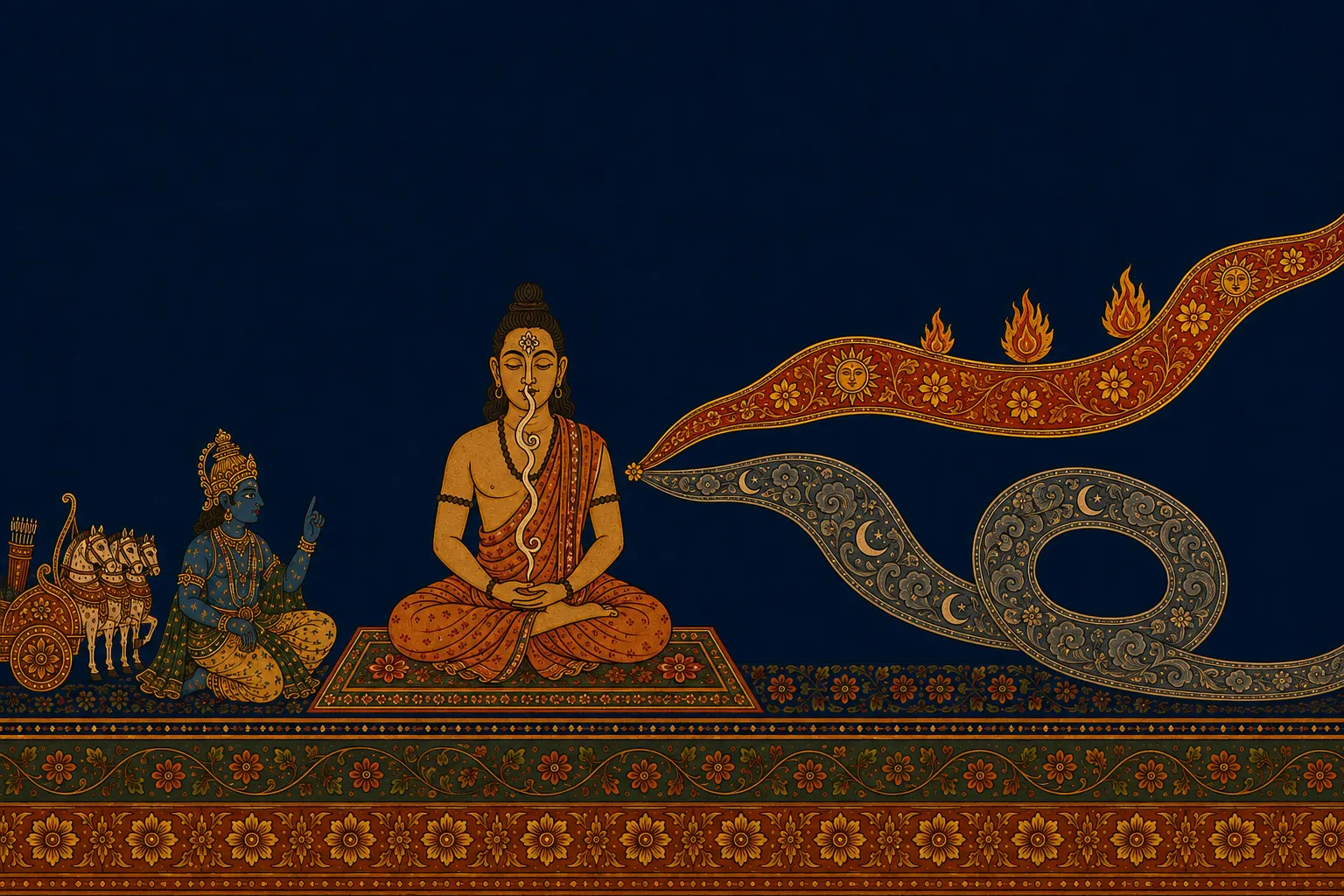
For someone who has prepared, Krishna paints a disciplined departure — the mind held firm and unmoving, the strength of yoga behind it, the breath drawn up and fixed between the brows.
A single syllable — Om — is sounded while holding him in mind. "One who leaves the body this way," he says, "reaches the highest goal." For someone long absorbed in him already, this comes without struggle — he is easy to reach.
The days of Brahma
Even the highest heavens offer no escape. A single day of the creator Brahma lasts a thousand ages, and his night just as long. When his day dawns, beings pour out into manifestation; when it ends, they dissolve back again — the same cycle, over and over, by no one's choice.
Beyond that entire turning of the manifest and the unmanifest lies another unmanifest — imperishable, untouched even when everything else is destroyed. Krishna calls it his own supreme abode. "From there," he says, "no one returns."
The two paths
He lays out two routes for the dying — one marked by light, fire, day, the bright half of the year; the other by smoke, night, the dark half.
By the first, those who know Brahman go and do not come back. By the second, a person reaches the light of the moon, and returns. "The yogi who knows both paths," Krishna says, "is deceived by neither — such a person should hold to yoga at all times."
Note: The chapter is not claiming that only a person's last, chance thought decides their fate; verses 8.6–8 tie that final state to a whole life of practice. "Remember me and fight" (8.7) is one of the Gita's sharpest joinings of contemplation and action. The two post-death paths reuse a cosmology already present in the Upanishads.
Source: Mahabharata — Bhishma Parva, The Imperishable