
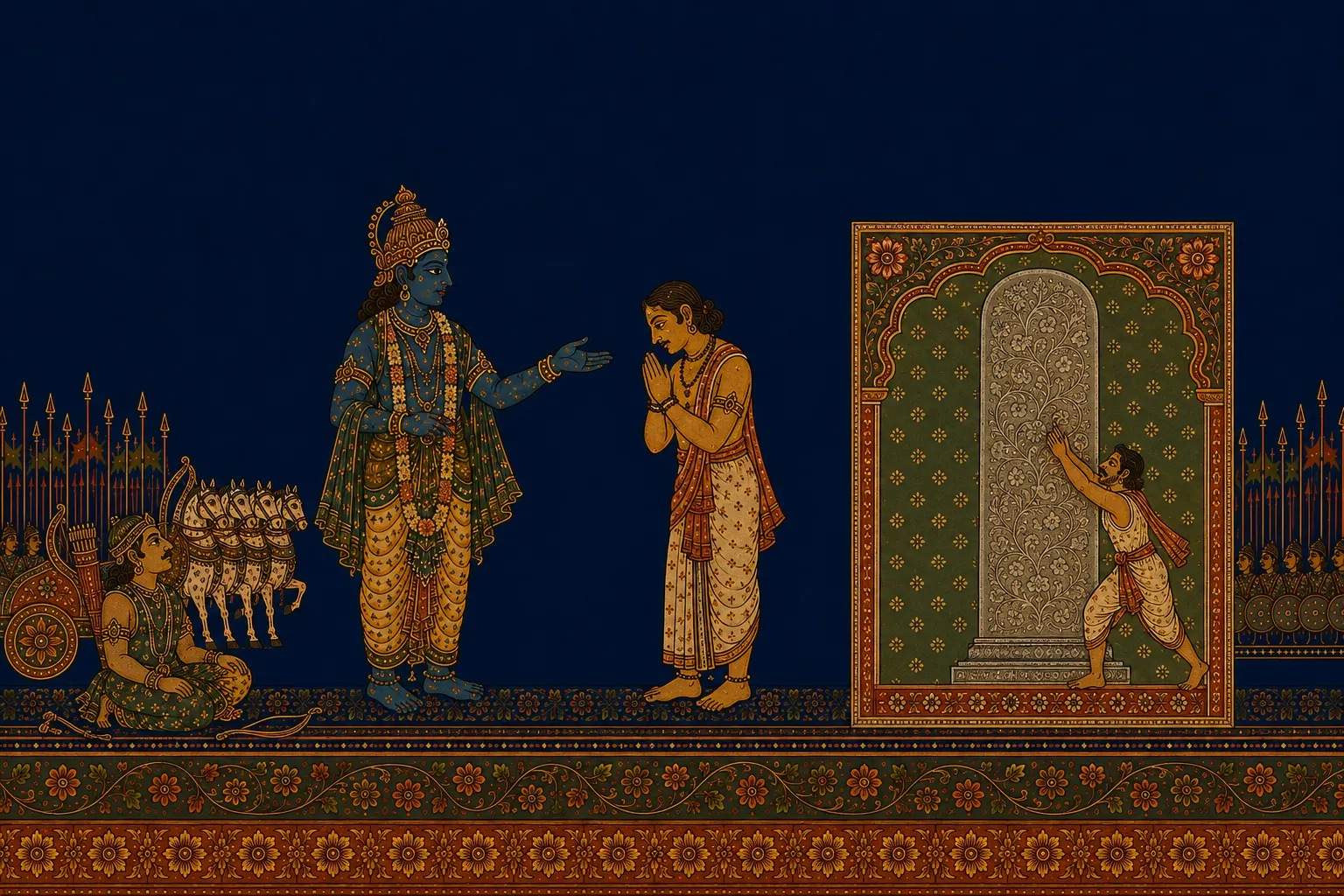
Chapter 12
The Way of Devotion
The Devotee Krishna Loves
The question
Arjuna asks a direct, comparative question. "Those who worship you as the personal Lord, always surrendered," he says, "and those who fix the mind on the imperishable, formless absolute — which of them are the better yogis?"
The more difficult path
"Both reach the goal," Krishna says, "but of the two, the path of the unmanifest is harder for embodied beings — it is difficult for a mind still tied to a body to hold on to what has no form at all."
Those who give him their whole mind and their faith, worshipping him, he counts as the most closely joined to himself. "For them," he says, "I soon become the one who lifts them out of the ocean of death and rebirth."
The ladder
The instruction that follows is graded, not all-or-nothing. "Fix your mind and understanding on me, and you will live in me. If you cannot hold that steadily, take up the discipline of repeated practice."
If steady practice is beyond reach, work for his sake instead. And if even that proves difficult, renounce attachment to the fruits of action. Then Krishna gives his own ranking: knowledge outranks mere practice, meditation outranks knowledge, and relinquishing the fruits of action outranks meditation — because peace follows only after that.
The dear devotee
Then comes the Gita's best-known portrait — the person Krishna holds dear — and it opens not with ritual but with character. "One who hates no living thing," he says, "who is friendly and compassionate, free of the sense of 'mine' and of ego, even in pleasure and pain, patient, always content, self-governed, firm in resolve —
"— one from whom the world does not shrink, and who does not shrink from the world; free of agitation, fear and excitement; wanting nothing, pure, capable, unconcerned, and having let go of every self-serving undertaking. Those who hold to this, with me as their only goal, are very dear to me."
Note: At twenty verses this is one of the shortest doctrinal chapters. The Gita does not call worship of the formless absolute false — only harder for embodied beings, and reachable. Coming straight after the terror of the universal form, the chapter deliberately changes register, from cosmic spectacle to daily disposition.
Source: Mahabharata — Bhishma Parva, The Way of Devotion