
Chapter 16
The Divine and the Demonic
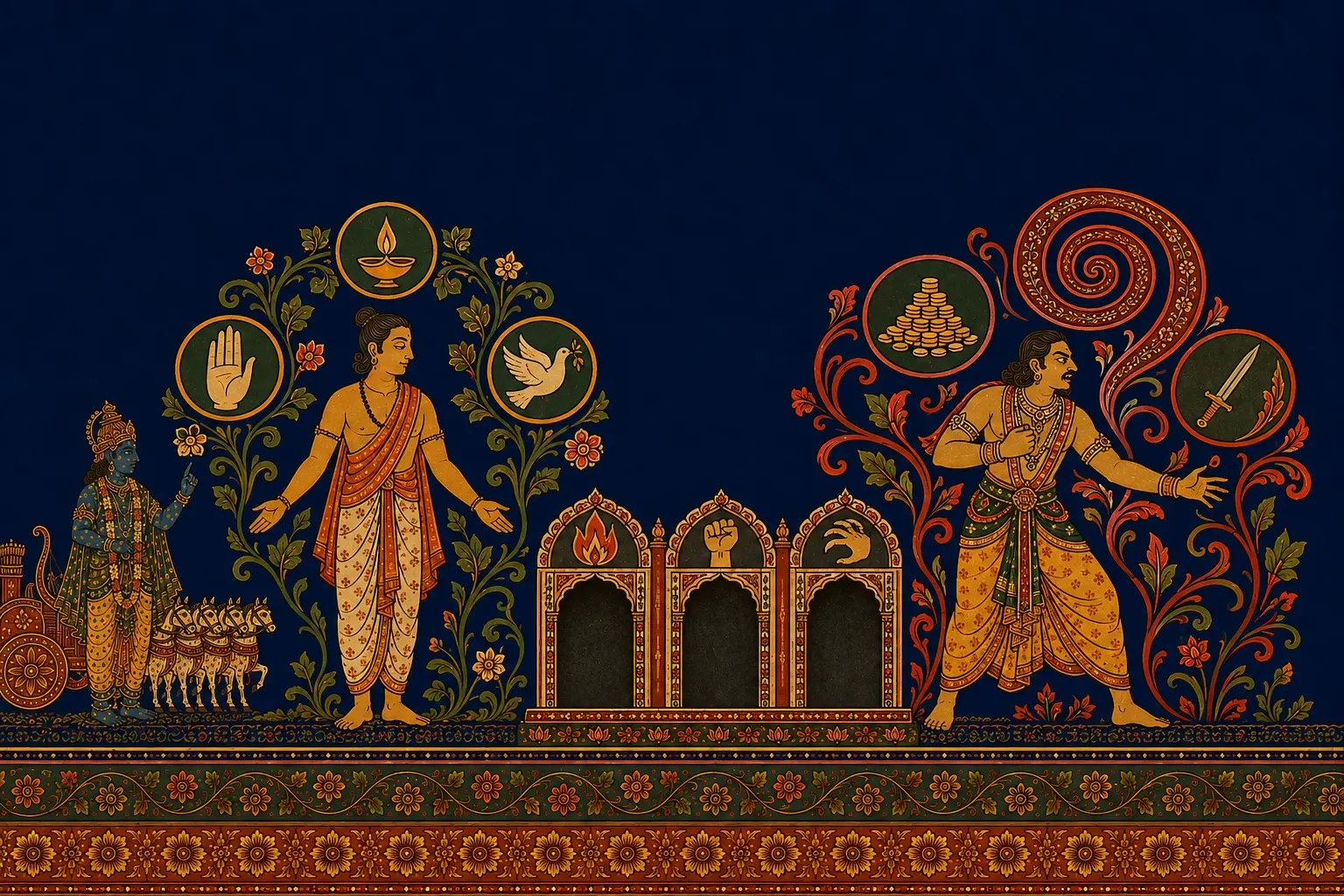
Divine and Demonic Traits
Two dispositions
Krishna sets out two sets of qualities a person may be born toward. The divine endowment: fearlessness, purity of heart, steadiness in knowledge, generosity, self-restraint, sacrifice, study, austerity, honesty.
The list keeps going — non-violence, truthfulness, freedom from anger, renunciation, calm, an absence of fault-finding, compassion for all beings, freedom from greed, gentleness, modesty, steadiness. Against it, the demonic endowment is far shorter: hypocrisy, arrogance, conceit, harshness, anger, and ignorance.
The demonic worldview
"The person of the demonic type," Krishna says, "holds that the world has no truth in it, no moral foundation, no governing order — that it arises only out of mutual desire, and nothing more."
Holding to that view, ruined and small-minded, such people come forth as enemies of the world, bent on its destruction. Driven by a desire that is never satisfied, full of hypocrisy, pride and delusion, they take up false ideas and act from an impure resolve.
The voice of possessive power
Krishna gives that mindset an actual voice: "This I have gained today; that wish I will fulfil tomorrow. This wealth is mine, and more will come. This enemy I have killed, and the rest I will kill too. I am the lord, I am the enjoyer, I am successful, strong and happy."
It is the ego continually swelling — sacrifices performed for display, wealth and power worn as pride, a mind bound by hundreds of expectations and starving for pleasure. Such people, Krishna says, fall into deluded states, and life after life of hatred and cruelty, sink lower still.
The three gates
"Desire, anger and greed," Krishna says, "these three are the gates of self-ruin, destroyers of the self — and a person should let go of all three."
Freed of these three dark gates, a person works toward what is good and reaches the highest goal. As the standard for deciding what should and should not be done, Krishna points not toward appetite but toward scripture.
Note: "Demonic" here names a moral and psychological type — a way of seeing and acting — not a category of races, nations or communities; applying it to those is a modern extrapolation, not a claim in the verse. The three gates are desire, anger and greed, not desire by itself. Non-violence stands openly in the divine list, spoken on a battlefield where Krishna is also urging Arjuna to fight; the traditions reconcile that tension in different ways, and this book does not reconcile it for them.
Source: Mahabharata — Bhishma Parva, The Divine and the Demonic