
Chapter 6
The Way of Meditation
The Restless Mind
Your own friend or your own enemy
Krishna turns now to seated meditation — and opens with a warning about the self. "Lift yourself by your own effort," he says, "and do not let yourself sink. The self is a person's own greatest ally — and their own greatest enemy."
For the one who has brought the self under control, it works like a friend. For the one who has not, that same self turns into a hostile stranger within, working against them from the inside.
The seat and the measure
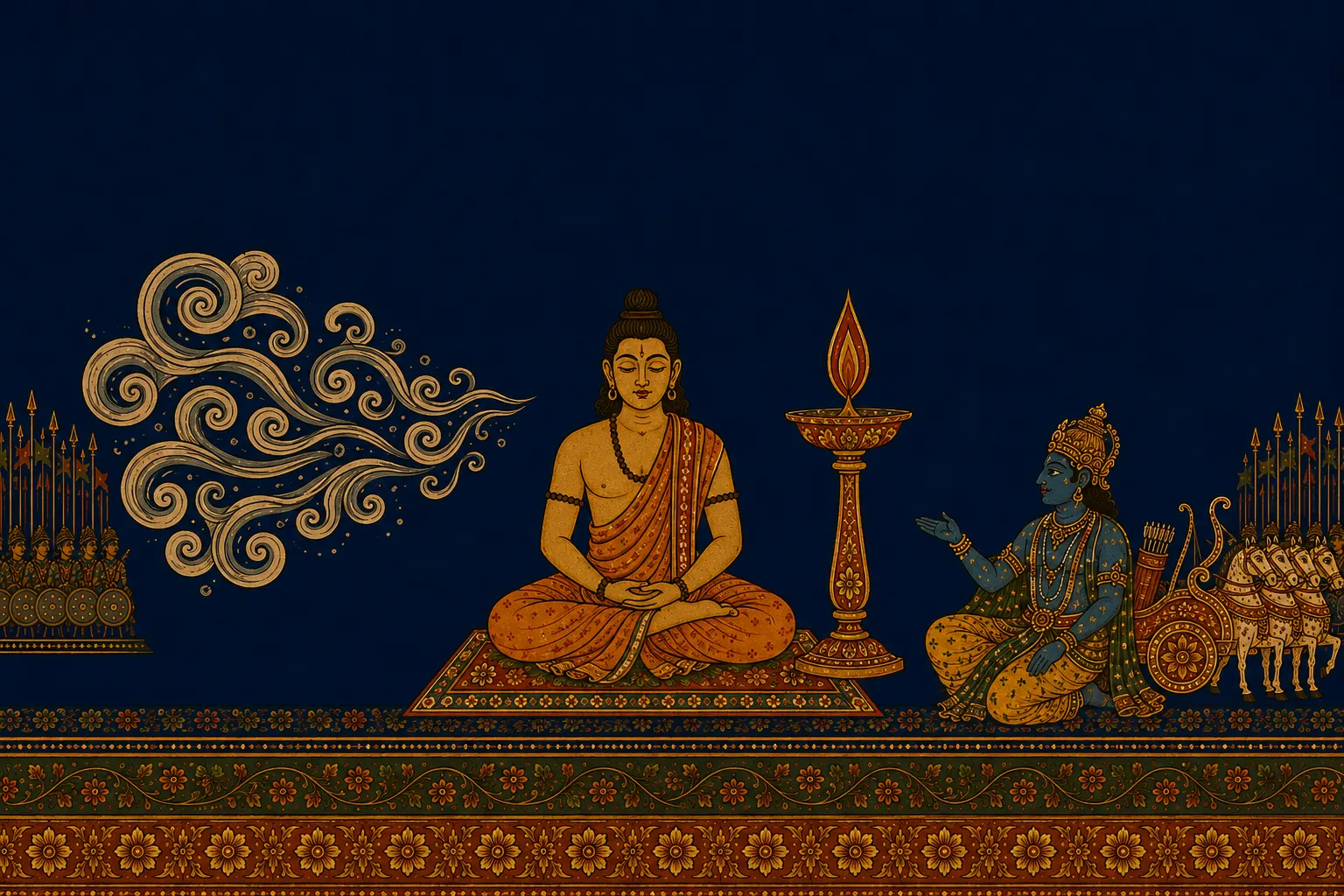
The instructions are entirely practical. Choose a clean, quiet place. Set a steady seat, neither too high nor too low. Hold the body, head and neck upright and still, and let the gaze settle rather than wander.
Maintain moderation in everything — "this yoga is not for the one who eats too much or fasts too hard," Krishna says, "who oversleeps or forces themselves to stay awake. For the one who is measured in food, rest, work and sleep, this discipline puts an end to sorrow."
The steady flame
The mind of a yogi deep in absorption, Krishna says, is like the flame of a lamp in a windless place — it never wavers, never flickers.
In that stillness rises a joy the senses could never supply — and once a person has truly touched it, no other gain looks greater, and not even heavy sorrow can move them from it. "That state," he says, "should be sought with a mind that refuses to give up."
The restless mind
Arjuna raises a plain objection. "The mind is restless," he says, "turbulent, wilful and strong — holding it feels as hard as holding the wind."
Krishna does not deny it. "The mind is hard to restrain, true," he agrees, "but it is done — through two things: steady practice, kept up over time, and dispassion." And nothing sincere is ever wasted — a person who takes up this path and does not finish it is not destroyed. They are reborn into a good home, or a wise one, and pick up exactly where they left off.
The highest yogi
Krishna places the yogi above the ascetic, above the person of mere learning, above the ritual performer, and tells Arjuna to become one.
"And among all yogis," he adds, "the highest of all is the one who turns inwardly to me with faith and devotion." That person, of everyone, is the most closely joined.
Note: The meditation discipline here overlaps with later yoga, but it is not Patanjali's eight-limbed system set out as such. The fear that spiritual failure wastes a whole life is raised by Arjuna and directly denied by Krishna: no one who does good comes to a bad end. The chapter's alternative title is Atma-samyama-yoga, "the yoga of self-restraint."
Source: Mahabharata — Bhishma Parva, The Way of Meditation