Chapter 14

The Three Gunas

Beyond the Three Gunas

Nature the womb

Krishna now sets the chapter in a cosmic frame. "Nature is the womb in which I place the seed," he says, "and from that all embodied beings are born." Nature supplies the material; he supplies the life.

"This knowledge is the highest," he adds. "Knowing it, the sages passed beyond this world — they are not born at creation, not disturbed at dissolution."

The three ropes

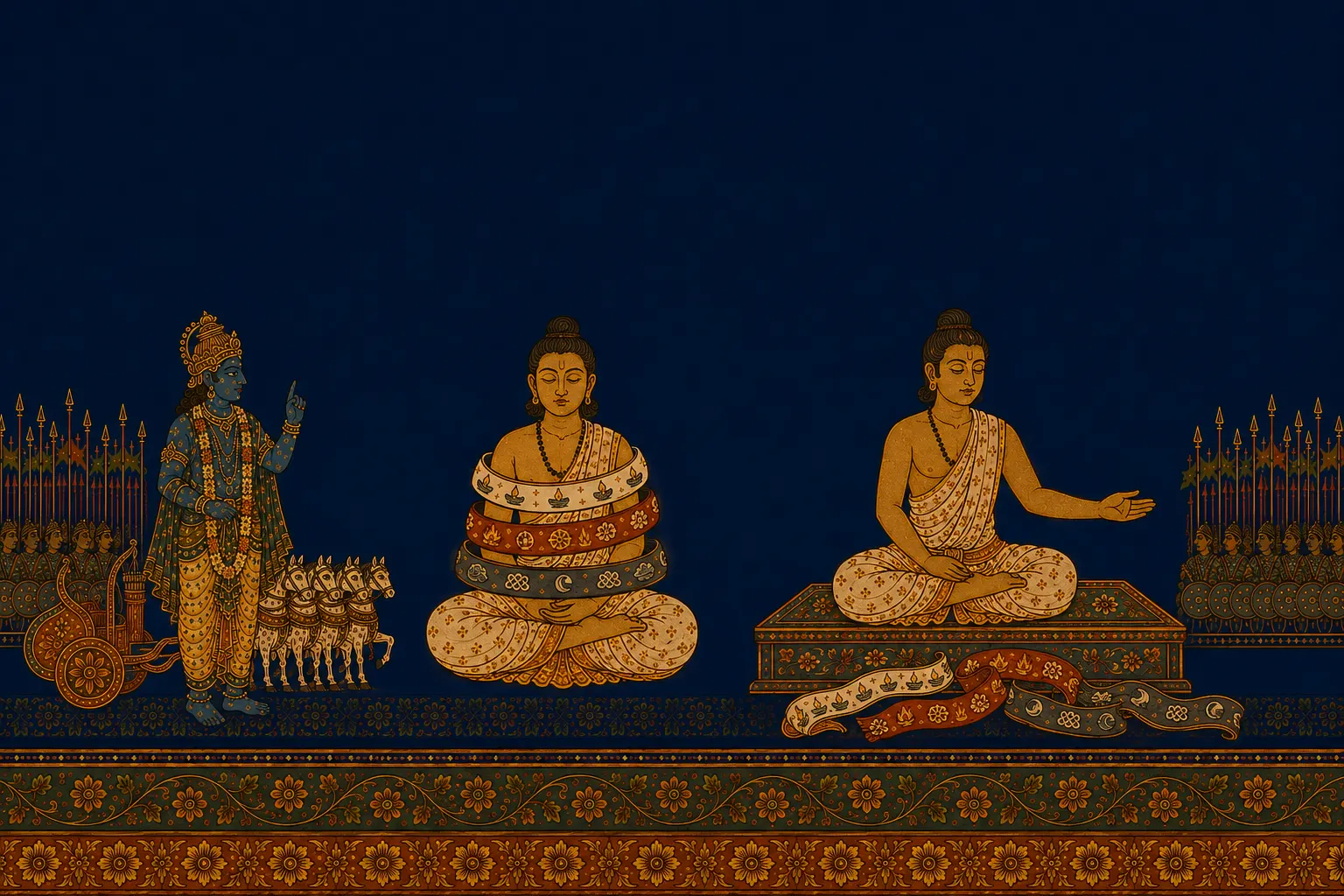
Three qualities rise out of nature and bind the deathless self to a perishable body. *Sattva*, clear and light, binds through attachment to happiness and to knowing. *Rajas*, passionate, binds through craving and attachment to activity. *Tamas*, dark, binds through carelessness, laziness, sleep.

The three take turns, Krishna says — each rising by overpowering the other two. Sattva is the clearest, the most luminous of them — and still it binds, through attachment to happiness and to knowledge.

Their signs

When one quality dominates, it shows plainly in a person. Sattva shows as the light of understanding shining through every gate of the body. Rajas shows as greed, restlessness, the constant starting of new undertakings. Tamas shows as dullness, inertia, negligence, confusion.

Each also decides where a being goes after death — the sattvic upward, into the worlds of those who know; the rajasic reborn among people bound to action; the tamasic downward.

Beyond the three

Arjuna asks: how does one recognise a person who has crossed beyond all three qualities? How does such a person act? How did they get there?

Krishna paints someone who neither hates clarity, activity or delusion when they arrive, nor longs for them when they leave; who sits apart, unmoved by the turning of the qualities, saying only, "the qualities are at work"; who stays level in pleasure and pain, in honour and disgrace, toward friend and enemy alike, and has let go of every self-serving project. "And unwavering devotion to me," Krishna says, "is what carries a person across all of it — for I am the very ground on which Brahman rests."

Note: The chapter is explicit that sattva, though the highest quality, is not liberation — freedom lies beyond all three. People are not permanently one "guna type"; the three compete, and each in turn becomes dominant. Verse 14.27, "I am the foundation of Brahman," is a major interpretive crux, because the schools define both "Brahman" and Krishna's relation to it in different ways.

Source: Mahabharata — Bhishma Parva, The Three Gunas

Now — how much stayed with you?

Fact

By what image does Krishna describe his relation to nature?

  • A potter and a wheel
  • Nature is the womb in which he places the seed, and from that all embodied beings are born
  • A river and the sea
  • A thread and gems
Read the whole story — Nature the womb

Krishna calls nature the womb and himself the seed-giving father.

This knowledge, he says, is the highest, knowing which the sages passed beyond the world.

Then Krishna turns to the three qualities that bind the deathless self to a perishable body.

Fact

What are the three gunas, according to Krishna, and why does even sattva bind?

  • Sattva, rajas, tamas
  • Knowledge, action, devotion
  • Divine, demonic, and human
  • Sattva (through attachment to happiness and to knowing), rajas (through craving and attachment to activity), tamas (through carelessness, laziness and sleep)
Read the whole story — The three ropes

The three take turns, Krishna says — one rising by overpowering the other two.

Sattva shows as the light of understanding through every gate of the body; rajas as greed and restlessness; tamas as dullness and confusion.

Each also determines where a being goes after death.

Who said it?

"How do I recognise a person who has crossed beyond all three qualities? How does such a person act? How did they get there?" — who asks this?

  • Krishna
  • Sanjaya
  • Arjuna
  • Dhritarashtra
Read the whole story — Beyond the three

Arjuna's question is practical — what such a person is like, how they behave, and how they got there.

Krishna describes someone who does not hate clarity, activity or delusion when they come, and does not long for them when they go.

Someone who sits apart, saying only "the qualities are at work."

What happened?

What does the guna-transcender say as the qualities turn, according to Krishna?

  • "The qualities are at work"
  • "I will stop them"
  • "They are my enemies"
  • "These are all an illusion"
Read the whole story — Sitting apart

The guna-transcender stays level in pleasure and pain, in honour and disgrace, toward friend and enemy alike.

They have given up self-serving projects.

And Krishna adds: unwavering devotion to him is what carries a person across — for he is the ground on which Brahman rests.

Riddle

I am the clearest and most luminous of the qualities — and yet I bind, and liberation lies beyond me. Which quality am I?

  • Rajas
  • Tamas
  • None; all three qualities liberate
  • Sattva
Read the whole story — Sattva binds too

The chapter is explicit that sattva, though the highest quality, is not liberation — freedom lies beyond all three.

People are not permanently one "guna type"; the three compete.

So the aim is not to increase sattva but to go beyond all three.

Who am I?

I am the ground on which Brahman rests — one speaker says this in verse 14.27, and it becomes a major interpretive crux. Who am I?

  • Brahma, the creator
  • Krishna
  • The imperishable person
  • Nature
Read the whole story — "The foundation of Brahman"

Verse 14.27: "I am the foundation of Brahman."

It is a crux because the schools define both "Brahman" and Krishna's relation to it differently.

For some Krishna is the qualified Brahman itself; for others the ground that manifests the formless Brahman; for others its lord.

Why is that?

Why does Krishna turn to devotion at the end of the guna-analysis?

  • Because the guna-analysis was worthless
  • Because the way beyond the three gunas, in the Gita's account here, is unwavering devotion
  • Because devotion is one of the gunas
  • Because Arjuna asked about devotion
Read the whole story — Beyond classification

The chapter's final move is devotional: "and the one who serves me with unwavering devotion" (14.26).

So understanding the gunas is one thing, and crossing beyond them another — and that crossing is by devotion.

Ramanuja and Madhva take this as decisive; for Shankara devotion is a rung toward knowledge.

The texts disagree

"Sattva is liberation" — does the Gita say this?

  • Yes, sattva is the highest quality, so it is the goal
  • Yes, the sattvic person is liberated
  • No
  • No
Read the whole story — A high quality, still bondage

For Shankara, the gunas belong to nature, not to the true self — knowledge disidentifies consciousness from guna activity.

For Ramanuja, the gunas are real properties of nature; the self is distinct from them but depends on the Supreme, and devotion is decisive.

For Madhva, transcending the gunas never means oneness with God — it means freedom from material bondage through Vishnu's grace.

Put it in order

In what order does Chapter 14's teaching move?

  • Nature the womb, Krishna the seed → the three gunas that bind (sattva too) → the signs of each and the post-death trajectory → Arjuna's question and the marks of the guna-transcender → unwavering devotion carries across
  • The marks of the guna-transcender → the three gunas → nature the womb → devotion carries across
  • The three gunas → devotion → nature the womb → the marks of the guna-transcender
  • The marks of the guna-transcender → devotion → the three gunas → nature the womb
Read the whole story — From cosmos to devotion

The chapter opens on a cosmic frame — nature the womb, Krishna the father.

In between is the full psychology of the three gunas — how they bind, how they show, where they lead.

The chapter ends by identifying unwavering devotion as the means of transcending all three.

Later tradition

"Every person is permanently one 'guna type'" — does the Gita say this?

  • Yes, one is sattvic, one rajasic, one tamasic
  • Yes, the gunas are set at birth and do not change
  • No
  • No
Read the whole story — Competition, not a fixed label

Verse 14.10 says sattva rises by overpowering rajas and tamas, rajas by overpowering the other two, tamas by overpowering both.

So a guna is a state, not an identity.

This is why the aim is not to settle into a label but to go beyond all three.