
Chapter 4
Knowledge and the Renunciation of Action
An Ancient Teaching Returns
An old teaching, retaught
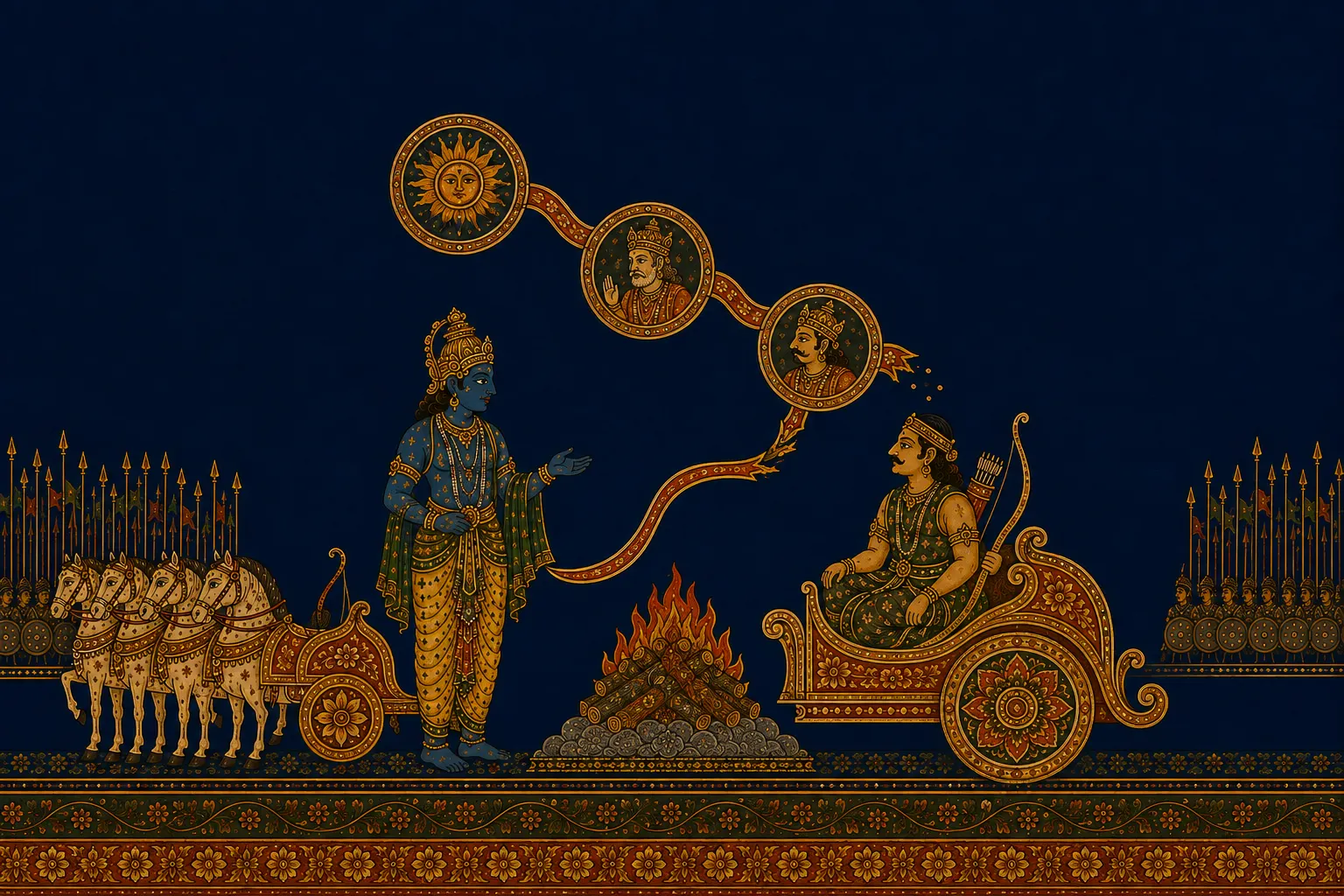
"This yoga is nothing new," Krishna says. "I taught it long ago to Vivasvan, the sun. Vivasvan passed it to Manu, Manu to Ikshvaku — it travelled down through a line of kings." But over the long stretch of time, the path was lost.
"What I am giving you now," he tells Arjuna, "is the recovery of that same teaching — I tell you because you are my friend and my devotee, and because this is the highest secret there is."
The divine birth
Arjuna catches the difficulty at once. "Vivasvan lived at the beginning of things — how could you have taught him?"
Krishna's answer is the turning point. "I have passed through many births, and I remember them all," he says. "You have too — you simply don't remember yours." Though unborn and unchanging, he takes form by his own power, age after age: whenever right order weakens and disorder rises, he appears — to protect the good, to check the harmful, and to set dharma back on its feet. Whoever truly understands this about his birth and his work, he adds, is never born again.
Action within inaction
Right seeing, Krishna says, perceives action inside stillness, and stillness inside action. The one who sees this in daily life is wise, disciplined, whole in whatever they do.
The one who has let go of attachment to results, content and inwardly independent, can stay fully engaged while the action itself loses its power to bind. The aim was never to stop acting — only to let go of the claim of ownership over the act.
Many kinds of sacrifice
Krishna lists them one by one. Some offer their senses into restraint; some offer the objects of the senses; some offer the breath; some offer their wealth, their study, their austerity; some offer knowledge itself.
"Of all these," he says, "the sacrifice made of knowledge stands highest — because knowledge burns up the binding residue of action the way a kindled fire turns a whole heap of wood to ash." All action, without exception, finds its completion in knowledge.
Learn by asking
That knowledge is learned from other people. "Go to those who have seen the truth," Krishna says, "and learn from them — bowing low, asking real questions, and serving."
Once knowledge takes hold, he says, a person never falls back into confusion — they see all beings within themselves, and within him. And no wrongdoing is heavy enough to survive it: knowledge is the boat that carries a person across even the worst of it.
Note: Verses 4.7–8, on Krishna taking form whenever dharma declines, state a general principle of repeated divine appearance; the fixed list of ten avatars is a later development. Verse 4.13 itself uses the language of a "division of *guna* and *karma*" — quality and action; how that connects to birth, social inheritance and later caste is heavily disputed among interpreters. Verse 4.34's instruction to approach a teacher explicitly includes *pariprashna*, searching questions.
Source: Mahabharata — Bhishma Parva, Knowledge and the Renunciation of Action