
Chapter 7
Knowledge and Realization
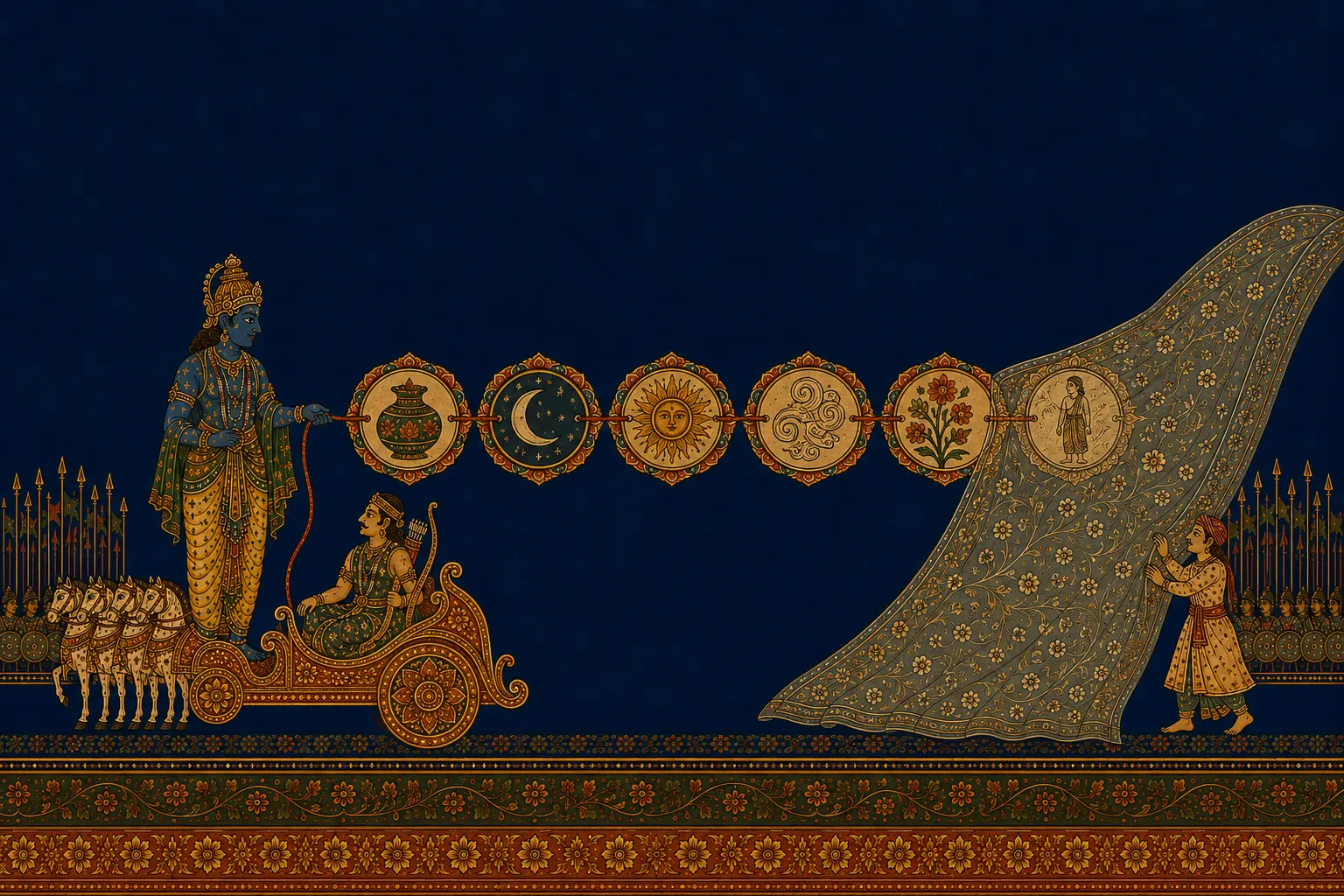
The Thread and the Veil
The rare knower
Krishna begins by stressing how rare true knowledge is. "Of many thousands," he says, "hardly one strives for perfection at all — and of those who strive and reach it, hardly one truly knows me as I am."
What follows, he says, is knowledge together with its realisation — knowing which, nothing further remains to be known. But this is not knowledge that comes easily, or to everyone.
The two natures
He then describes two aspects of his nature. The lower is eightfold — earth, water, fire, air, space, and then mind, intellect and the ego-sense. Beyond it lies a higher nature: the living principle that holds up the entire world.
"I am the source both proceed from," he says, "and the point they dissolve back into. There is nothing at all higher than me."
The thread of gems
All this is strung upon him the way gems are strung on a thread. "I am the taste in water," he says, "the light in the moon and sun, the sacred syllable in the Vedas, the sound in space, the manliness in men.
"The fragrance in the earth, the brilliance in fire, the life in every being, the austerity in ascetics — in each thing I am the essential quality, not the thing's whole surface. The strength of the strong, but free of craving; the desire in beings that never runs against dharma."
The veil of maya
Beings are deceived by states born of the three *gunas*, and fail to see him standing behind them, unchanging. "This maya of mine," Krishna says, "is divine, made of the gunas — and very hard to get past."
Only those who take refuge in him cross it. The rest stay trapped inside it: those who do wrong, those whose knowledge has been carried off by the illusion, those who have taken on a demonic cast of mind.
Four who turn to him
"Four kinds of people worship me," Krishna counts them off — "those in trouble, those who want some good, those who want to understand, and those who already know. All four are counted among the good."
Of the four, the one established in knowledge and devoted to him alone is dearest to him, and is like his own self. Those who turn with faith to other divine forms also receive fruits — real, but limited and passing; each devotee reaches whatever god they turn to.
Note: Verses 7.20–23, on faith directed to other deities, became one of the central passages in later Hindu debate about worshipping many gods. "Maya" here is called divine and made of the gunas; whether that means the world is unreal, or real but dependent, or real and eternally distinct, is exactly where Shankara, Ramanuja and Madhva part company.
Source: Mahabharata — Bhishma Parva, Knowledge and Realization